
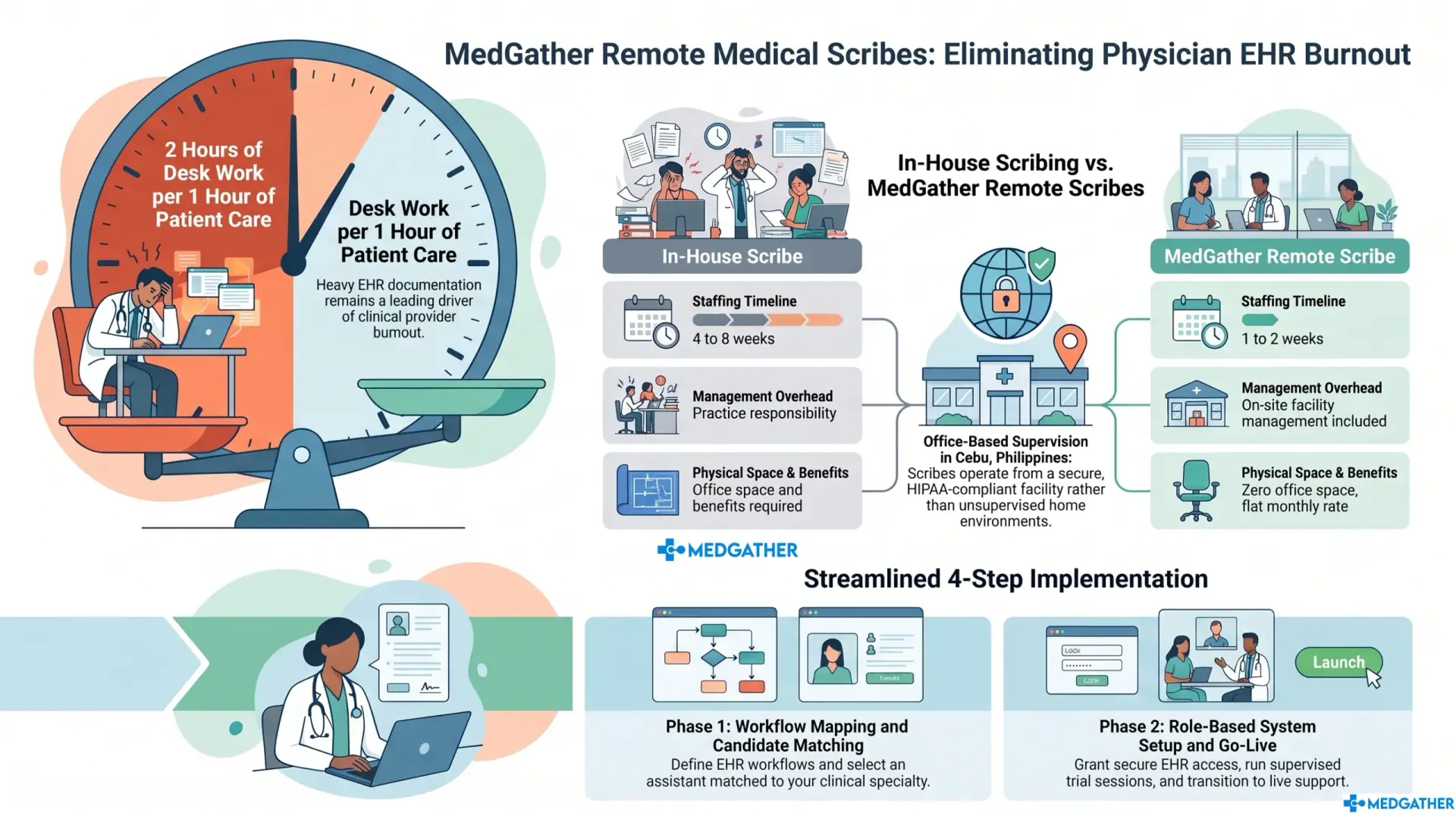
Medical documentation is one of the top drivers of physician burnout. The average physician spends nearly two hours on EHR and desk work for every hour of direct patient care, according to research published in the Annals of Internal Medicine. MedGather’s remote medical scribe service puts a dedicated, office-based assistant in that documentation seat, so your providers can stay focused on the patient, helping practices reduce medical practice costs tied to overtime and provider turnover.
MedGather provides remote medical scribe support through supervised, office-based assistants in Cebu City, Philippines. Every client defines the exact scribing workflow for their practice, from transcription of recorded visits to chart preparation and order documentation. Every scribe has a clinical (nursing) background. Setup takes one to two weeks.

A remote medical scribe is a trained assistant who handles medical documentation from an off-site location, working after the visit to keep your EHR current from recordings, dictation or notes. The role reduces the documentation burden on physicians, nurse practitioners, and physician assistants so providers can focus on clinical work rather than keyboard entry.
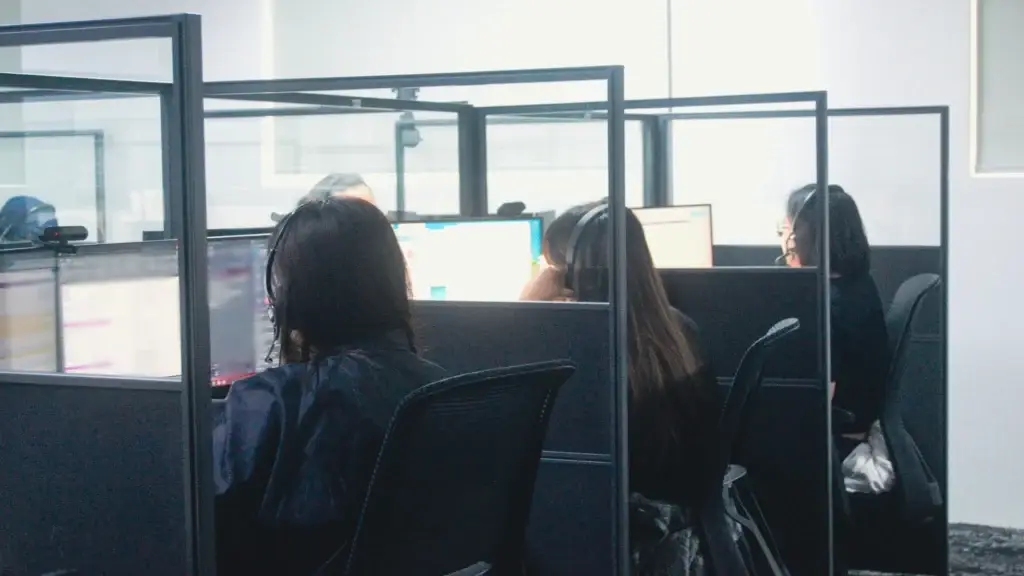
At MedGather, remote does not mean work-from-home. Every assistant operates from a supervised, HIPAA-compliant office facility in Cebu City, Philippines, staffed and managed the way a US medical office would expect. The security model aligns with what the American Health Information Management Association (AHIMA) recommends for remote health information access: a controlled environment, restricted access, and monitored workstations. For a full look at the service model, see the MedGather company overview.
Definition
Remote Medical Scribe: A trained documentation specialist who captures, organizes, and enters patient encounter data into an EHR system from a secure off-site facility. Tasks are defined by the client practice and may include transcription of recorded encounters, chart preparation, and order documentation.
MedGather does not define scribing scope for you. Each client practice specifies exactly what their scribing workflow looks like, and MedGather staffs to that specification based on the medical virtual assistant skills required. Common task sets include the following.
The assistant works from your recording, dictation or notes and enters the subjective, objective, assessment, and plan into your EHR after the visit. The provider reviews and signs the note.
The provider dictates or records a brief audio summary after the visit. The assistant transcribes, formats, and enters the note. Turnaround is typically under four hours.
Before the next clinic day, the assistant pulls upcoming patient records, fills in pending referral notes, updates medication lists, and flags overdue orders so the provider walks in with a ready chart.
For practices that require it, the assistant documents verbal or written orders, routes referrals, and closes outstanding tasks in the EHR workflow.
The mix of tasks is client-defined and can evolve as the practice’s needs change.
Getting a dedicated remote medical scribe from MedGather to your practice follows a structured four-step process.
Step 1. Discovery call and workflow mapping
MedGather learns your EHR system, documentation format, provider preferences, and patient volume. This call also defines which scribing tasks the assistant will handle and in what priority order.
Step 2. Candidate matching
MedGather selects candidates from its supervised office pool based on your specialty, EHR system, and task scope. Clients review a shortlist and select their preferred assistant.
Step 3. Onboarding and system access
Your team grants the assistant secure, role-based EHR access. MedGather configures the workflow, sets documentation standards, and runs a supervised practice session before go-live. For tips on this process, see how to integrate a medical virtual assistant into your team.
Step 4. Go-live and continuous support
The assistant begins their assigned documentation duties under ongoing MedGather supervision. A client success manager handles performance reviews, schedule adjustments, and any scope changes.
Typical onboarding takes one to two weeks from the initial call to the first live documentation session.
| Factor | In-House Scribe | MedGather Remote Medical Scribe |
|---|---|---|
| Staffing timeline | 4 to 8 weeks to recruit and onboard | 1 to 2 weeks |
| Turnover risk | High in competitive local markets | Managed by MedGather; replacement included |
| Supervision | Practice responsibility | MedGather on-site office management |
| HIPAA compliance | Practice must train and monitor | Enforced by MedGather facility protocols |
| Scope flexibility | Fixed to local hire's skills | Adjusted by the client at any time |
| Office space required | Yes | No |
| Benefits and payroll overhead | Yes | No, flat monthly rate |
| EHR access method | Direct terminal or workstation | Secure remote access, same EHR, same workflow |
Yes. Every MedGather remote medical scribe has a clinical background, with a nursing degree (BSRN) as the standard. Scribes understand what they are documenting, which makes notes more accurate and cuts the time providers spend on corrections.
This flexibility matters because scribing looks different from one practice to the next. A solo primary care physician may want a scribe who can follow SOAP structure and flag incomplete assessments. A high-volume gastroenterology practice may prioritize speed of procedure note entry. A concierge practice may want chart preparation and inbox management bundled with documentation. MedGather staffs each case according to what the client describes, not a company-wide standard. For more on how these roles differ, see Healthcare VA vs. Medical Scribe.
MedGather assistants have experience across the most widely used EHR platforms in US ambulatory care, including Epic, eClinicalWorks, Athenahealth, DrChrono, Kareo, ModMed, and Prompt. If your system is not on this list, note it in the discovery call. You can also book a call to discuss compatibility. MedGather will assess compatibility and, where needed, include EHR-specific familiarization in the onboarding period before the assistant goes live.
A remote medical scribe from MedGather makes the most measurable impact in practices where:
MedGather’s model also fits practices that have tried gig-based scribing platforms before and want a more controlled, supervised alternative to independent contractors.
A remote medical scribe is a trained documentation specialist who handles EHR entry, transcription, and chart preparation from a secure, off-site location. At MedGather, every assistant works from a supervised, HIPAA-compliant office facility rather than from home.
MedGather does not publish rates. Pricing depends on task scope, hours, and specialty. Visit /book-now/ to request a quote based on your practice’s specific needs.
MedGather assistants have experience with Epic, eClinicalWorks, Athenahealth, DrChrono, Kareo, ModMed, Prompt, and other major ambulatory EHR platforms. Confirm your system in the discovery call and MedGather will confirm compatibility before onboarding begins.
Most practices go live within one to two weeks of the initial discovery call. The timeline includes candidate selection, EHR access setup, workflow configuration, and a supervised practice session before the assistant takes on live documentation.
A medical virtual assistant handles a broad range of administrative tasks: scheduling, insurance verification, prior authorization, referrals, and patient communication. A remote medical scribe focuses specifically on clinical documentation: EHR entry, transcription, and chart management. Many MedGather clients use a medical virtual assistant for front-office work and a dedicated scribe for documentation, or combine both into one expanded role.