
Your front desk is doing two jobs at once, and the phone is the one that loses. A MedGather receptionist answers your practice line, books and confirms appointments, and verifies insurance eligibility from a supervised office, under a signed BAA with your practice.

MedGather places medical virtual receptionists with practices across the United States. Every one of them works from a supervised office on company equipment, under a signed Business Associate Agreement with your practice.
Not an answering service that takes a message and hangs up, and not a phone tree. A trained person who handles your front desk phone line as part of your team.
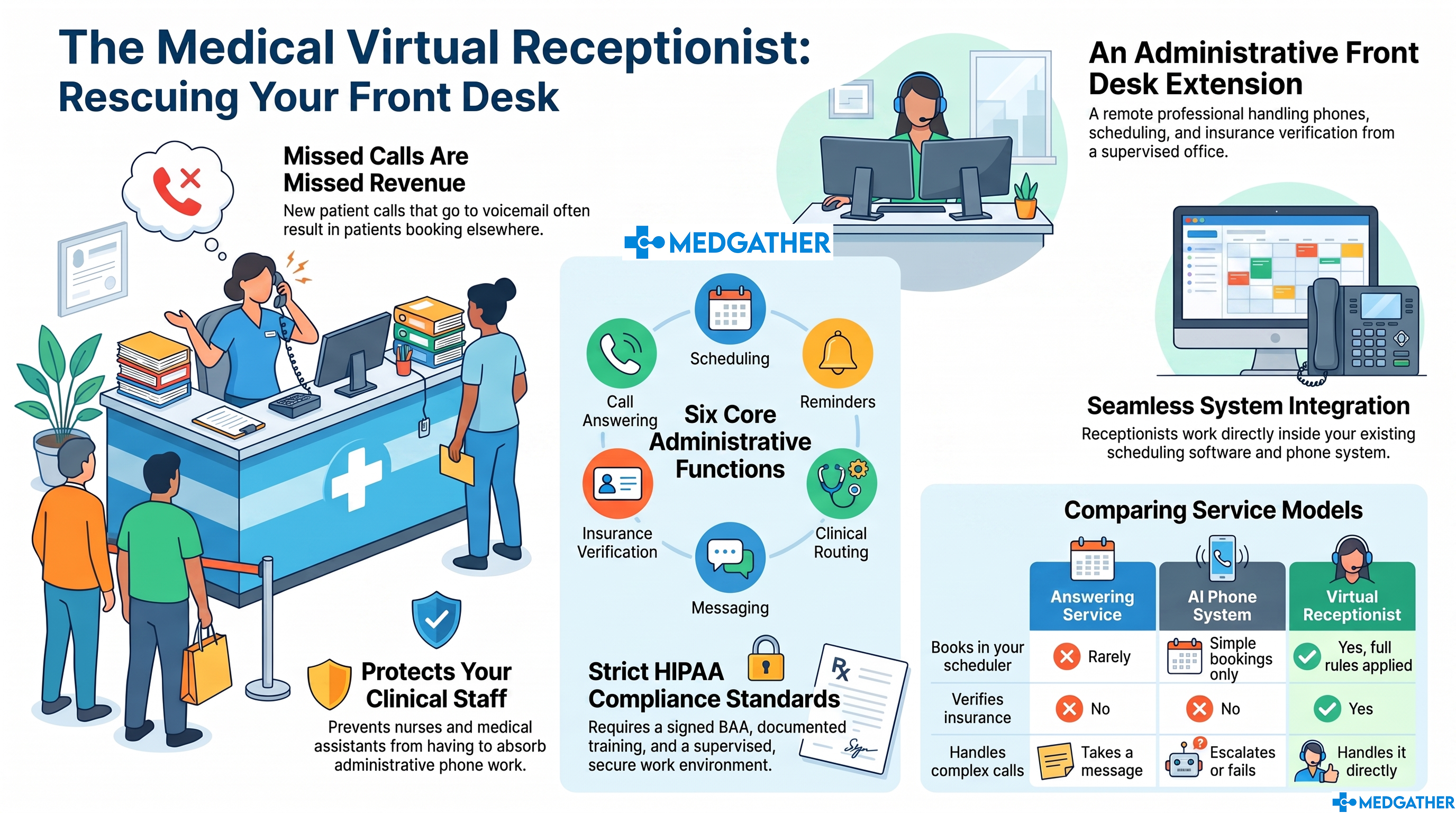
A medical virtual receptionist is a trained remote professional who answers your practice phone line, books and confirms appointments, verifies insurance eligibility, handles patient messages, and routes anything clinical to your staff. The role covers six core functions, all administrative. What the role does not cover: clinical advice, triage decisions, medical billing, claims, or revenue cycle management.
Every MedGather placement includes a signed BAA and documented HIPAA training before the receptionist takes a single call.

A medical virtual receptionist is a trained administrative professional who handles a medical practice’s phone line and front desk communication remotely. The work is similar to what an in-house receptionist does, but the role is performed remotely and focused on supporting the practice’s administrative workload.
A virtual receptionist handles the administrative side of patient communication. They do not determine how urgent a patient’s symptoms are, provide clinical guidance, or make clinical decisions. When a call requires clinical judgment, it is escalated to the appropriate member of your clinical staff.
The goal is simple: patients still reach a real person, while your clinical team remains responsible for clinical decisions.
Definition
Medical virtual receptionist: a remote administrative professional who answers patient calls, schedules and confirms appointments, verifies insurance eligibility, manages patient messages, and routes clinical questions to practice staff, working under a Business Associate Agreement with the practice.
Practices searching for this service use different terms for it, and the terms are interchangeable. A virtual medical receptionist, a remote medical receptionist, a medical office virtual receptionist, a virtual front desk receptionist, a virtual receptionist for medical practice, a virtual front desk for medical practice, and a digital medical receptionist all describe the same role: a trained administrative professional handling a practice’s inbound calls and scheduling from outside the building.
Three roles that sound similar but are not the same:
Front desk work split into two jobs long before anyone gave the remote half a name. Practices grew, call volume rose, and the person at the desk could no longer keep up with the growing volume of greeting patients while also answering the phone. Some practices added a second desk hire. Others sent overflow to an answering service and accepted that those callers would not get booked.
Cloud based phone systems and browser-based practice management software removed the reason the work had to happen in the building. Once the phone line and the schedule were both reachable from anywhere, the receptionist did not need to sit behind the desk to do the job. What changed after that was the compliance question, which is covered in full further down this page.
A medical virtual receptionist handles six categories of front desk work.
A receptionist’s placement is usually the first step for a practice that has never used remote staff. If you want the wider list of administrative work that can move off the front desk, see the 25 tasks a medical virtual assistant can take on.
The front desk has effectively become two jobs for one person. When staff have to prioritize patients standing in front of them, phone calls are often the first part of the workload to get pushed aside.
Your phones ring during clinic hours. Someone must answer them, book the appointment, confirm the one from last week, check whether the insurance is still active, and take a message for the provider. When that person is also checking patients in at the desk, some of it does not get done.
The pattern is consistent across practice sizes. Call volume rises. The person at the desk is checking in the patient standing in front of them. Calls go to voicemail. Voicemails get returned late or not at all. A caller who cannot reach you books somewhere else, and you never find out that they called.
Three things follow from that:
Clinical staff absorb the overflow. Nurses and medical assistants start answering phones between patients. That is expensive coverage for administrative work, and it is a reliable route to turnover.
Practices at higher call volume tend to feel this first. How busy clinics keep call volume from overwhelming in-house staff covers what changes at scale.
A medical virtual receptionist service should cover the receptionist, the systems access, the paperwork compliance, and the supervision. If a provider is only supplying the person, the rest becomes your problem.
MedGather’s medical virtual receptionist service includes:
A solo practice usually starts with part-time coverage on the main line, enough to stop calls from reaching voicemail during clinic hours. A multi-provider practice more often needs full coverage plus outbound confirmation calls, since the cost of no-shows increases with every unused appointment slot. A multi-site group tends to need call routing rules by location before anything else, so that a caller reaching the main number lands with someone who can see the right schedule. The consultation helps determine which setup actually fits your practice. In some cases, the right solution is smaller and simpler than expected.
Practices that need coverage outside clinic hours can add after hours call answering and message relay alongside the daytime receptionist.
The receptionist works inside your systems, not alongside them. Calls route to them through your existing phone system, and they book directly in the scheduling software your staff already use.
In practice, a day looks like this. Calls forward from your main line during the hours you set. The receptionist answers in your practice’s name, books or moves appointments in your system, and verifies coverage for tomorrow’s schedule between calls. Messages go into the same place your staff already look. Anything clinical is passed to a nurse or provider with the patient details already recorded.
Patients are not told they are speaking to a remote person, because there is no meaningful sense in which they are speaking to an outside company. The receptionist is working your line, in your name, following your rules.
A medical office virtual receptionist does not replace the front desk, and the distinction matters when you are planning coverage. Two things stay with your in house team. Anyone physically in the building still needs a person at the desk, and clinical judgement stays with clinical staff. A virtual receptionist changes who answers the phone, not who runs the practice. A virtual front desk for medical practice works the same way: it changes who picks up the call, not who is responsible for the patient.
Dental, chiropractic, behavioral health, surgical, aesthetic, telehealth and multi-specialty practices all use a medical virtual receptionist, and each one puts a different kind of pressure on the front desk. The call patterns, intake questions and scheduling rules differ enough that specialty knowledge is not optional. Every MedGather Medical Virtual Receptionist completes healthcare and HIPAA training plus specialty-specific training before placement, receives refresher training after placement, and then works from the scripts, scheduling rules and verification steps your practice already uses.
Dental front desks carry a heavier benefits workload than most medical offices, because plan maximums reset annually and treatment plans are quoted to the patient before work begins. A medical virtual receptionist verifies coverage ahead of the visit, confirms treatment-plan appointments, and works recall lists for hygiene visits that would otherwise sit untouched. Call volume also spikes around dental emergencies, where a same-day triage path matters far more than a callback queue.
These clinics run on visit frequency, so a single missed confirmation call does not cost one appointment, it puts a whole care plan at risk. A medical virtual receptionist handles the confirmation and rescheduling volume that a block-scheduled plan of care generates, keeps authorization counts current, and rebooks patients who drop off mid-plan. The work is repetitive and high volume, which is exactly the profile that suits a dedicated remote receptionist rather than a front desk staff member who is also checking patients in.
Intake calls in behavioral health are longer, more sensitive and more likely to be the patient’s first contact with care. A medical virtual receptionist collects intake details, confirms benefits and schedules the first appointment without offering clinical guidance of any kind, and routes anything clinical to your licensed staff immediately. This is where training scope matters most, because the receptionist has to recognize what must be handed off rather than answered. Because these calls also carry a higher confidentiality burden, MedGather’s model matters here more than in any other vertical: work happens in a supervised, office-based facility with biometric access and company-issued devices, under an executed Business Associate Agreement.
Surgical practices generate call volume in two concentrated bursts, pre-operative preparation and post-operative follow-up, and both are time sensitive. A medical virtual receptionist confirms pre-op instructions have been received, schedules post-op visits before the patient leaves the surgical calendar, and manages the authorization follow-up that procedures require. The scheduling rules are more rigid than in primary care, which is why support built around a single medical practice outperforms a shared pool here.
Medical spa, dermatology and plastic surgery inquiries are consultation driven and the patient is usually contacting several providers at once. Response speed decides who books. A medical virtual receptionist answers the inquiry while the patient is still deciding, books the consultation, and follows up on quotes that have not converted. Because these services are elective and often self-pay, the front desk conversation is closer to a sales conversation than an insurance conversation, and it should be staffed accordingly.
A virtual-first practice has no physical front desk at all, so the receptionist function is the practice’s entire reception layer. A medical virtual receptionist confirms the patient can access the visit platform before the appointment starts, handles the technical questions that cause virtual no-shows, and reschedules failed connections the same day. This is the vertical where a remote receptionist is not a substitute for an on-site person, it is the only version of the role that exists.
Multi-specialty groups face the opposite problem: one phone number, many scheduling rule sets, and a caller who does not know which department they need. A medical virtual receptionist routes by presenting reason rather than by department name, which reduces the transfers that drive callers to hang up. For clinics already running at full schedule, the gain shows up as recovered calls during the daily peak rather than as coverage of an occasional surge. Practices comparing options usually start with how a receptionist is brought on board and the skills the role requires.
| Specialty | Front desk pressure point | Without a specialty-trained receptionist | With a MedGather Medical Virtual Receptionist |
|---|---|---|---|
| Dental | Annual benefit resets and pre-treatment quoting | Benefits verified at the chair, visit runs late or the quote is revised in front of the patient | Coverage verified before the visit, treatment plan quoted accurately at booking |
| Chiropractic and PT | High-frequency visit plans | One missed confirmation ends a multi-visit plan of care | Confirmations and rebooking handled for the full plan, authorization counts kept current |
| Behavioral health | Long, sensitive first-contact intakes | Intake rushed between in-office tasks, first appointment delayed | Full intake captured in a supervised facility under an executed BAA, clinical questions routed to licensed staff |
| Surgical | Pre-op and post-op call bursts | Post-op visits booked after the patient has left, authorization follow-up slips | Post-op scheduled before discharge from the surgical calendar, authorizations tracked to closure |
| Aesthetic and elective | Shopping patients, speed decides the booking | Inquiry sits in voicemail, patient books with whoever answered first | Inquiry answered live, consultation booked, unconverted quotes followed up |
| Telehealth | Platform access failures at visit time | Patient cannot connect, visit is recorded as a no-show | Access confirmed before the visit, failed connections rescheduled same day |
| Multi-specialty | One number, many scheduling rule sets | Repeated transfers, callers abandon mid-queue | Routing by presenting reason rather than department name, fewer transfers per call |
The cost of an unstaffed phone is measurable. In one health system case study published by MGMA, some clinics were sending more than 50 percent of incoming calls to voicemail before intervention, and the organization set a target of a 10 percent or lower missed-call rate, taking roughly a year to reach it. Call handling itself averaged about 95 seconds. Those figures come from a single organization rather than a national benchmark, so treat them as illustrative of scale, not as an industry average. The pressure is also increasing: an MGMA Stat poll conducted on August 11, 2026 with 190 applicable responses found that 32 percent of medical groups reported higher patient no-show rates year to date compared with 2025, up from 27 percent in the same poll a year earlier, with average deductibles rising 37 percent to $3,786 in 2026.
To talk through which model fits your specialty and call volume, book a consultation with the MedGather team.
These three options solve different problems, and the honest answer is that the cheapest one is sometimes the right one.
An answering service is built to capture a message when nobody is available. That is genuinely useful for overnight and weekend coverage. It is not built to book into your schedule or check coverage.
An AI phone system handles high volume routing and simple requests at low cost, and it never has a bad day. It struggles with the calls that matter most: the confused elderly patient, the caller who does not use the word your system is listening for, the situation that needs judgement.
A medical virtual receptionist costs more than either and does the work both route around.
| Capability | Answering Service | AI Phone System | Medical Virtual Receptionist (MedGather) |
| Answers in your practice name | Yes | Yes | Yes |
| Books directly in your scheduler | Rarely | Simple bookings only | Yes, full scheduling rules |
| Verifies insurance eligibility | No | No | Yes |
| Handles a caller who goes off script | Takes a message | Escalates or fails | Handles it |
| Makes outbound confirmation calls | No | Automated reminders only | Yes |
| Knows your providers and visit types | No | Configured rules only | Yes, trained on your practice |
| Same person each time | No | Not applicable | Yes, named receptionist |
| Best suited to | After-hours message capture | High-volume simple routing | Daytime front desk coverage |
The comparison most practices are actually making is against hiring another front desk person. That one turns on total employer cost rather than hourly rate.
A full-time medical receptionist or medical secretary sits in a job family BLS tracks as Medical Secretaries and Administrative Assistants, where the Bureau of Labor Statistics (BLS) reports a median annual wage of $40,640 in its May 2023 Occupational Employment and Wage Statistics (OEWS) release. That is base pay, and it is not what the role costs a practice.
BLS Employer Costs for Employee Compensation (ECEC) data puts wages and salaries at 69.9 percent of what private employers spend per hour worked, with benefits making up the remaining 30.1 percent. Layered on top of that are costs the ECEC does not capture at all: a workstation and phone system, software seats, the square footage the desk occupies, onboarding time, and the coverage gap every time the position turns over. U.S. Bureau of Labor Statistics
So the real cost of a front desk hire sits meaningfully above the wage line. How far above depends on your benefits package, your local wage market, and how much space and equipment you are already carrying.
MedGather does not publish a standard rate, because coverage hours and call volume vary too much between practices for a list price to mean anything. Book a consultation for a figure based on your actual schedule.
The full picture of what an in-house administrative hire costs a practice goes through every employer’s cost category. If you are weighing a staffing company against hiring someone directly, the comparison between an independent hire and a managed placement covers the compliance side.
Yes, when the placement is set up correctly. The question is not whether remote work is allowed under HIPAA. It is whether the specific arrangement meets the requirements, and that depends on the provider rather than on the model.
A receptionist handles protected health information on nearly every call. The patient’s name, the reason for the visit, the provider they are seeing, and their insurance details. All of it is PHI. The compliance requirements are the same as they are for the person sitting at your front desk.
Three things need to be in place before a virtual receptionist takes a call:
That third requirement is the one worth asking any provider about directly. A receptionist working from a personal laptop in a shared house is handling your patients’ information in an environment nobody is supervising, and the exposure belongs to your practice rather than to the vendor.
Every MedGather receptionist works from a supervised office designed to keep clinical and patient information within a controlled, secure environment. The company prioritizes investment in data protection and operational security, building safeguards into how patient information is accessed, handled, and stored. Personal phones are not permitted on the operations floor. Equipment is company-issued and access-managed, connections are VPN-secured and logged, and every placement is background-screened.
How HIPAA applies to remote administrative staff sets out the full regulatory picture, and our secure remote medical office documents the facility and access controls.
MedGather places office based medical virtual receptionists with practices across the United States. Placement takes four steps.
MedGather was founded by Dr. Ruel Garcia, a practicing gastroenterologist who dealt with the same administrative pressure inside his own practice. The service reflects that: healthcare only, office-based, and built around the compliance obligations a practice carries.
A receptionist is often the starting point rather than the whole answer. Practices that begin with front desk coverage frequently expand into scheduling, insurance verification, and prior authorization support. The full medical virtual assistant service covers what that looks like, and the hiring process explains what happens after the consultation.
A virtual medical receptionist is a trained administrative professional who answers a medical practice’s phone line, books and confirms appointments, verifies insurance eligibility, and routes clinical questions to practice staff, all from outside the building. The terms virtual medical receptionist, medical virtual receptionist, and remote medical receptionist describe the same role. The primary difference is where the work is performed, although a virtual receptionist may not handle physical, on-site front-desk duties such as patient check-in or paperwork.
A virtual receptionist primarily handles a practice’s phone line and related patient communication, including answering calls, scheduling appointments, taking messages, and routing calls to the appropriate staff. A medical virtual assistant has a broader administrative scope that can include reception, along with scheduling management, insurance verification, records requests, prior authorization support, referral coordination, and other non-clinical workflows.
During clinic hours. A medical virtual receptionist is daytime front desk coverage, working the hours you set in your time zone. This is the main difference from an answering service, which is built for the hours when nobody is available. Practices that want both can run a daytime receptionist alongside after hours answering.
Your receptionist answers in your practice’s name, following the greeting you specify, and books into your scheduling system. From the caller’s side it is your front desk, because functionally it is. MedGather does not identify itself to your patients.
Yes, when the arrangement is set up correctly. Any receptionist handling patient calls is handling protected health information, so three things must be in place before the first call: a signed Business Associate Agreement between the staffing provider and your practice, documented HIPAA training completed before assignment, and a work environment meeting the Security Rule’s physical and technical safeguards. MedGather includes all three as standard, with receptionists working from supervised offices on company issued equipment.
Yes. Calls route to your receptionist through your existing phone system, and they book directly in the scheduling software your staff already use. There is no separate platform for your practice to adopt and no change to how your in house team works. Training on your specific setup happens before the first live call.
It depends on call length and complexity rather than on a fixed number. A practice with short scheduling calls supports far more volume per receptionist than one where most calls involve insurance questions or complex booking rules. This is one of the things the consultation is for: we look at your actual call pattern and tell you what coverage you need, which is sometimes less than practices expect.



See which front-office tasks are quietly eating your clinical hours — and how a trained, office-based Medical Virtual Assistant takes them off your plate. Get the guide instantly, free.
No spam. Unsubscribe anytime.