How Much Does a Medical Virtual Assistant Cost? (2026 Pricing Guide)
How much does a medical virtual assistant cost? Most practice owners ask this question early in the research process, and most of them get vague answers. Ranges with no context. Monthly rates with no mention of what drives them. Hourly figures that look attractive until you realize they exclude everything that makes a healthcare VA actually usable.
This guide gives you the real numbers for 2026, a breakdown of the factors that affect cost, and a direct comparison of what a full-time medical virtual assistant actually costs versus keeping that work in-house. If you are trying to make a real decision, this is where to start.
TL;DR: How Much Does a Medical Virtual Assistant Cost?
A full-time medical virtual assistant (MVA) through a structured, HIPAA-compliant provider typically costs between $1,200 and $3,000 per month, depending on the scope of work, experience level, and level of support provided. Freelance virtual assistants may charge as little as $8 to $15 per hour, but they generally do not include healthcare-specific training, compliance oversight, or managed support.
By comparison, hiring an in-house medical administrative employee often costs $45,000 to $65,000 per year after salary, payroll taxes, benefits, and overhead are included. For many small and independent practices, a managed medical virtual assistant can reduce administrative staffing costs while providing predictable monthly pricing and dedicated healthcare support.

Board-certified gastroenterologist and Founder of MedGather. Read full bio →
In This Guide
- What affects the cost of a medical virtual assistant
- Medical virtual assistant pricing models explained
- Medical VA cost vs. in-house staff
- Is a medical virtual assistant worth the cost?
- How to get the best value from a medical VA
- Frequently asked questions
What Affects the Cost of a Medical Virtual Assistant?
Not all medical VA pricing is built the same, and the gap between a $500/month arrangement and a $2,500/month one is not just about hours. It is about what you actually get for the money. Here are the four factors that drive cost most significantly.
Full-Time vs. Part-Time Coverage
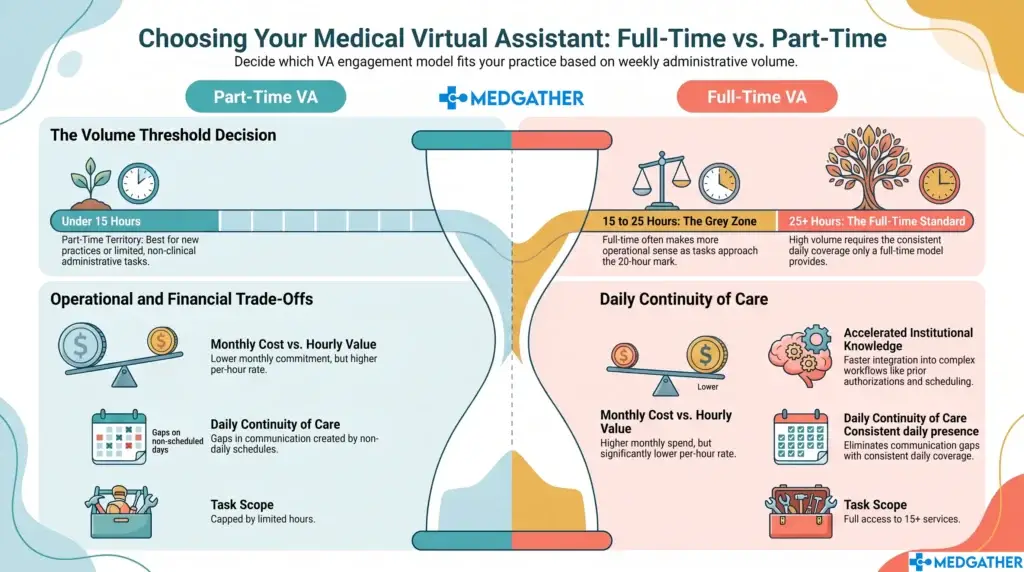
A full-time MVA working 40 hours per week costs more than a part-time arrangement, but the per-hour rate is usually lower when volume is higher. For practices with consistent daily administrative volume , scheduling, documentation support, prior auth follow-up, patient communication , full-time coverage produces better operational results than splitting the work across a shared or part-time resource.
For a detailed look at the task volume a full-time MVA can realistically handle in a busy practice, the full breakdown of what a properly scoped MVA owns from day one is worth reviewing before deciding on scope.
Task Complexity
This is the biggest cost variable and the one most practices underestimate. Freelance VAs have the lowest headline rate. They also have no oversight structure, no guaranteed HIPAA compliance, no backup coverage, and no clinical vetting. Some providers operate a fully remote model with staff working from home on personal devices. Others, like MedGather, operate an office-based model where every assistant works from a supervised, HIPAA-compliant workspace.
Provider Model: Freelance vs. Agency vs. Office-Based
A scheduling-only VA costs less than one who handles prior authorization follow-up, EHR documentation, and patient communication. Clinical scribing support requires a higher skill baseline than inbox management. The more your practice needs healthcare-specific work rather than general administrative tasks, the higher the rate should be , and the more carefully you should vet the provider.
The office-based model costs more than unmanaged freelance arrangements. It also eliminates the data security exposure and compliance risk that come with unsupervised remote workers. Why that distinction matters more than the monthly rate becomes clear when you look at what a HIPAA breach actually costs a small practice.
US-Based Oversight vs. Purely Offshore
Many lower-cost VA services operate with offshore staff and no US-based supervisory layer. MedGather’s model includes US-aligned oversight, structured onboarding, and a supervisory structure that ensures quality and compliance accountability. That layer adds cost. It also means you have an escalation path when something goes wrong, which is something freelance and unmanaged offshore arrangements do not offer.
How Much Does a Medical Virtual Assistant Cost? Pricing Models Explained
Medical VA services are sold through a few different pricing structures. Here is what each looks like in practice and what to watch for.
2026 Medical Virtual Assistant Pricing Overview
Pricing Model | Typical Rate (2026) | Best For |
Freelance hourly | $8 to $15/hr | Simple, low-stakes tasks only , no HIPAA guarantee |
Agency hourly (offshore) | $12 to $20/hr | General admin, non-clinical tasks |
Agency monthly retainer | $1,200 to $2,500/mo (full-time) | Practices needing consistent daily coverage |
Office-based (structured) | $1,500 to $3,000/mo (full-time) | HIPAA-sensitive clinical admin + documentation |
MedGather (full-time) | Contact for custom quote | Clinical + admin MVA with oversight and compliance built in |
The rates above represent the honest market range for 2026. Some providers advertise sub-$800/month rates. Those arrangements typically involve part-time hours, shared resources, or staff without clinical backgrounds operating without a managed compliance structure. They can work for low-stakes tasks. They are not suitable for documentation support, prior auth management, or anything that touches patient data.
Hourly vs. Monthly Retainer: Which Is Better for Healthcare?
Hourly pricing creates incentives that do not align well with clinical administrative work. An hourly VA has no structural reason to complete tasks efficiently, and tracking hours in a healthcare environment adds administrative overhead on your end. Monthly retainers create a cleaner accountability structure: defined scope, defined expectations, defined coverage windows.
For practices that have been through the process of integrating a VA into their workflow, the monthly retainer model consistently performs better because it allows the MVA to fully own their task scope rather than tracking time against an hourly budget.
Medical Virtual Assistant Cost vs. In-House Staff
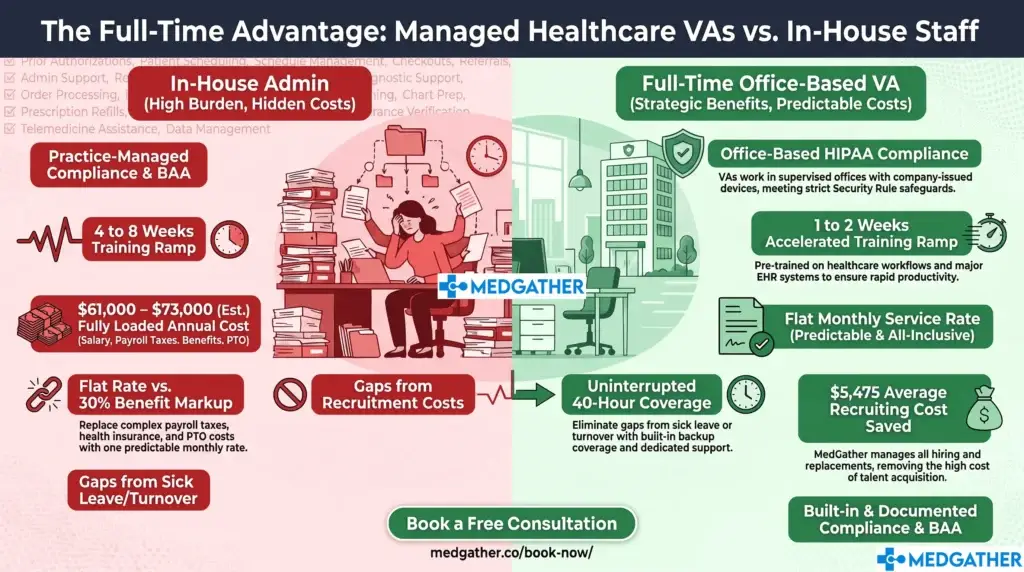
This is the comparison that changes most practices’ perspective on the medical virtual assistant cost question. The monthly rate for an MVA looks higher than it actually is when you measure it against what in-house administrative staff truly costs.
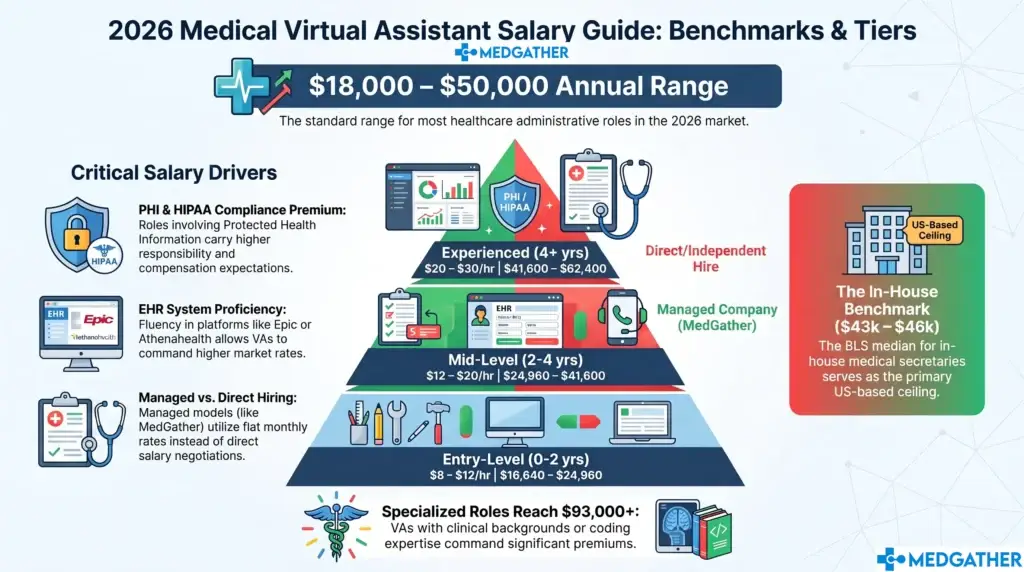
According to Bureau of Labor Statistics data, the median annual salary for a medical administrative assistant in the US is approximately $42,000. That is before employer-side costs that most practice owners undercount.
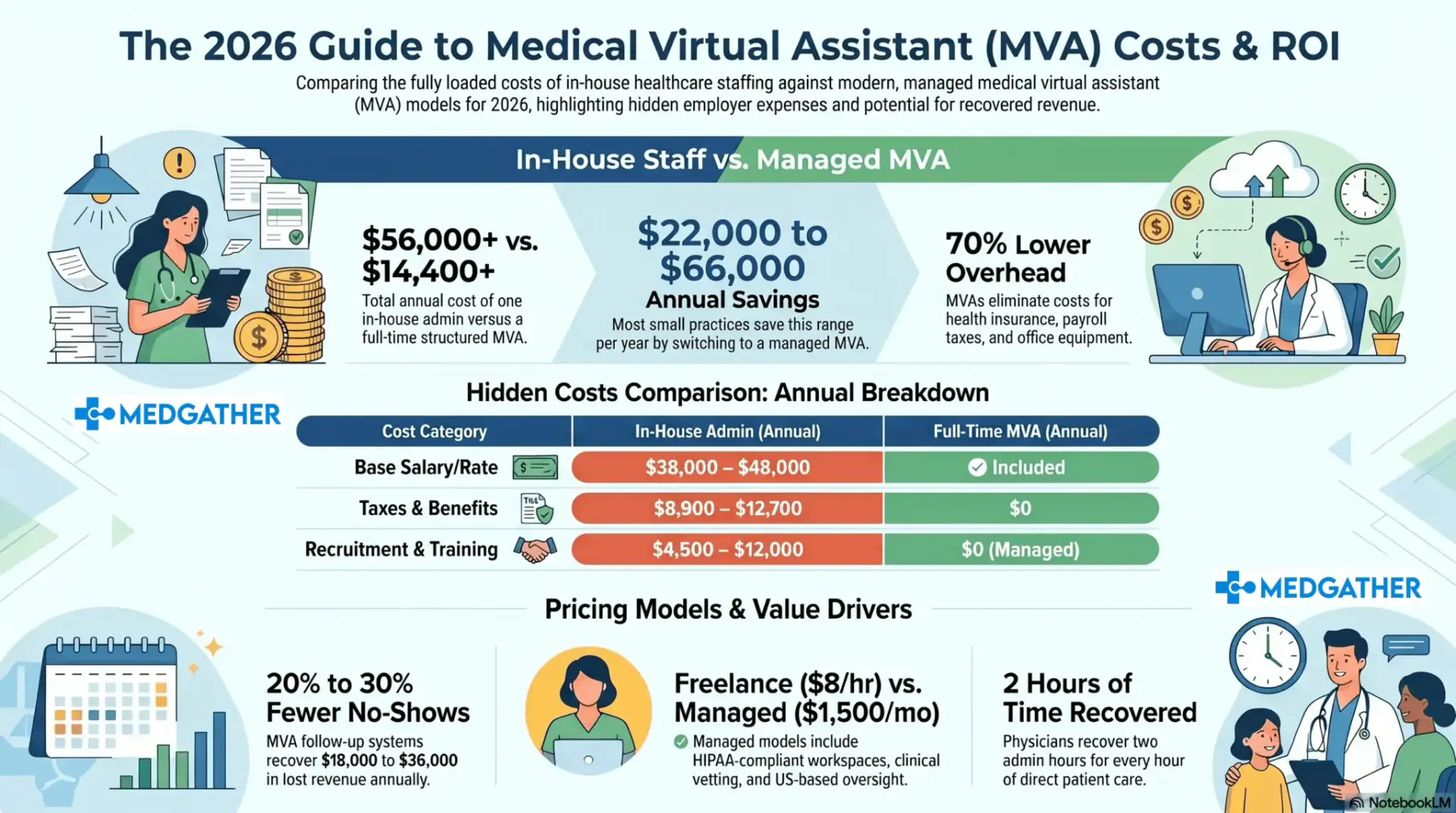
True Annual Cost: In-House Admin vs. Full-Time Medical VA
Cost Category | In-House Admin (Annual) | Full-Time Medical VA (Annual) |
Base salary | $38,000 to $48,000 | Included in monthly rate |
Employer payroll taxes (7.65%) | $2,900 to $3,700 | None |
Health insurance | $6,000 to $9,000 | None |
PTO and sick leave | $1,800 to $3,000 | None , continuous coverage |
Recruitment and hiring cost | $3,000 to $8,000 per turnover | Handled by MedGather |
Training and onboarding | $1,500 to $4,000 | Pre-trained before assignment |
Office space and equipment | $3,000 to $6,000 | None |
Total estimated annual cost | $56,000 to $81,000 | $14,400 to $36,000 |
Estimated annual savings |
| $22,000 to $66,000 |
The savings range is wide because it depends on practice size, location, and staff turnover rate. What is consistent across practice types is that the fully loaded cost of in-house administrative staff is significantly higher than the headline salary, and most practice owners have not done the full calculation.
Is a Medical Virtual Assistant Worth the Cost?
The cost comparison above answers part of the question. But ROI in a medical practice is not just about what you spend. It is about what you recover.
Time Recovered
Physicians in small and independent practices spend an estimated two hours on administrative tasks for every hour of direct patient care, according to AMA data. An MVA that absorbs scheduling, documentation support, prior auth follow-up, and patient communication gives that time back. How that translates into measurable practice efficiency improvements is something most practices see clearly within the first 60 to 90 days.
Revenue Recovered
No-shows cost a small practice an average of $150 to $300 per missed appointment. A consistent reminder and follow-up system reduces no-show rates by 20 to 30 percent in most primary care settings. For a practice seeing 80 patients per week with a 15 percent no-show rate before intervention, eliminating even half of those no-shows represents $900 to $1,800 in recovered weekly revenue.
ROI Example: A Solo Practice at Full-Time MVA Cost
A solo practice paying $2,000/month for a full-time MVA ($24,000/year) recovers:
- $18,000 to $36,000/year from no-show reduction alone (at conservative estimates)
- $15,000 to $25,000/year in staff overtime reduction
- $3,000 to $8,000/year in avoided recruiting and onboarding costs
- Uncounted provider time recovered , at $150 to $300/hour clinical billing rate, even 5 hours/week represents $39,000 to $78,000/year in potential revenue
The math is not close. For most small and solo practices, the question is not whether a medical virtual assistant is worth the cost. It is why they waited this long to look into it.
How to Get the Best Value From a Medical VA
What to Delegate First
Start with the tasks that consume the most front desk time and produce the most errors when rushed: scheduling and reminder outreach, prior authorization follow-up, and patient intake coordination. These have the fastest ROI and the clearest before-and-after measurement. The role a medical VA plays in a well-run practice gives context for sequencing the handoff in a way that minimizes disruption.
Red Flags in Cheap Providers
If a provider is offering full-time medical VA coverage for under $800/month, ask these questions before signing anything:
- Is the VA working from a personal device on an unsecured home network? If yes, that is a HIPAA exposure your practice owns.
- Does the VA have a nursing or clinical background? If not, documentation support and clinical workflow tasks are not appropriate to delegate.
- Is there a Business Associate Agreement in place before day one? No BAA means your practice is operating outside HIPAA requirements from the start.
- Is there an oversight structure? A single freelancer with no supervisor and no escalation path is a vendor you manage entirely on your own.
- What happens when the VA is sick, on vacation, or simply stops responding? If the answer is unclear, coverage gaps are coming.
These are not edge cases. They are the standard failure modes of low-cost, unmanaged VA arrangements. The skills and compliance standards a properly qualified MVA should meet before your practice ever sees their name sets a useful baseline for what to require during evaluation.
MedGather's Model
MedGather operates an office-based model where every assistant works from a supervised, HIPAA-compliant workspace with company-issued devices and a documented backup system. All assistants come from nursing or clinical backgrounds, complete EHR proficiency checks before assignment, and are endorsed to clients only after a background check and HIPAA compliance training. How the office-based structure works day to day is covered in detail for practices that want to understand the model before having a pricing conversation.
The Bottom Line on Medical Virtual Assistant Cost
The monthly rate is only part of the number. What you pay for a structured, clinically trained, HIPAA-compliant MVA through a managed provider is almost always less than what you are currently spending on in-house admin when all the real costs are on the table. And it comes with better coverage, lower turnover risk, and no compliance exposure from unsupervised remote workers.
If you want a direct conversation about what a MedGather MVA would cost for your specific practice and workflow, a free consultation is the right starting point. No obligation. Just a real answer for your situation.
Get a real number for your practice.
MedGather provides custom quotes based on your practice size, specialty, and task scope. No guesswork, no vague ranges.
Frequently Asked Questions
Can a remote assistant manage fax-based referral workflows?
A full-time medical virtual assistant through a structured, HIPAA-compliant provider typically costs between $1,200 and $3,000 per month in 2026, depending on task scope, oversight model, and hours. Freelance options start lower at $8 to $15 per hour but come without clinical background, compliance infrastructure, or supervisory oversight. Office-based models like MedGather provide custom quotes based on your practice’s specific needs.
Is a medical virtual assistant cheaper than a front desk receptionist?
Yes, in most cases significantly so. A full-time in-house medical administrative assistant costs between $56,000 and $81,000 per year when salary, employer taxes, benefits, PTO, recruiting, and training are fully accounted for. A full-time MVA through a structured provider typically costs $14,400 to $36,000 per year. The savings range from $22,000 to $66,000 annually for most small and solo practices.
What affects the cost of a medical virtual assistant?
The four main cost drivers are: hours and coverage scope (full-time vs. part-time), task complexity (general admin vs. clinical documentation support), provider model (freelance vs. agency vs. office-based), and oversight level (unmanaged offshore vs. US-supervised). The lowest rates come with the highest operational and compliance risk. The right question is not what is the cheapest option, but what is the total cost including the risks you are taking on.
Does MedGather offer flexible pricing?
MedGather provides custom quotes based on your practice’s size, specialty, and workflow requirements. The base model is full-time placement with pre-assignment screening, HIPAA compliance training, EHR proficiency checks, and supervisory oversight included. To get a specific quote for your practice, the starting point is a free consultation at https://medgather.co/book-now/.
What is included in a medical virtual assistant monthly rate?
This depends entirely on the provider. A structured service model like MedGather includes matching the right assistant to your workflows, pre-assignment background check and HIPAA compliance training, EHR proficiency verification, one to two weeks of onboarding and workflow training, ongoing supervisory oversight, and backup coverage protocols. Freelance arrangements typically include none of these. When comparing rates, the question to ask is what the rate actually covers, not just what it is.