Healthcare Virtual Assistant Full Time Part Time: Which Model Is Right for Your Practice?
The choice between a healthcare virtual assistant full time or part time engagement comes down to one variable: how many hours of administrative work your practice generates per week. Get that number right and the decision is mostly made for you. Underestimate it and you will spend the first three months of a part-time arrangement discovering you actually needed full-time.
This guide gives you a clear threshold for each model, an honest comparison of the trade-offs, and the two specific scenarios where part-time is genuinely the right starting point. Why the full-time model delivers six distinct operational and financial advantages for practices with steady administrative volume covers the full-time case in more depth if you are already leaning that direction.
MedGather places full-time healthcare virtual assistants only. That context matters for this guide: where MedGather is referenced, the comparison applies to the full-time model. For practices where part-time is the right starting point, MedGather is not the right fit yet, and this guide says so directly.
TL;DR, Healthcare Virtual Assistant Full Time vs Part Time: Which Is Right?
If your practice generates 25 or more hours of administrative work per week: full-time is the stronger model. You get consistent coverage, a lower per-hour rate, and a VA who builds institutional knowledge fast enough to run your full administrative workflow.
If your practice generates under 15 hours per week: part-time is a reasonable starting point. The lower monthly commitment fits the lighter task volume, and scaling to full-time later is straightforward once volume justifies it.

Board-certified gastroenterologist and Founder of MedGather. Read full bio →
In This Guide
- What is the difference between a full-time and part-time healthcare virtual assistant?
- How do you calculate how many administrative hours your practice needs?
- Where does the full-time vs part-time threshold sit in practice?
- What are the cost trade-offs between each model?
- What are the operational and coverage trade-offs?
- What does the full comparison look like side by side?
- When does part-time genuinely make sense?
- How does MedGather fit into this decision?
What Is the Difference Between a Full-Time and Part-Time Healthcare Virtual Assistant?
Definition
Full-time healthcare VA: a dedicated virtual assistant engaged for approximately 40 hours per week, handling your practice's administrative workflows on a consistent daily basis. The VA has a single employer relationship with your practice (or, in a managed model, your practice is their sole client for the full workweek).
Part-time healthcare VA: a virtual assistant engaged for fewer hours per week, typically 10 to 25 hours, handling a selective set of tasks on a scheduled basis. Part-time arrangements may cover specific workflows on specific days or a capped number of hours across the full week.
The core structural difference is not just hours. A full-time VA builds a working knowledge of your practice, your providers, your systems, and your patient communication patterns over weeks and months. A part-time VA handles assigned tasks but has less opportunity to develop that institutional depth. For administrative work that requires context, like Prior Authorizations that take several touchpoints or patient callbacks that require practice-specific knowledge, that depth difference matters.
How Do You Calculate How Many Administrative Hours Your Practice Needs?
The fastest way to estimate your administrative hour needs is to count the daily tasks that currently fall through the cracks, are absorbed by your clinical staff, or pile up between patient appointments. These are the hours a VA would own.
- Count scheduling and patient communication tasks. How many appointments are scheduled, rescheduled, and confirmed per day? How many patient callbacks, messages, and portal responses does your team handle? Each of these is a trackable time unit.
- Count prior authorization and referral follow-up. Prior authorizations are among the most time-intensive administrative tasks in a US medical practice. If your specialty requires frequent prior auth submissions and follow-up, that volume alone can constitute 15 to 20 hours of weekly administrative work.
- Count documentation support and data entry tasks. EHR data entry, chart preparation, and insurance verification together can add another 10 to 15 hours per week depending on patient volume.
Medical Group Management Association benchmarking data shows that most US medical practices staff three to five support positions per physician. What those support positions typically handle across all 15 MedGather medical VA services gives you a task-by-task reference for estimating your volume.
Where Does the Full-Time vs. Part-Time Threshold Sit in Practice?
Three volume bands, three different answers.
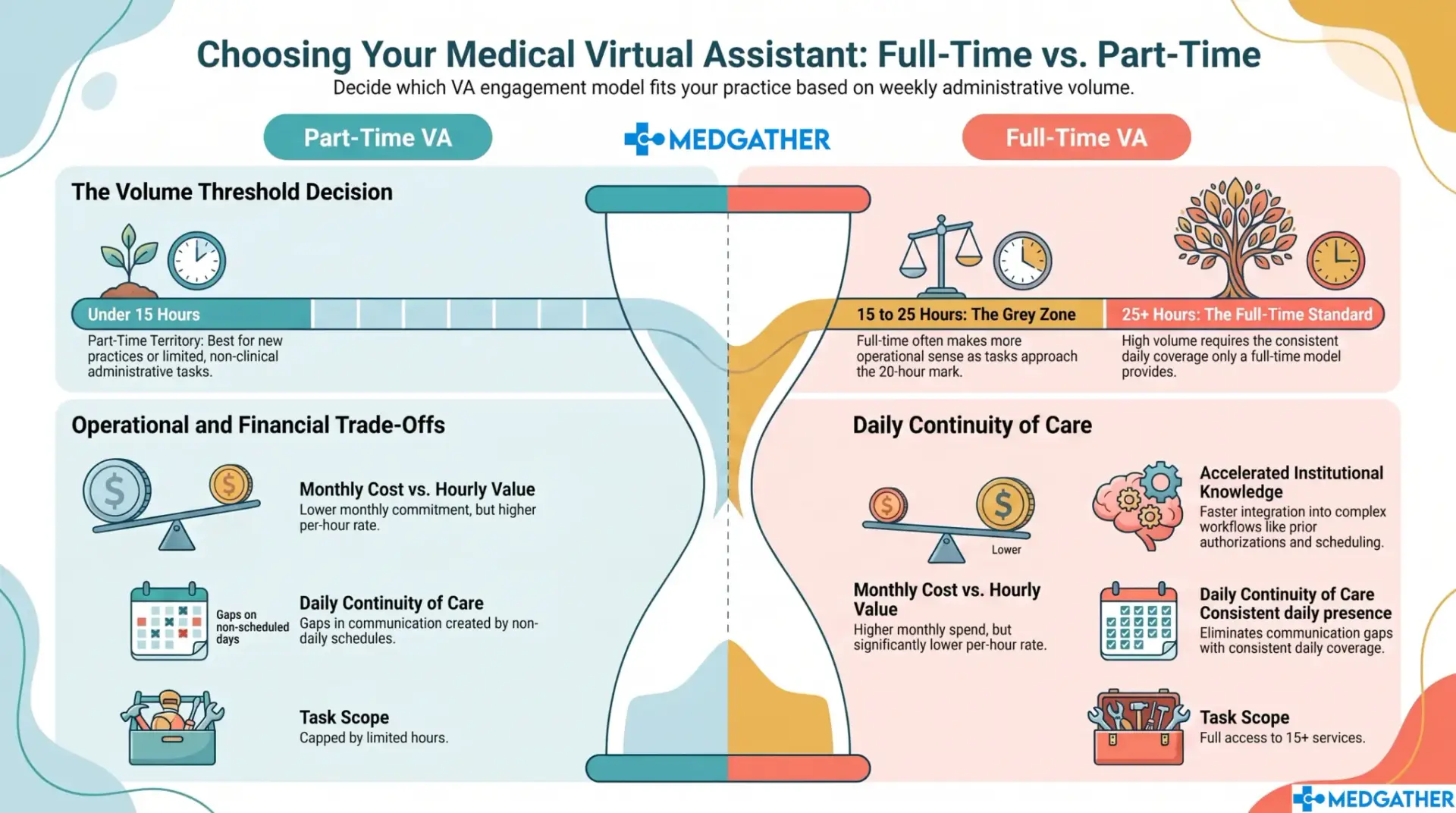
- Under 15 hours per week. This is part-time territory. The administrative volume is light enough that a dedicated part-time engagement covers it without underutilizing a full-time VA. This typically applies to very small solo practices, practices in early growth stages, or practices where most admin work is currently handled by clinical staff and the VA is taking over a selective subset.
- 15 to 25 hours per week. This is the grey zone. At 15 to 20 hours, part-time may suffice but you are close to the point where task scope limitations and ramp-time constraints start to create friction. At 20 to 25 hours, full-time often makes more operational sense than a capped part-time arrangement, because the per-hour cost advantage of full-time becomes significant and the task scope fits a full-time model better.
- 25 or more hours per week. Full-time is the stronger model. A practice generating 25 or more weekly administrative hours from scheduling, prior authorizations, patient communications, referral management, and insurance verification does not benefit from the artificial ceiling a part-time engagement creates. The per-hour rate is lower at full-time volume, coverage is continuous, and the VA builds workflow knowledge at a useful pace.
For smaller practices doing this calculation for the first time, how administrative task volume typically scales with practice size and patient load provides relevant context.
What Are the Cost Trade-Offs Between a Full-Time and Part-Time VA?
The cost picture is genuinely mixed, which is why this guide presents it honestly rather than positioning full-time as the clear winner on every dimension.
- Monthly cost. Part-time costs less per month. This is a real advantage for practices with budget constraints or limited administrative volume. A part-time engagement at 15 to 20 hours per week carries a proportionally lower monthly rate than a full-time engagement.
- Per-hour rate. Full-time typically carries a lower per-hour rate than part-time. At higher weekly volumes, the per-hour efficiency of full-time engagement tends to outweigh the lower monthly commitment of part-time.
- Total cost over 12 months including turnover. Part-time arrangements can carry higher total cost over a full year if the VA turns over, because the recruiting and ramp-up cycle applies regardless of engagement level. The recruiting and onboarding cost applies equally to a part-time replacement as to a full-time one.
For a complete breakdown of what each model costs once all factors are counted, the full annual cost comparison for a medical VA including all placement factors provides verified figures. What the full-time monthly rate looks like against the fully loaded cost of an in-house admin position shows the broader cost context.
What Are the Operational and Coverage Trade-Offs?
Coverage and task scope are where the full-time model has a clearer operational advantage, regardless of cost.
- Daily continuity. A full-time VA is present in your administrative workflow every day. Scheduling confirmations, prior authorization follow-up, patient callbacks, and inbox management happen consistently. A part-time VA working three days per week creates natural gaps in those daily workflows.
- Institutional knowledge. A VA who works 40 hours per week on your practice’s workflows builds familiarity with your providers, your patient population, your EHR setup, and your edge cases significantly faster than one working 15 to 20 hours per week. That knowledge compounds over months and directly reduces the supervision time your clinical staff invest.
- Task scope flexibility. Full-time engagement creates space for a VA to handle a broader range of MedGather’s 15 services as the relationship grows. A part-time arrangement typically requires tighter task scope boundaries to stay within the engagement hours.
The efficiency gain from consistent full-time VA coverage goes beyond the direct task output. How practices measure the operational impact of a dedicated full-time administrative workflow owner tracks those secondary gains in detail.
What Does the Full Comparison Look Like Side by Side?
The table below maps both models across cost, coverage, and operational factors. Where part-time has a genuine advantage (monthly cost), it is shown as such.
Full-Time vs. Part-Time Healthcare VA: Trade-Off Comparison
| Factor | Part-Time VA (10 to 25 hrs/week) | Full-Time VA (40 hrs/week) |
| Monthly cost | Lower , proportional to engagement hours | Higher monthly rate , covers full-time scope |
| Per-hour rate | Higher per-hour rate at lower volume | Lower per-hour rate at full-time volume |
| Daily workflow coverage | Gaps on non-scheduled days or when hours are used up | Consistent daily coverage, no scheduling gaps |
| Institutional knowledge built | Slower , fewer weekly touchpoints with your practice | Faster , daily engagement accelerates familiarity |
| Task scope available | Selective tasks only , capped by engagement hours | Full 15-service scope available as relationship grows |
| Coverage if VA unavailable | No backup structure typical | Backup coverage included in managed model |
| Ramp-up to full productivity | Slower , less weekly practice time | 1 to 2 weeks to productivity (pre-trained VA) |
| Scalability to higher volume | Requires a new arrangement or upgrade | Expand task scope through existing relationship |
| Best fit | Low or variable admin volume (under 15 hrs/week) | Consistent daily admin volume (25+ hrs/week) |
| Verdict | Right model for low-volume or early-stage practices | Stronger model for most established US practices |
When Does a Part-Time VA Genuinely Make Sense?
Two specific situations where part-time is the right starting point, not a compromise.
- A new practice building administrative volume. If you are in the first year of practice and your daily patient volume has not yet reached the level that generates 25 or more weekly administrative hours, part-time is an appropriate match. Engaging full-time before the volume justifies it means paying for coverage the practice is not yet producing enough work to fill. Starting part-time and scaling when volume grows is a rational progression.
- A practice with limited PHI-adjacent administrative work. If the VA’s role is primarily general administrative support, calendar management, or inbox management that does not involve patient data, and that work runs to 10 to 15 hours per week, part-time is a reasonable fit. The compliance overhead of a full managed placement is built for higher-volume PHI-handling work.
Outside these two situations, part-time is often a cost-reduction decision that creates operational friction within a few months. Which hiring model is right for your practice based on volume and compliance requirements covers the broader model decision if you are still evaluating the engagement structure.
How Does MedGather Fit Into This Decision?
MedGather places full-time office-based healthcare virtual assistants only. The placement model, including BAA execution, pre-assignment HIPAA training, managed supervision, and access to all 15 MedGather medical VA services, is built for practices with consistent daily administrative volume. If your practice is generating 25 or more administrative hours per week, the full-time MedGather model is a direct match.
If your practice is currently in the part-time range, the most useful next step is a free consultation to map your actual administrative task volume against the full-time model threshold. Many practices discover during that conversation that their volume is higher than the informal estimate suggested. How MedGather’s placement and onboarding process works before a VA starts covers what that process looks like in practice. What the financial return looks like across all three value streams once a full-time VA is in place shows the full ROI picture.
Find out whether your practice's administrative volume fits the full-time model.
MedGather's free consultation maps your task scope, patient volume, and workflow needs against the full-time VA structure before any commitment.
Key Takeaways, Full-Time vs Part-Time Healthcare Virtual Assistant
- The decision turns on weekly administrative hours. Under 15 hours: part-time. Over 25 hours: full-time. Between 15 and 25 hours: full-time often makes more operational sense than its monthly cost suggests.
- Part-time costs less per month. Full-time costs less per hour. Over a 12-month period, full-time at sufficient volume typically carries lower total cost once turnover and ramp-time costs are factored in.
- The operational advantages of full-time are daily continuity, faster institutional knowledge, broader task scope access, and backup coverage. These do not apply in the same way at part-time hours.
- Part-time genuinely makes sense in two situations: a new practice building administrative volume, and a practice with consistently light non-PHI admin work. Outside those two scenarios, part-time is usually a cost decision that creates friction within a few months.
- MedGather places full-time healthcare VAs only. Practices not yet at full-time volume can use the free consultation to confirm where their task scope actually sits before committing to either model.
Frequently Asked Questions
Should I hire a healthcare VA full-time or part-time?
If your practice generates 25 or more hours of administrative work per week through scheduling, prior authorizations, patient communications, and related tasks, full-time is the stronger model. If you are generating under 15 hours per week, part-time is a reasonable starting point. The 15 to 25 hour range is where a free consultation to map your actual task volume gives you the most useful answer.
How many hours per week does a medical practice need a VA?
Most established US medical practices generate between 25 and 40 or more administrative hours per week once scheduling, prior authorizations, insurance verification, patient communications, and referral coordination are all counted. Medical Group Management Association data shows most practices staff three to five support positions per physician, which suggests the administrative load is substantial enough to justify full-time coverage for most practice types.
Is full-time or part-time VA more cost-effective for a small practice?
For a small practice generating consistent daily administrative work, full-time is typically more cost-effective over 12 months because the per-hour rate is lower and turnover costs apply equally to both models. For a practice with genuinely light administrative volume, part-time reduces the monthly commitment without underutilizing the engagement. How administrative volume and cost typically scale for smaller practices provides the relevant cost context.
Can I start with a part-time VA and transition to full-time later?
Yes, and this is a reasonable approach for practices that are growing administrative volume. Starting part-time lets you establish workflows, train the VA on your systems, and confirm that the VA model works for your practice before committing to full-time hours. The transition to full-time is operationally simpler than starting from scratch with a new full-time hire, because the VA already knows your practice.
Does MedGather offer part-time VA placements?
MedGather’s placement model is built for full-time engagements. If your current administrative volume sits in the part-time range, the best step is a free consultation to map your actual task hours against the full-time threshold. Practices often discover their volume is closer to full-time than their initial estimate suggested. Book a consultation at medgather.co/book-now/ to work through the volume calculation for your practice.
Board-certified gastroenterologist and Founder of MedGather. Read full bio →
Sources
- Bureau of Labor Statistics. Occupational Outlook Handbook – Medical Secretaries and Administrative Assistants (SOC 43-6013).
- Society for Human Resource Management. 2025 Talent Acquisition Benchmarking Report – Average Cost-per-Hire for Non-Executive Roles.
- Medical Group Management Association. MGMA DataDive – Cost and Revenue / Practice Operations Benchmarking, Administrative Staffing Ratios.