How Can a Virtual Assistant Reduce Medical Practice Costs?
A virtual assistant can reduce medical practice costs by $18,000 to $27,000 per administrative position each year by lowering the total cost of staffing. While base salary is the most visible expense, the actual cost of an employee also includes payroll taxes, benefits, paid time off, and management overhead. Those additional costs are often overlooked, making salary only part of the overall financial picture.
This guide breaks down which cost categories a virtual assistant eliminates, which tasks drive the largest savings, and how to calculate the reduction for a specific practice. It also covers a worked example using a single in-house administrative position at the current Bureau of Labor Statistics median wage, so the math is grounded in real published data rather than estimates. How much a medical virtual assistant costs on the other side of the comparison provides the full rate context.
MedGather places office-based virtual medical assistants with US medical practices through a single flat monthly rate. The cost reduction this guide covers is the direct result of that model structure, and MedGather is named throughout.
TL;DR, How a Virtual Assistant Reduces Medical Practice Costs
$18,000 to $27,000 per year is the employer-side cost gap between the salary line in the budget and the fully loaded cost of one in-house administrative position. A virtual assistant eliminates most of this gap by removing payroll taxes, benefits, PTO, recruiting, and management overhead in a single flat monthly rate.
If the position turns over, the savings widen further: SHRM puts the cost of replacing one administrative employee at $9,500 to $16,000 per hiring event, costs a managed VA model absorbs into the placement structure.
The cost reduction is not theoretical. It comes from specific employer-side line items that disappear when the employment relationship does.

Board-certified gastroenterologist and Founder of MedGather. Read full bio →
In This Guide
- How much can a virtual assistant reduce medical practice costs?
- Which specific cost categories does a virtual assistant eliminate?
- What administrative tasks does a virtual assistant take on that drive the savings?
- How do you calculate the cost savings for your specific practice?
- Does a virtual assistant save more money than it costs?
- How quickly do cost savings from a virtual assistant show up?
- Is the cost reduction the same for solo practices and larger groups?
- How does MedGather help practices achieve this cost reduction?
How Much Can a Virtual Assistant Reduce Medical Practice Costs?
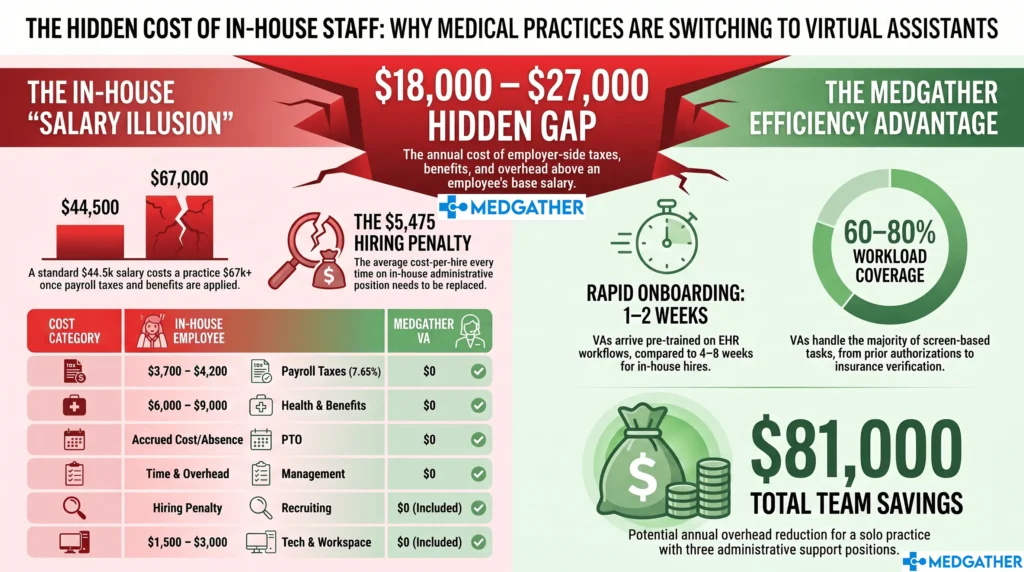
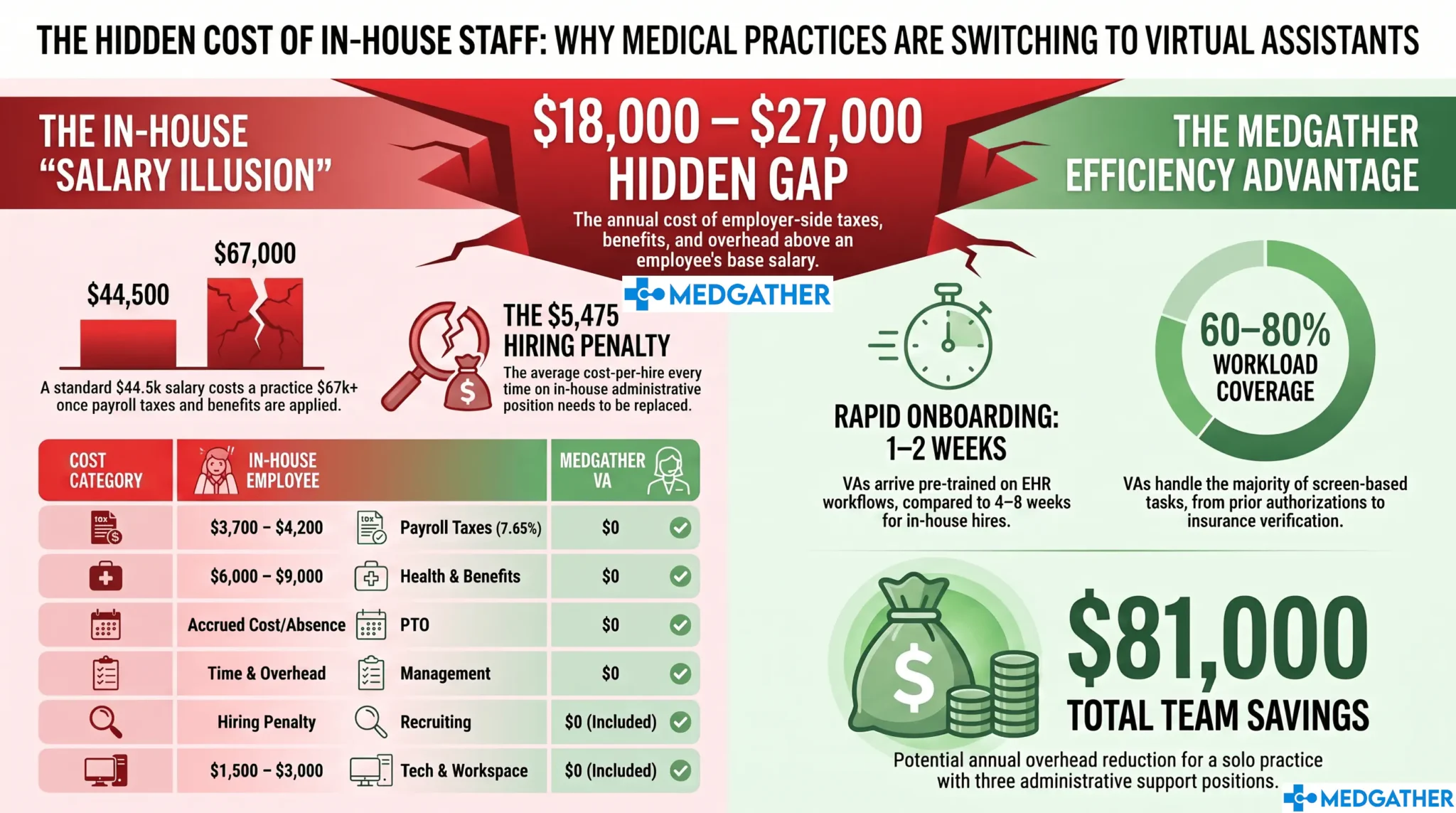
A virtual assistant can reduce medical practice costs by lowering the total employment cost of an in-house administrative position. When the full cost breakdown is taken into account, the savings typically range from $18,000 to $27,000 per position each year. According to the Bureau of Labor Statistics, medical secretaries and administrative assistants earn a median annual wage of approximately $43,000 to $46,000. For many practices, that salary serves as the starting point for estimating staffing costs. However, it does not include an additional $18,000 to $27,000 in payroll taxes, health insurance, paid time off, management time, and technology costs that contribute to the total cost of employment each year. What the full hidden cost layer of an in-house position adds up to breaks this down in detail with all six cost categories verified.
A virtual assistant model replaces that layered structure with a single flat monthly rate. The payroll tax line disappears. The benefits line disappears. The PTO accrual disappears. The recruiting and onboarding cycle disappears. What remains is a predictable monthly cost that is lower than the fully loaded cost of the in-house position it replaces for most US medical practices.
Outbound stat: Bureau of Labor Statistics. Occupational Outlook Handbook, Medical Secretaries and Administrative Assistants (SOC 43-6013). Median annual wage approximately $43,000 to $46,000 based on the most recent published data.
Which Specific Cost Categories Does a Virtual Assistant Eliminate?
A virtual assistant eliminates six employer-side cost categories that apply to every in-house administrative position, regardless of whether the employee ever turns over.
- Employer payroll taxes. Social Security and Medicare taxes (7.65% of gross wages) plus federal and state unemployment insurance apply to every employee on payroll, adding $3,700 to $4,200 per year at the median salary range for this role. A virtual assistant model carries no employer payroll tax liability.
- Health insurance and benefits. Employer contributions toward health, dental, and vision coverage plus any retirement match typically add $6,000 to $9,000 per year per employee. The VA model carries none of this.
- PTO, sick leave, and holiday pay. A practice paying 15 to 20 days per year of salary against no administrative output adds $4,000 to $5,500 per year per position. A managed VA arrangement provides continuous coverage and does not charge for days when work is not produced.
- Management and supervision time. The practice owner or office manager spends measurable time managing an in-house employee, valued at $2,500 to $5,000 per year at a conservative estimate. MedGather handles day-to-day VA management on the employer side.
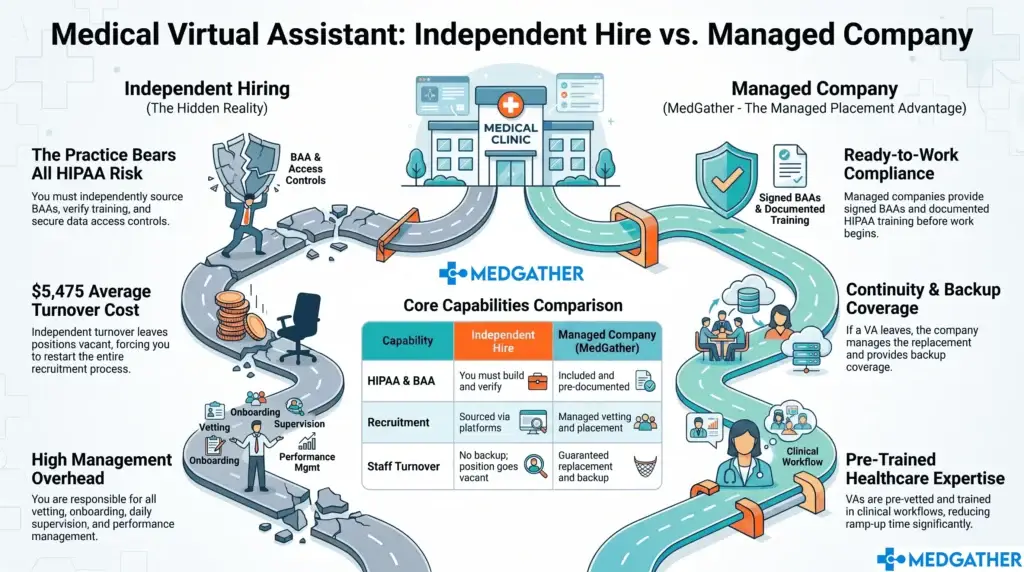
- Recruiting and hiring costs. According to SHRM’s 2025 Talent Acquisition Benchmarking data, the average cost per hire for a non-executive role is $5,475. This cost applies every time the position needs to be filled. In a managed VA model, the cost is absorbed into the placement structure.
- Technology, workspace, and equipment. A physical workstation, computer, software licenses, phone line, and office supplies add $1,500 to $3,000 per year. MedGather provides company-issued devices and workspace; the practice does not carry this line item.
Together these six categories add $18,000 to $27,000 per year per position to the base salary line, without a single hiring event. The cost savings table below shows the full breakdown side by side.
Cost Savings Breakdown: In-House Employee vs. Virtual Medical VA
| Cost Category | In-House Employee | Virtual Medical VA (MedGather) |
| Always-On Annual Employer Costs | ||
| Annual base pay | $43,000 to $46,000 | Flat monthly rate , no separate salary negotiation |
| Employer payroll taxes | $3,700 to $4,200 | None |
| Health insurance and benefits | $6,000 to $9,000 | None |
| PTO, sick leave, and holidays | $4,000 to $5,500 | None , continuous coverage provided |
| Management and supervision | $2,500 to $5,000 | Included , handled by MedGather |
| Technology and workspace | $1,500 to $3,000 | Provided by MedGather |
| Hiring-Event Costs (Apply When Position Is Filled or Replaced) | ||
| Recruiting and hiring cost | $5,475 avg. per hire (SHRM 2025) | Included in model , no separate recruiting fee |
| Onboarding and training ramp | $2,000 to $4,000 | Included , pre-trained on healthcare workflows |
| Coverage gap during vacancy | $2,000 to $6,000 | Backup model , minimal vacancy gap |
| Total steady-state annual cost | $61,000 to $73,000/yr | Flat monthly rate , see medgather.co/book-now/ |
What Administrative Tasks Does a Virtual Assistant Take On That Drive the Cost Savings?
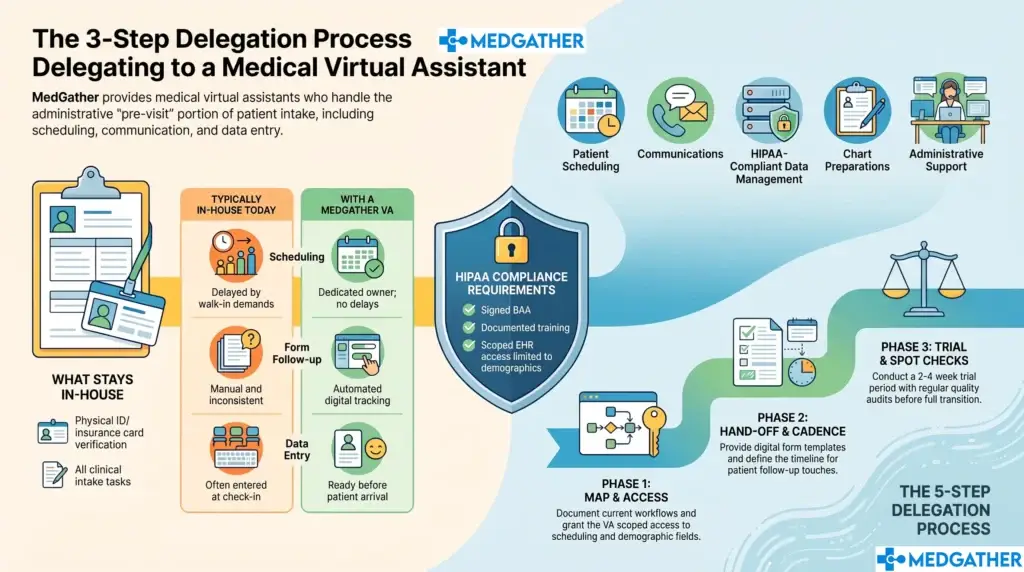
A virtual assistant drives cost savings by taking on many of the administrative tasks that do not require an on-site presence. These responsibilities make up a significant portion of an in-house administrative employee’s daily workload and can be performed effectively in a remote support environment. The full 25-category task scope a medical VA covers shows the complete range, but the categories that drive the largest cost savings are those where the practice is currently paying the highest fully loaded in-house cost for work that can be handled remotely without any reduction in quality or speed.
The highest-impact task categories for cost reduction are scheduling and appointment management, prior authorization follow-up, insurance verification and eligibility checks, patient communication and callback management, EHR data entry and documentation support, and referral coordination. Together these categories typically account for 60 to 80 percent of an in-house administrative employee’s daily workload in a US medical practice.
MedGather places virtual assistants pre-trained on these workflows, including experience with major EHR platforms such as Epic, Athenahealth, eClinicalWorks, and Modmed. The task handoff does not require the practice to train from scratch, which removes the onboarding ramp cost and means the cost reduction begins from the first week of placement rather than after a multi-month learning curve. How the ROI calculation looks once tasks are fully transitioned shows the full return once both the cost reduction and the efficiency gain are measured together.
How Do You Calculate the Cost Savings a Virtual Assistant Produces for Your Practice?
To calculate the direct cost savings of a virtual assistant, start with the fully loaded cost of the in-house administrative position being replaced or the position you would otherwise hire for, then subtract the flat monthly rate for a comparable VA. The difference represents the direct cost reduction before any efficiency or capacity gains are factored into the calculation.
Worked example: one administrative position at $44,500 base salary
A solo practice budgets $44,500 for a front-desk and administrative employee, a figure near the midpoint of the Bureau of Labor Statistics range for this role. Using verified cost factors from published data:
- Employer payroll taxes at 7.65% approximately $3,400
- Health insurance contribution approximately $7,500 (employer share, midpoint estimate)
- PTO and sick leave approximately $4,750 (midpoint of 15 to 20 days at this salary)
- Management and supervision time approximately $3,750 (midpoint estimate)
- Technology and workspace approximately $2,250 (midpoint estimate)
Total steady-state cost: approximately $66,000 to $67,000 per year, against a budget line of $44,500. The hidden gap for this one position is approximately $21,500 to $22,500 per year.
If this position turns over once every two years, the recruiting, onboarding, and coverage costs add another $12,500 in the replacement year based on SHRM benchmarking data, bringing the total cost for that year to approximately $79,000 against the original budget of $44,500.
Replacing this position with a flat-rate virtual assistant removes the $21,500 to $22,500 annual employer-side gap immediately. The coverage gap during turnover disappears because the managed VA model includes backup coverage, and the recruiting cost disappears because it is included in the placement structure. How this comparison plays out between a VA and an in-house staff model across the full cost range provides a broader baseline.
Does a Virtual Assistant Save More Money Than It Costs to Hire?
For most US medical practices, yes. The fully loaded annual cost of an in-house administrative position in the current BLS wage band runs $61,000 to $73,000 per year. MedGather does not publish its rate structure publicly because team size, hours, and task scope vary by practice. What is consistent across the model is that the flat monthly rate does not include payroll taxes, benefits, PTO liability, or recruiting costs, which are the line items that push the in-house position above the salary line. That structural difference is where the savings come from.
The savings calculation is also not just about the direct cost substitution. A practice that previously spent four to eight weeks filling an administrative vacancy, during which the physician and existing staff absorbed the additional workload, avoids that coverage cost entirely with a managed VA arrangement. Why the total return from removing the in-house cost layer typically exceeds the direct rate comparison works through the full ROI calculation including both the cost reduction and the productivity recovery.
How Quickly Do Cost Savings from a Virtual Assistant Show Up?
Cost savings from a virtual assistant begin in the first billing cycle because the employer-side cost categories, payroll taxes, benefits, PTO accrual, do not apply from day one. There is no 90-day waiting period for the savings to kick in. The flat monthly rate replaces the fully loaded cost structure immediately.
The efficiency gains from task handoff follow a slightly longer timeline. A pre-trained VA placed through MedGather typically reaches full productivity within one to two weeks, compared to four to eight weeks for a new in-house hire who is learning practice-specific workflows from scratch. That ramp-time difference is itself a cost reduction, because a practice paying full salary during a partial-productivity period absorbs approximately $2,000 to $4,000 in onboarding cost that does not apply to a pre-trained VA placement.
The structure of how a VA placement works before the first day of work, including what is trained before placement and what the practice needs to provide, covers the timeline from consultation to productive placement in detail.
Is the Cost Reduction the Same for Solo Practices and Larger Groups?
The percentage cost reduction is similar across practice sizes. The impact on the bottom line tends to be more pronounced for solo and smaller practices because the savings represent a larger share of total overhead when the revenue base is smaller.
Medical Group Management Association benchmarking data shows that most US medical practices staff three to five support positions per physician. At three positions and a hidden cost gap of $18,000 to $27,000 per position, the always-on employer-side overhead for a solo practice runs $54,000 to $81,000 per year on top of base salary across the full administrative team, before any position turns over. For a solo physician generating $500,000 to $800,000 in annual revenue, that gap is a material percentage of the practice margin. Why the cost impact of in-house administrative staffing hits independent and smaller practices most directly covers the economics of this at the solo and small group level specifically.
Outbound statistic: According to the Medical Group Management Association (MGMA) Cost and Revenue / Staffing benchmarking, most medical practices operate with approximately three to five support FTEs per physician. This staffing ratio highlights why the cost impact of in-house administrative staffing hits independent and smaller practices most directly, where each additional employee represents a significant increase in payroll, benefits, and operational overhead.
How Does MedGather Help Practices Reduce Administrative Costs?
MedGather reduces medical practice costs by providing office-based virtual medical assistants through a single flat monthly rate that already accounts for the cost categories this guide covers. Payroll, benefits administration, recruiting, onboarding, technology, and supervision are handled on MedGather’s side. The practice receives a trained, HIPAA-compliant VA on day one without the employer-side cost structure that makes in-house administrative positions more expensive than the salary line suggests.
Every MedGather placement includes a signed Business Associate Agreement before the VA touches any patient data, documented HIPAA training completed pre-assignment, and a supervised office environment with company-issued devices. How HIPAA compliance is built into the MedGather placement model covers the regulatory structure in detail. The compliance infrastructure the practice would otherwise need to build and document separately is included in the placement from the first day.
For practices that are evaluating the VA model against other hiring options, how a managed agency placement compares to hiring a VA independently covers the cost and compliance differences across the three models. How virtual assistants improve practice efficiency beyond the direct cost reduction tracks the operational gains that accompany the financial ones.
See what the cost reduction looks like for your practice specifically.
MedGather's office-based virtual medical assistants remove the employer-side cost layer covered in this guide, with a signed BAA, pre-assignment training, and a managed work environment already built in.
Key Takeaways ,
- A single in-house administrative position at the current BLS median wage costs $61,000 to $73,000 fully loaded per year, against $43,000 to $46,000 in base salary. The hidden employer-side gap is $18,000 to $27,000 annually.
- A virtual assistant eliminates six specific cost categories, employer payroll taxes, health insurance, PTO costs, recruiting expense, management time, and technology, in a single flat monthly rate.
- MedGather's office-based placement model includes HIPAA compliance infrastructure, pre-assignment training, and supervised workspace. Compliance costs the practice would otherwise carry separately are built into the model from day one.
- For a solo practice with three administrative support positions, switching to a virtual assistant model can reduce the employer-side annual cost layer by $54,000 to $81,000 across the full team before any efficiency gains are counted.
- Cost savings begin in the first billing cycle, not after a multi-month ramp period, because the employer-side cost categories disappear from the moment the employment relationship is replaced with a flat-rate service arrangement.
Frequently Asked Questions
How much does a virtual assistant reduce medical practice costs?
A virtual assistant typically reduces the annual cost of one in-house administrative position by $18,000 to $27,000 per year by eliminating employer payroll taxes, health insurance contributions, PTO costs, management overhead, and technology expenses. Based on current Bureau of Labor Statistics data, an in-house medical admin position at $43,000 to $46,000 in base salary costs $61,000 to $73,000 fully loaded. A flat-rate virtual assistant model removes most of that cost layer.
What is the ROI of hiring a medical virtual assistant?
The ROI of a medical virtual assistant combines two components: the direct cost reduction of $18,000 to $27,000 per in-house position replaced, and the efficiency and capacity gains from having dedicated administrative coverage without gaps or ramp-up delays. For most US medical practices, the combined return exceeds the flat monthly rate within the first year and often within the first quarter, depending on prior administrative staffing structure.
Does a virtual assistant cost less than a full-time in-house employee in a medical office?
In most cases, yes. A full-time in-house medical administrative employee costs $61,000 to $73,000 per year fully loaded based on published BLS wage data and standard employer burden rates. MedGather’s flat monthly rate does not include payroll taxes, benefits, PTO liability, or recruiting costs, all of which are included in that in-house figure. The flat rate is the total cost. The in-house salary is the starting point.
How fast will I see cost savings after hiring a medical virtual assistant?
Cost savings begin in the first billing cycle. Payroll taxes, benefits contributions, and PTO accrual stop applying the moment the in-house position is replaced with a flat-rate VA arrangement. The efficiency gains from task handoff typically reach full productivity within one to two weeks for a pre-trained MedGather placement, compared to four to eight weeks for a new in-house hire learning practice-specific workflows from scratch.
Can a virtual medical assistant really save my practice $20,000 a year?
Yes, and the figure is consistent with published data rather than marketing claims. The employer-side cost gap above base salary for a medical admin position runs $18,000 to $27,000 per year based on BLS wage data and standard payroll tax, benefits, and PTO factors. A flat-rate VA model eliminates most of that gap. How the full savings calculation works for a practice your size covers the math at the solo and small group practice level specifically.
Board-certified gastroenterologist and Founder of MedGather. Read full bio →
Sources
- Bureau of Labor Statistics. Occupational Outlook Handbook – Medical Secretaries and Administrative Assistants.
- Society for Human Resource Management. 2025 Talent Acquisition Benchmarking Report – Cost Per Hire.
- Medical Group Management Association. MGMA DataDive – Cost and Revenue / Practice Operations Benchmarking.