Medical Virtual Assistant Salary Range: What Is Fair in 2026?
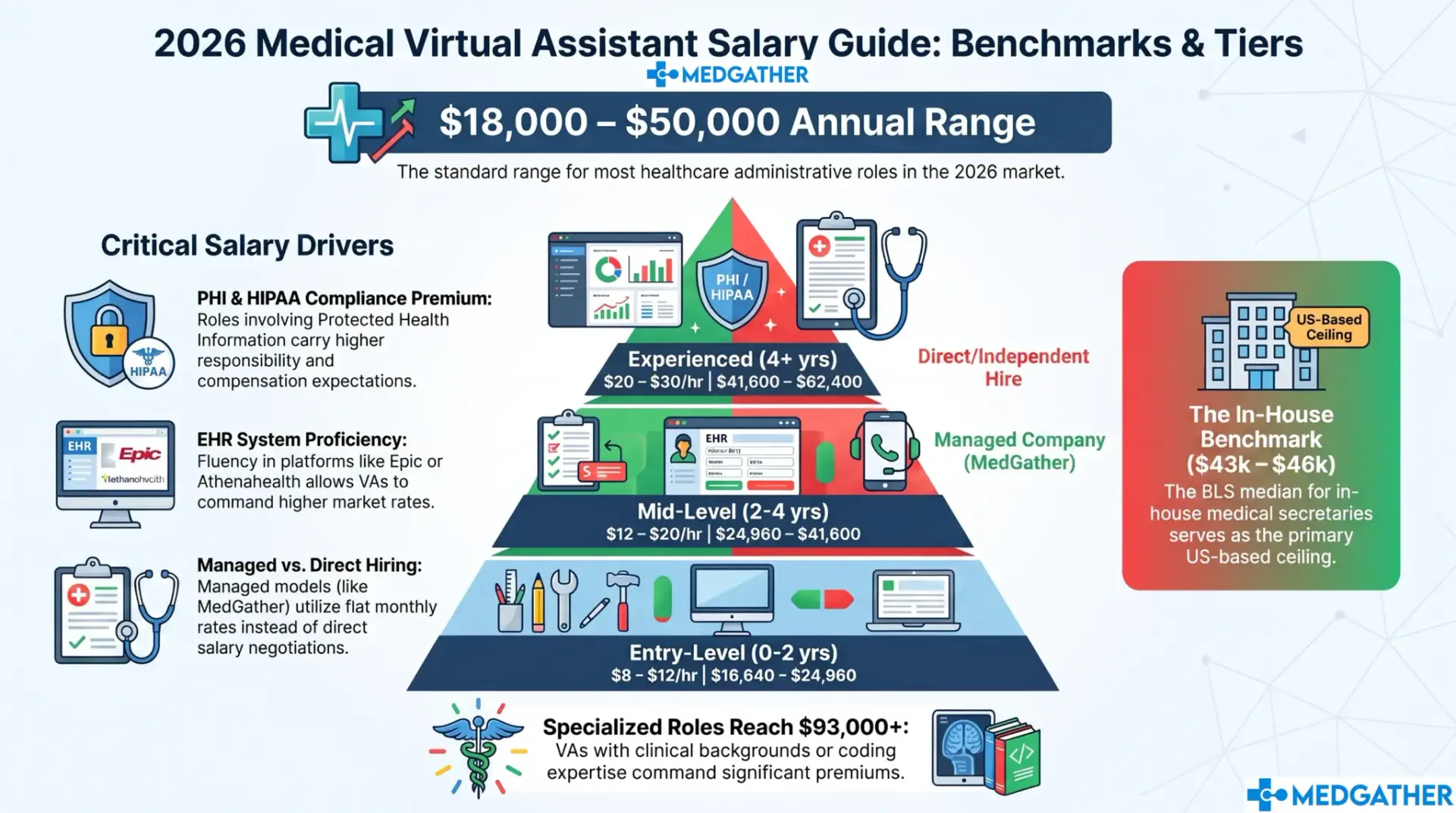
The medical virtual assistant salary range in 2026 runs from approximately $18,000 to $50,000 per year for most healthcare administrative roles, depending on experience level, task complexity, and whether the VA is placed through a freelance platform, a direct independent arrangement, or a managed placement company. That widespread reflects a genuinely fragmented market rather than a single unified salary standard.
This guide covers what the range looks like from both sides of the arrangement. If you are a practice owner evaluating whether a rate offer is fair before hiring a VA directly, the experience tiers and compensation factors in this guide give you a market benchmark. If you are a medical VA researching your market rate, the same data applies. What practices actually pay for a medical VA on an hourly basis covers the hourly pricing side of the same question in more detail.
MedGather is a managed, office-based VA placement company. MedGather handles recruited virtual assistants’ compensation directly as part of the placement model, which means practices pay a flat monthly rate rather than setting individual salary terms. That structure is covered in the final section of this guide.
TL;DR, Medical Virtual Assistant Salary Range 2026
$18,000 to $50,000 per year covers most medical virtual assistant roles in 2026. Entry-level general admin VAs sits at the lower end ($18,000 to $25,000). Experienced healthcare-specific VAs handling prior authorizations, EHR documentation, and PHI-involved workflows reach $36,000 to $50,000. Highly specialized roles with clinical backgrounds push past $50,000.
For context: The Bureau of Labor Statistics data puts the median annual wage for in-house medical secretaries and administrative assistants at $43,000 to $46,000 for 2024; the closest published benchmark for the equivalent in-house role.
The placement model (freelance platform, direct hire, or managed company) affects not just the rate, but who handles the compliance, oversight, and compensation structure.

Board-certified gastroenterologist and Founder of MedGather. Read full bio →
In This Guide
- What does the medical virtual assistant salary range actually cover?
- What does BLS data say about equivalent in-house medical admin salaries?
- What is the salary range from the practice owner perspective?
- What is the salary range from the VA perspective?
- What factors push medical VA compensation higher or lower?
- What do the four experience tiers look like in detail?
- How does salary work differently under each VA hiring model?
What Does the Medical Virtual Assistant Salary Range Actually Cover?
Definition: Medical Virtual Assistant Salary Range
The medical virtual assistant salary range refers to the annual compensation a medical VA earns or is offered for handling healthcare administrative workflows, including Patient Scheduling, Patient Communications, Prior Authorizations, Insurance Verification, EHR data entry, and related tasks. The range varies by experience, task complexity, geographic location, and placement model.
Two important boundaries on what this range covers. First, it does not include billing or revenue cycle management work. Second, ‘salary’ in this context refers to the medical VA’s direct compensation rather than the total cost to the practice, which in a managed model includes placement, oversight, and compliance overhead on top of the base rate. Those total-cost figures are covered separately.
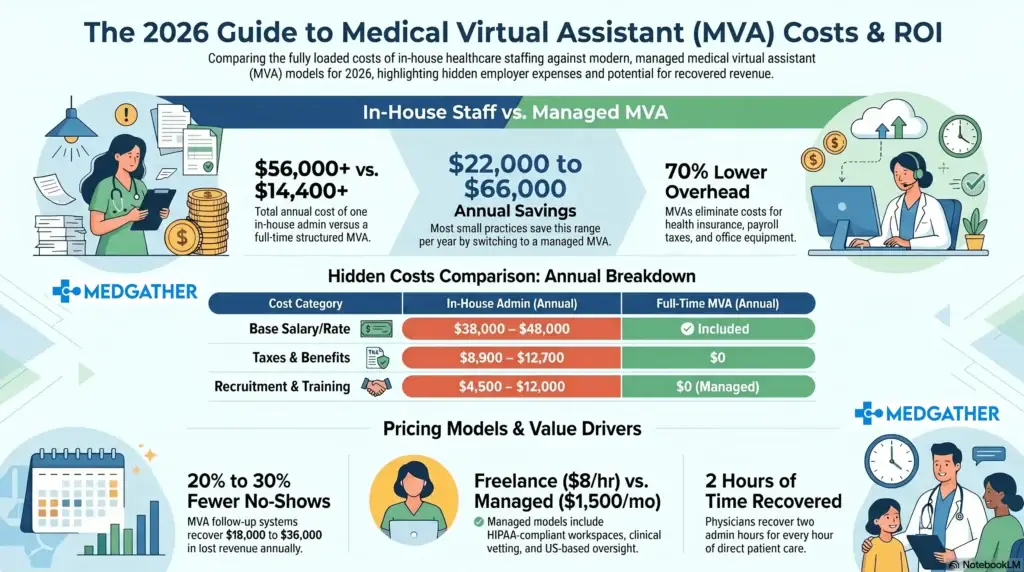
The distinction between what a medical virtual assistant earns and what clinical practices pay are important for practices evaluating cost. What the full annual cost of a medical VA placement looks like once all components are included covers the total cost side of the calculation.
What Does BLS Data Say About Medical Administrative Assistant Salaries?
The most relevant published benchmark for medical virtual assistant compensation is the Bureau of Labor Statistics median annual wage for Medical Secretaries and Administrative Assistants (SOC 43-6013), which is approximately $43,000 to $46,000 based on May 2024 data. This figure covers in-house US employees performing the same administrative functions a medical VA handles remotely.
The BLS figure is useful as a floor and ceiling reference rather than a direct equivalent. A medical VA’s compensation depends on the staffing model, experience level, and scope of tasks handled, so it won’t always match this benchmark one-for-one. Task complexity and PHI-handling requirements are often comparable to an in-house role, which means compensation should track closer to experience and task scope than to the staffing model alone.
For practices, the BLS figure matters because it is based on what the equivalent role costs when staffed in-house, before employer-side costs like payroll taxes, benefits, and PTO are added. See the hidden costs of in-house medical office staff for how this salary translates to actual annual cost.
What Is a Fair Salary Range from the Practice Owner Perspective?
From the practice owner’s perspective, a reasonable rate offer for a medical VA depends on three variables: (1) what task scope they should be covering; (2) how much healthcare-specific experience do they have; and (3) which hiring model your clinic is operating. A rate that works for a general scheduling VA on a freelance platform is not necessarily appropriate for an experienced prior authorization specialist who manages PHI daily.
The practical benchmark for a practice is to start with the BLS equivalent for the in-house role and work backward. If the work is equivalent to a full-time medical secretary role, the market rate for a VA with equivalent experience and task scope should be meaningfully lower than $43,000 to $46,000 annually, because the VA arrangement removes the employer’s payroll tax, benefits, PTO, and overhead costs. A fair rate reflects that cost difference without simply pushing all the savings onto the VA side.
For practices comparing VA compensation directly against in-house costs, comparing a managed virtual assistant company versus an independent hire covers which model makes the compensation question simpler to manage.
What Is a Fair Salary Range from the Medical VA Perspective?
From the medical VA’s perspective, fair compensation reflects also on their own separate three factors: (1) the complexity of the tasks handled; (2) the compliance requirements of the work (PHI involvement, HIPAA); and (3) the experience level brought to the role. General administrative work that does not involve patient data sits at one end of the range. Prior authorization management, insurance verification, and EHR documentation involving PHI sit meaningfully higher.
Medical virtual assistants should also factor in platform fees if working through Upwork or similar services. Gross earnings before platform commission are not the same as take-home pay, and the effective hourly rate after fees is often 10 to 20 percent lower than the posted rate. Direct arrangements and managed company placements typically do not carry the same fee structure. This tracks with the Society for Human Resource Management benchmarking on administrative compensation, which similarly ties pay to task complexity and compliance responsibility rather than job title alone.
What Factors Push Medical VA Compensation Higher or Lower?
Six factors consistently determine where a medical VA’s compensation lands within the broader range.
- Experience level. The clearest predictor. A VA with two years of healthcare administrative experience commands a higher rate than one entering the field from general admin. The difference between entry-level and experienced in the medical VA market is approximately $12,000 to $20,000 per year in annual terms.
- PHI involvement. Any role that involves handling patient protected health information carries higher compensation expectations and a higher task of responsibility. Medical virtual assistants who can demonstrate documented HIPAA training and prior PHI-handling experience are compensated for more than those who are only beginning.
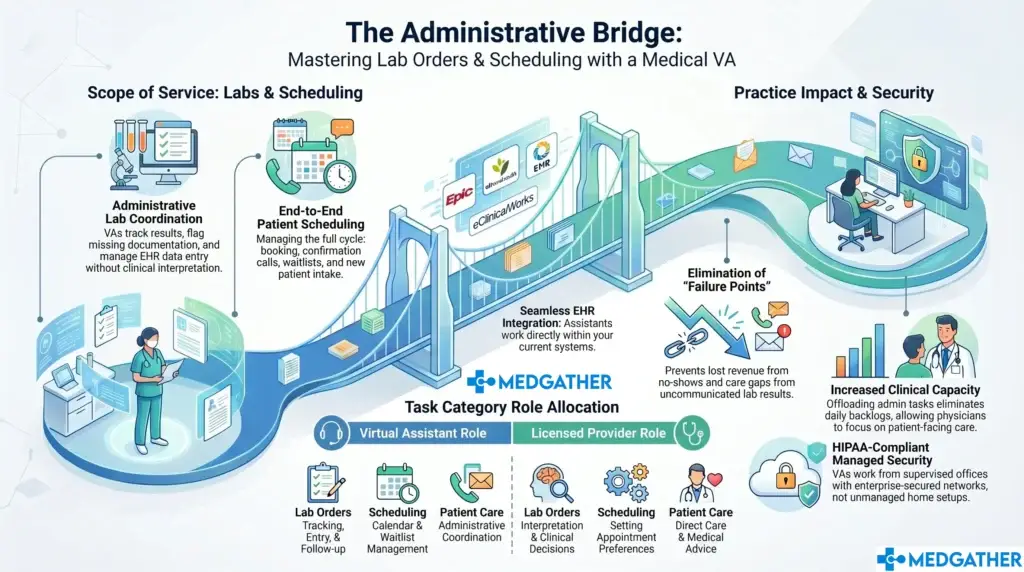
- EHR proficiency. Fluency in specific EHR systems, particularly Epic, Athenahealth, eClinicalWorks, and Modmed, commands a premium. Practices with specific EHR requirements often pay more for a medical VA who does not require system training from scratch.
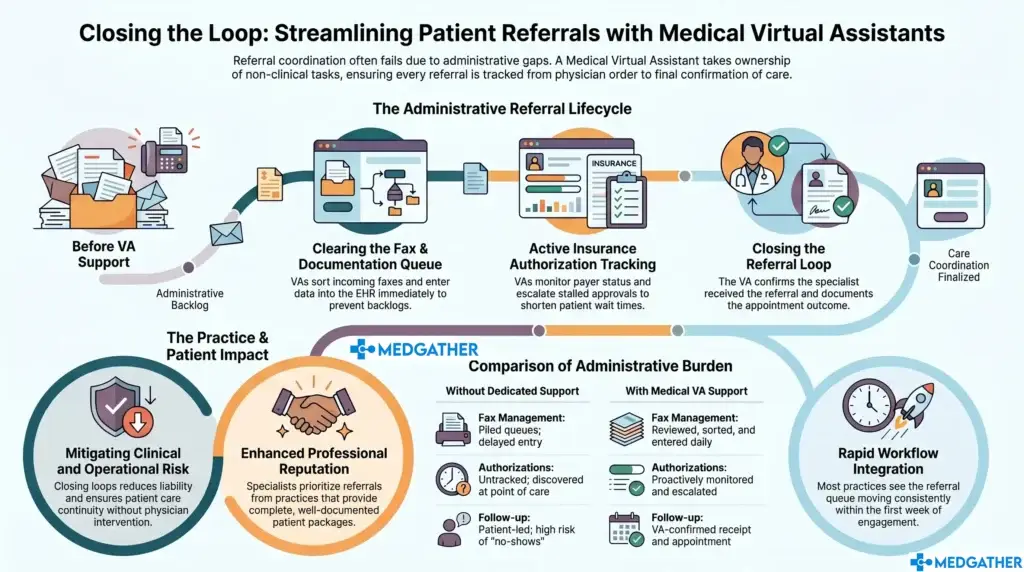
- Task complexity. Prescription Refills coordination, Prior Authorizations follow-up, and Insurance Verification are more complex tasks than general Patient Scheduling or inbox management. Task scope directly affects where in the range a VA’s compensation sits.
- Placement model. Freelance platform rates are typically lower than direct independent hire rates, which are typically lower than managed company rates. The managed model includes oversight, compliance infrastructure, and replacement coverage that the direct rate does not.
- Full-time vs. part-time engagement. Full-time placements often carry a lower per-hour rate than part-time arrangements, since full-time provides scheduling consistency and task continuity that a practice values.
What Do the Four Medical VA Experience Tiers Look Like in 2026?
The table below maps the four experience tiers to their typical hourly rate and annual equivalent based on current market data for healthcare virtual assistant roles.
Medical Virtual Assistant Salary Range by Experience Tier (2026)
| Experience Tier | Typical Hourly Rate | Annual Equivalent | Typical Task Scope |
| Entry-level (0 to 2 years, general admin) | $8 to $12/hr | $16,640 to $24,960/yr | Patient Scheduling, inbox management, general Administrative Support |
| Mid-level (2 to 4 years, healthcare-specific) | $12 to $20/hr | $24,960 to $41,600/yr | Patient Communications, Chart preparations, Order Processing, basic Insurance Verification |
| Experienced (4+ years, PHI-involved tasks) | $20 to $30/hr | $41,600 to $62,400/yr | Prior Authorizations, Insurance Verification, Referral Managements, Prescription Refills, multi-EHR proficiency |
| Highly specialized (clinical background, complex tasks) | $30 to $45/hr | $62,400 to $93,600/yr | Diagnostic Supports, Medical Coding, complex Prior Authorizations, Telemedicine Assistance, clinical admin coordination |
How Does Salary Work Differently Under Each VA Hiring Model?
The salary question looks different depending on which hiring model is in use. In a direct independent arrangement, the practice negotiates salary terms directly with the VA. In a managed placement, the placement company handles VA compensation as part of the service model.
Medical VA Compensation: Direct Hire vs. Managed Company
| Compensation Factor | Direct or Platform Hire | Managed VA Company (MedGather) |
| How VA compensation is set | Practice negotiates directly with the VA | Handled by MedGather , not negotiated by the practice |
| Employer payroll taxes (if US employee) | Practice carries if VA is classified as employee | None, flat service rate covers all |
| Benefit obligations | Depends on legal classification of VA | None, MedGather handles |
| Compensation benchmarking research | Practice responsible | Handled by MedGather |
| Cost predictability | Variable, salary plus potential increases | Fixed flat monthly rate |
| Compensation if VA leaves and is replaced | Restart negotiation with new VA | No renegotiation, rate stays the same |
| Total compensation transparency to practice | Base salary plus any employer-side obligations | Single known monthly rate, no hidden additions |
For practices weighing the two models, how the full annual cost compares between independent and managed arrangements once all factors are included puts dollar figures on the comparison that this salary-focused guide does not cover.
How Does MedGather Handle VA Compensation?
MedGather is a managed VA placement company. In MedGather’s model, your practice pays a single flat monthly rate that covers the medical virtual assistant’s compensation, management, oversight, HIPAA compliance infrastructure, and the full 15-service task scope. MedGather sets and manages VA compensation internally. The practice does not negotiate a salary directly with the VA, set a rate, or carry any employer-side payroll obligations.
This means the salary range figures in this guide are most relevant to practices evaluating a direct or platform hire. For a MedGather placement, the relevant question is not “what salary should I offer?” but “what does the flat monthly rate include?” Staffing and compensation benchmarks from the Medical Group Management Association show that predictable, all-in cost structures are increasingly what practices look for when evaluating administrative support options. The full-time managed model and its cost predictability covers what that structure provides in detail, and the ROI of a medical VA placement shows what the return looks like across all three value streams.
See what MedGather's managed placement looks like for your practice.
MedGather handles VA compensation, HIPAA compliance, and oversight in a single flat monthly rate. No salary negotiation required.
Key Takeaways , Medical Virtual Assistant Salary Range 2026
- The medical virtual assistant salary range in 2026 runs $18,000 to $50,000 annually for most roles, with highly specialized clinical admin VAs reaching $62,000 to $93,600.
- The BLS median for in-house medical secretaries is $43,000 to $46,000. This is the most reliable, published benchmark for the in-house equivalent role, not a direct VA salary standard.
- Four factors consistently push VA compensation higher: PHI involvement, EHR platform proficiency, task complexity (Prior Authorizations, Insurance Verification), and years of healthcare-specific experience.
- From the practice perspective, a fair rate reflects the task scope without pushing the full employer cost savings onto the VA's side. From the VA perspective, PHI handling and HIPAA compliance requirements justify compensation above the general admin rate.
- In a managed placement like MedGather, the practice does not set or negotiate a VA salary. The flat monthly rate includes VA compensation, oversight, and compliance infrastructure.
Frequently Asked Questions
What is the average medical virtual assistant salary in 2026?
The average medical virtual assistant salary in 2026 ranges from approximately $18,000 to $50,000 annually for most healthcare administrative roles. Entry-level general admin VAs sits around $18,000 to $25,000. Mid-level VAs with healthcare-specific experience reaches $25,000 to $42,000. Experienced VAs handling PHI-involved tasks like Prior Authorizations and Insurance Verification earn $42,000 to $62,000 or more depending on specialization.
How much should I pay a medical virtual assistant if I hire directly?
A fair rate for a direct hire reflects the VA’s experience tier, task complexity, and whether PHI is involved. Entry-level general admin: $8 to $12 per hour. Mid-level healthcare-specific: $12 to $20 per hour. Experienced PHI-involved: $20 to $30 per hour. The Bureau of Labor Statistics median for the equivalent in-house role is $43,000 to $46,000 annually, which provides a useful ceiling context. How the hourly rate translates into annual cost when you account for all placement factors provides the full rate breakdown.
Do offshore medical VAs earn less than US-based VAs?
Typically, yes, in direct compensation terms, because cost-of-living differences between offshore locations and the US are significant. However, task complexity and PHI-handling requirements are the same regardless of location. An experienced medical VA handling Prior Authorizations and EHR documentation at volume should be compensated closer to the mid-to-experienced tier of the range than to the entry-level general admin tier.
What is a fair hourly rate for a medical virtual assistant?
A fair hourly rate for a medical virtual assistant range is from $8 to $30 per hour depending on experience and task scope. General admin without PHI involvement: $8 to $12 per hour. Healthcare-specific with EHR proficiency: $12 to $20 per hour. PHI-involved tasks like Prior Authorizations and Insurance Verification: $20 to $30 per hour. Highly specialized roles with clinical backgrounds reach $30 to $45 per hour.
How does a managed VA company handle salary compared to hiring independently?
In a managed VA placement, the company handles VA compensation internally and practices pay a flat monthly service rate rather than setting a salary directly. This removes the compensation negotiation, employer-side tax obligations, and benchmark research burden from the practice. In a direct or platform hire, the practice negotiates salary directly with the VA and carries any applicable employer obligations. Which model is right for your practice based on task scope and management capacity covers that decision in detail.
Board-certified gastroenterologist and Founder of MedGather. Read full bio →
Sources:
- Bureau of Labor Statistics for medical secretaries and administrative assistants median annual wage data. Verify the cited figures before publishing.
- Society for Human Resource Management for compensation benchmarking guidance. Verify the applicable SHRM compensation benchmarking resource before publishing.
- Medical Group Management Association for administrative staffing compensation and practice operations benchmarking. Verify the applicable MGMA benchmarking data before publishing.