Healthcare Virtual Assistant Full-Time Remote Benefits: What Practices Gain
Healthcare virtual assistant full-time remote benefits start with something most practices do not fully appreciate until they have experienced the alternative: administrative coverage that does not disappear when someone calls in sick, takes vacation, or gives notice. A full-time office-based VA provides a dedicated 40-hour-per-week administrative resource without the employer-side cost structure, compliance setup burden, or turnover risk that comes with a full-time in-house hire.
This guide covers six specific benefits of the full-time model, how the office-based placement structure MedGather uses differs from both home-based freelancers and in-house staff, and what that structure costs compared to keeping administrative work in-house. A comparison table puts the key differences on one page.
MedGather has always been an office-based placement company. Every VA is placed in a supervised office in with company-issued devices and a HIPAA-compliant working environment, not a home office. That difference matters for compliance, quality consistency, and for the coverage model. It comes up throughout this guide.
TL;DR, Healthcare Virtual Assistant Full Time Remote Benefits
Six specific benefits: (1) consistent 40-hour-per-week coverage with no vacancy gaps, (2) no employer payroll taxes, benefits, or PTO costs, (3) HIPAA compliance built in before day one, (4) pre-trained on healthcare workflows with a 1-to-2-week ramp, (5) access to MedGather’s full 15-service scope, (6) scalability through the service relationship rather than a new hire cycle.
The ‘remote’ in this keyword means the VA is off-site from your practice, not that they are working from a home office. MedGather places office-based VAs in supervised workspaces in the Philippines, which is both a compliance advantage over home-based freelancers and the foundation for every benefit on this list.

Board-certified gastroenterologist and Founder of MedGather. Read full bio →
In This Guide
- What is a full-time office-based healthcare VA and how does it differ from a remote freelancer?
- What is the first benefit: consistent, uninterrupted administrative coverage?
- What is the second benefit: no employer-side overhead on the monthly rate?
- What is the third benefit: HIPAA compliance built into the placement before day one?
- What is the fourth benefit: pre-trained on healthcare workflows from the start?
- What is the fifth benefit: access to MedGather’s full 15-service scope?
- What is the sixth benefit: scalability without a new hire cycle?
- How does the full-time model compare to in-house admin on a side-by-side basis?
- How does MedGather deliver the full-time office-based model?
What Is a Full-Time Office-Based Healthcare VA and How Does It Differ from a Remote Freelancer?
A full-time office-based healthcare VA is a trained administrative professional who works a standard 40-hour week handling your practice’s administrative workflows from a managed, supervised office environment rather than from your building. The VA is off-site from your practice but is not working from a personal home office.
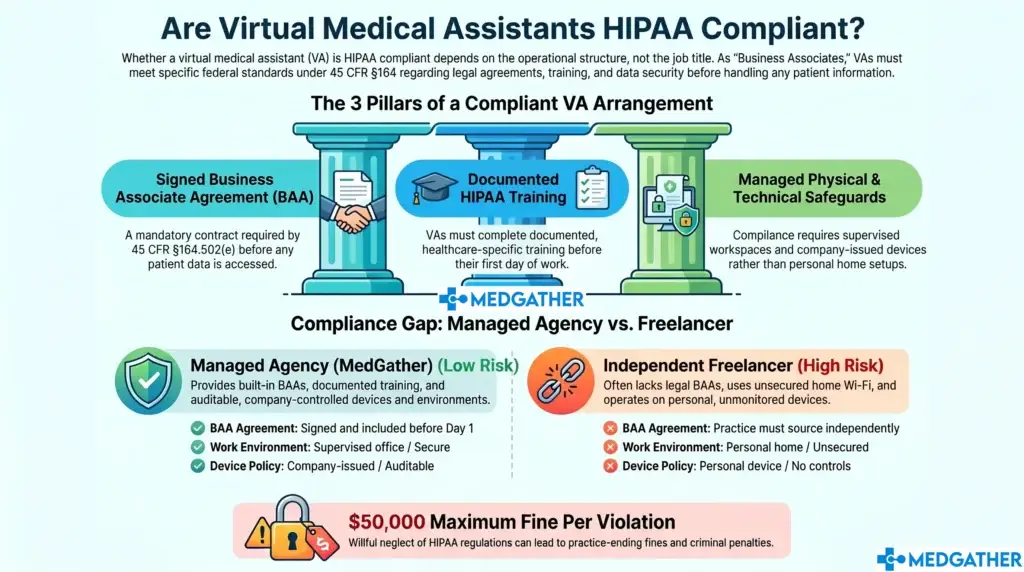
The distinction matters more than most practices initially realize. A home-based freelancer works from their own equipment, on their own network, without day-to-day supervision or auditable physical safeguards. A VA placed through MedGather works from a company-managed office in the Philippines with company-issued devices, physical access controls, a supervised workspace, and a documented HIPAA compliance structure that meets the Security Rule’s physical and technical safeguard requirements.
This is why the ‘remote’ in the focus keyword is not a limitation. The VA is remote from your practice. The working environment is not. Why the office-based model changes the HIPAA compliance picture compared to a home-based freelancer covers the regulatory distinction in full.
Why does the office-based model matter for a full-time placement specifically?
When a VA is working full-time on your administrative workflows, they are handling patient data at volume. The HIPAA exposure surface is not a one-off task; it is 40 hours per week of PHI interaction. A managed, auditable office environment with company devices and documented controls is not optional at that scale. It is the compliance baseline.
What Is the First Benefit: Consistent, Uninterrupted Administrative Coverage?
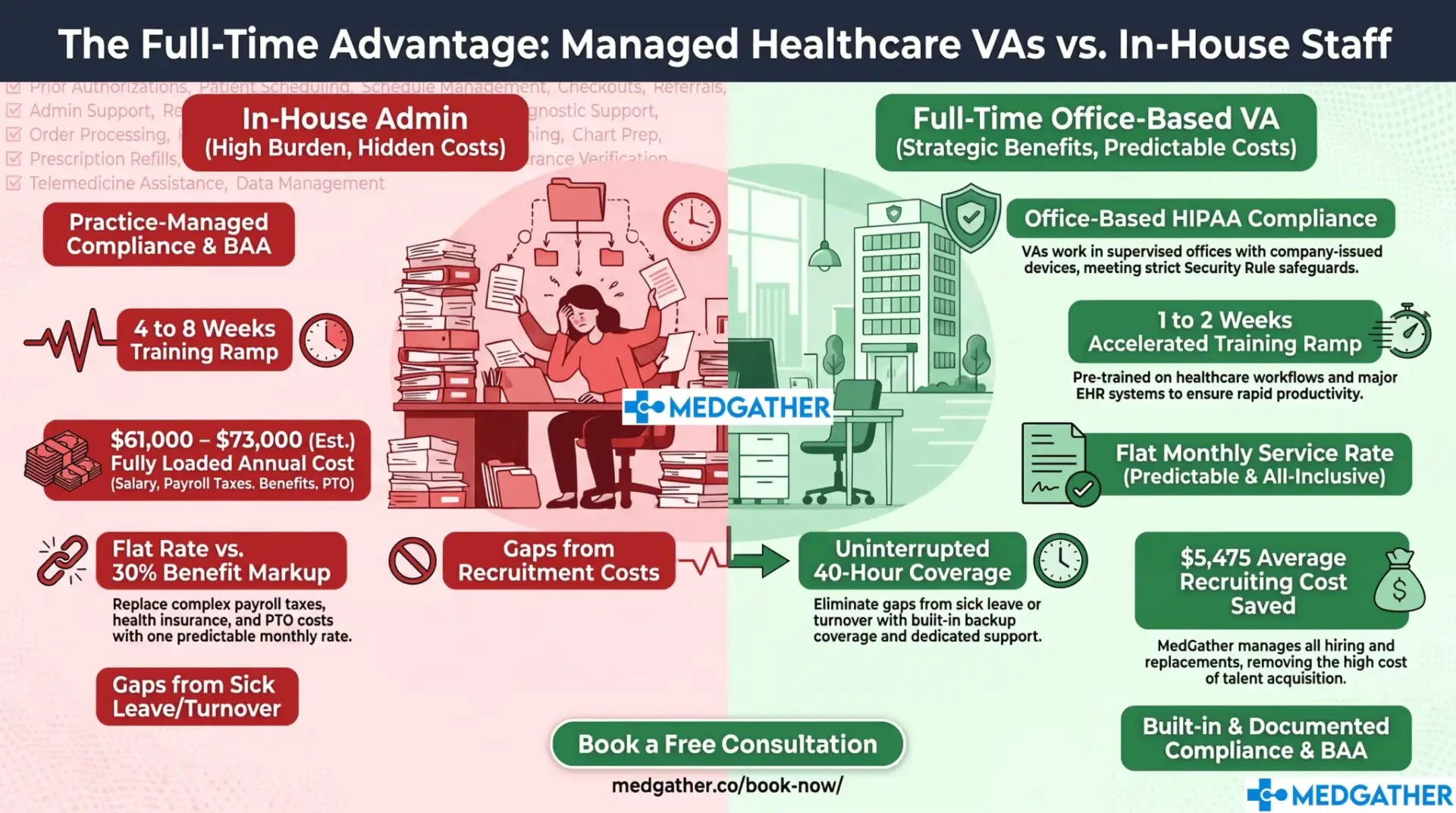
A full-time healthcare VA provides 40 hours of dedicated administrative coverage per week without the disruptions that regularly break in-house coverage. No sick days creating an immediate workload spike on your clinical staff. No vacation weeks where scheduling falls behind. No two-week notice that leaves a position vacant while you recruit.
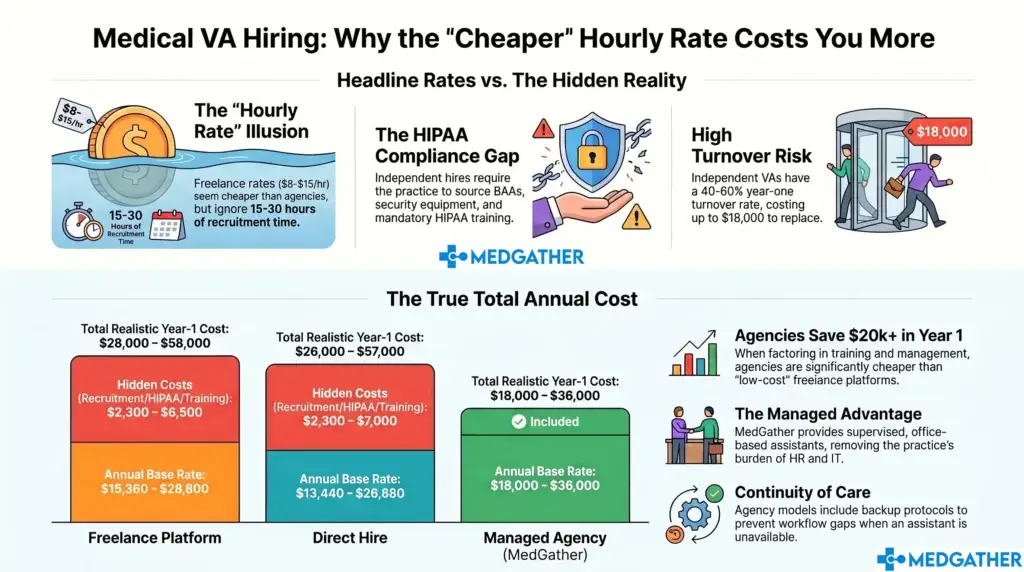
MedGather’s placement model includes backup coverage. If a VA is unavailable, coverage does not fall on your team while you wait. This is one of the structural differences between a full-time managed placement and an independent hire. Why independent VA arrangements create coverage gaps that the managed model avoids explains the comparison in detail.
What Is the Second Benefit: No Employer-Side Overhead on the Monthly Rate?
A full-time office-based VA replaces the employment relationship with a flat service rate. Employer payroll taxes disappear. Health insurance contributions disappear. PTO accrual disappears. Technology and workspace costs are absorbed by MedGather. The monthly rate is the total cost, not the starting point for a layered employer cost structure.
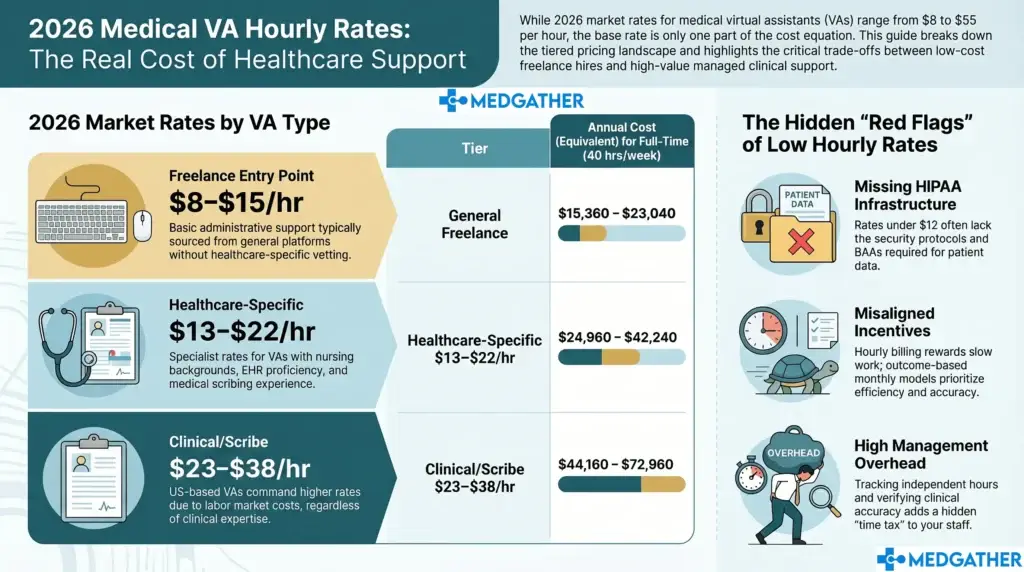
For context: a full-time in-house administrative employee at the current Bureau of Labor Statistics median wage runs $61,000 to $73,000 per year fully loaded once those employer-side layers are added. What the complete hidden cost layer of an in-house administrative position actually adds up to breaks the calculation down across all six cost categories with verified figures.
What Is the Third Benefit: HIPAA Compliance Built Into the Placement Before Day One?
Every MedGather placement includes a signed Business Associate Agreement before the VA accesses any patient data, HIPAA training completed and documented before the first day, and a supervised office environment with company-issued devices. The covered entity, your practice, does not need to source, arrange, or verify any of that independently.
This is the direct operational consequence of the office-based model described in the first section. Because MedGather controls the working environment, the compliance infrastructure is part of what MedGather manages rather than something the practice builds. For a full-time placement handling patient data at volume, this is not a detail , it is the foundation of the entire arrangement.
The minimum necessary standard under HIPAA also applies here: MedGather scopes each VA’s system access to the fields and functions relevant to their specific tasks, not full chart access. How HIPAA compliance is structured in practice for a full-time healthcare VA placement covers the BAA, training documentation, and supervised environment requirements in detail.
What Is the Fourth Benefit: Pre-Trained on Healthcare Workflows From the Start?
A MedGather VA arrives trained on the specific task categories relevant to healthcare administrative work before placement: scheduling platforms, EHR systems including Epic, Athenahealth, eClinicalWorks, and Modmed, prior authorization workflows, insurance verification processes, and patient communication protocols.
The practical consequence is a 1-to-2-week ramp to full productivity versus 4 to 8 weeks for a new in-house hire learning practice-specific workflows from scratch. At a full-time 40-hour-per-week pace, that ramp difference represents 100 to 240 fewer hours of partial productivity. What the full scope of tasks a MedGather-placed VA is trained to handle across all 15 services maps the complete task range.
What Is the Fifth Benefit: Access to MedGather's Full 15-Service Scope?
A full-time placement is not scoped to a single task or a narrow role. MedGather’s placement model gives the practice access to all 15 medical VA services through the same VA, growing the task handoff as the working relationship matures: Prior Authorizations, Patient Scheduling, Manage Doctor’s Schedule, Patient Checkouts, Referral Managements, Administrative Support, Order Processing, Diagnostic Supports, Patient Communications, Chart preparations, Medical Coding, Prescription Refills, Insurance Verification, Telemedicine Assistance, and HIPAA Compliant Data Management.
What Is the Sixth Benefit: Scalability Without a New Hire Cycle?
When a practice’s administrative needs grow, scaling a full-time VA arrangement happens through the existing service relationship: adjusting the task scope, the working hours within the placement, or the number of VAs through MedGather’s model. The alternative, hiring additional in-house staff, requires a recruiting cycle, a compliance setup, another onboarding ramp, and another employer cost layer.
This scalability advantage applies directly to the decision between the full-time and part-time VA model. A full-time placement that can expand its task scope through the service relationship is structurally different from a part-time arrangement that requires a new hire decision every time volume increases.
How Does the Full-Time Office-Based Model Compare to In-House Admin Side by Side?
The table below compares the full-time office-based VA model against a full-time in-house administrative hire across cost, compliance, coverage, and operational factors. Part-time VA comparison is intentionally excluded here , that decision is covered in a dedicated post.
Full-Time Office-Based VA vs. Full-Time In-House Admin: Key Comparison
| Factor | Full-Time In-House Admin | Full-Time Office-Based VA (MedGather) |
| Annual base pay (BLS median) | $43,000 to $46,000 salary | Flat monthly rate , no separate salary negotiation |
| Employer payroll taxes | $3,700 to $4,200 per year | None |
| Health insurance and benefits | $6,000 to $9,000 per year | None |
| PTO and sick leave cost | $4,000 to $5,500 per year | None , continuous coverage |
| HIPAA training and BAA | Practice arranges and verifies independently | Included , completed and documented before day one |
| Working environment | In your office | Supervised office in Philippines , company devices |
| Recruiting cost if position turns over | $5,475 average per hire (SHRM 2025) | Included in model , replacement managed by MedGather |
| Training ramp to full productivity | 4 to 8 weeks | 1 to 2 weeks , pre-trained on healthcare workflows |
| Coverage if position is vacant | Gap until replacement is hired | Backup coverage included |
| Fully loaded annual cost (est.) | $61,000 to $73,000 per year | Flat monthly rate , see medgather.co/book-now/ |
How Does MedGather Deliver the Full-Time Office-Based Model?
MedGather places office-based virtual medical assistants with US medical practices through a single flat monthly rate. The placement model is built specifically for practices that want dedicated full-time administrative support without building the compliance, vetting, and management infrastructure in-house. Every VA works from MedGather’s managed office in the Philippines, not from a personal home, which is the structural foundation for the compliance and coverage benefits described in this guide.
MedGather’s placement process starts with understanding your practice’s specific task scope, then vetting and placing a VA pre-trained on the relevant services. How MedGather’s vetting and onboarding process works before a VA starts covers the placement structure. For practices that have evaluated both the independent hire and the managed company route, why the managed model typically fits PHI-handling practices better regardless of task volume addresses that decision directly.
For practices comparing the full-time office-based VA against other staffing options, what the full-time VA model looks like compared to an in-office assistant in the same administrative role provides the role-by-role comparison.
See what the full-time office-based model looks like for your practice.
MedGather's VAs are pre-trained on healthcare workflows, HIPAA-compliant from day one, and placed in a supervised office environment that supports all 15 MedGather medical VA services.
Key Takeaways , Healthcare Virtual Assistant Full Time Remote Benefits
- Full-time office-based means the VA works 40 hours per week in a MedGather-managed office in the Philippines, not from a personal home office. That distinction is the foundation for both the compliance structure and the coverage model.
- Six specific benefits: consistent coverage, no employer overhead, HIPAA compliance from day one, pre-trained ramp time of 1 to 2 weeks, access to all 15 MedGather services, and scalability through the service relationship.
- The fully loaded annual cost of a full-time in-house admin position runs $61,000 to $73,000. The flat monthly rate for a MedGather VA eliminates most of the employer-side layer that creates that gap.
- HIPAA compliance for a full-time VA placement requires a BAA executed before day one, documented training, and a supervised working environment. MedGather's office-based model provides all three without the practice needing to arrange any of it independently.
- The full-time model is not the only option. The decision between full-time and part-time engagement depends on task volume and budget. That decision is covered in a separate post in this cluster.
Frequently Asked Questions
What are the benefits of a full-time healthcare virtual assistant?
A full-time healthcare virtual assistant provides six specific benefits: consistent 40-hour-per-week administrative coverage without vacancy gaps, no employer payroll taxes or benefits costs, HIPAA compliance infrastructure built into the placement before day one, a short 1-to-2-week ramp due to pre-training on healthcare workflows, access to a full 15-service task scope, and the ability to scale through the service relationship rather than through a new hire cycle.
Is a full-time VA better than a part-time VA for a medical practice?
For practices with steady, high-volume administrative work, full-time provides better coverage continuity, a more predictable cost structure, and a deeper task scope that develops over time. For practices with lighter or variable administrative needs, part-time may be more appropriate. That decision is covered in detail in the full-time vs. part-time guide in this cluster.
What does office-based mean for a healthcare virtual assistant?
Office-based means the VA works from a managed, supervised office environment rather than from a personal home. MedGather’s VAs work in MedGather’s office in the Philippines with company-issued devices, physical access controls, and HIPAA-compliant infrastructure. This is different from a home-based freelancer who works on their own equipment from an unsupervised personal environment.
How does a full-time remote healthcare VA handle HIPAA compliance?
MedGather’s full-time placement includes a signed Business Associate Agreement executed before the VA touches any patient data, HIPAA training completed and documented before the first day, and a supervised office environment that meets the Security Rule’s physical and technical safeguard requirements. The practice does not need to arrange or verify any of this independently.
How much does a full-time healthcare virtual assistant cost compared to in-house staff?
A full-time in-house administrative hire at the current Bureau of Labor Statistics median wage costs $61,000 to $73,000 per year fully loaded once employer payroll taxes, benefits, PTO, and management overhead are included. MedGather does not publish a flat rate publicly because practice needs vary, but the flat monthly rate does not include any of the employer-side cost categories that produce that in-house figure. The full cost comparison is available at the pricing guide, and a specific quote is available via free consultation at medgather.co/book-now/.
Board-certified gastroenterologist and Founder of MedGather. Read full bio →
Sources
- Bureau of Labor Statistics. Occupational Outlook Handbook – Medical Secretaries and Administrative Assistants.
- Society for Human Resource Management. 2025 Talent Acquisition Benchmarking Report – Average Cost-per-Hire.
- U.S. Department of Health and Human Services. HIPAA Security Rule – Business Associate Agreement (BAA) Requirements and the Minimum Necessary Standard.
Illustrative estimates only: figures in this guide are general industry estimates built from published data sources. Actual cost savings vary by location, role scope, benefits package, and practice size. This is not a guarantee of savings for any specific practice. This is not legal or compliance advice.