The Hidden Costs In-House Medical Office Staff Create for Your Practice
The hidden costs in-house medical office staff create are the reason a $44,500 salary line in the budget rarely matches what a position actually costs your practice over the course of a year. Payroll taxes, health insurance, paid time off, management time, and basic technology all sit underneath that number, mostly invisible until someone adds them up. None of it shows up on the offer letter, and most of it shows up on the bank statement every month regardless.
This guide breaks the full cost into two layers: the always-on costs that apply to every in-house position every year, and the hiring-event costs that hit only when a position needs to be filled or refilled. Most practices comparing in-house staffing against a virtual assistant model already sense this gap exists without having a specific number to put on it. The breakdown below uses Bureau of Labor Statistics wage data and Society for Human Resource Management (SHRM) benchmarking data to put real figures against both layers.
This guide covers what the base salary figure actually includes, the costs that sit on top of it every year, the additional costs that hit only when a position turns over, and what the full picture looks like side by side with MedGather’s flat-rate virtual assistant model.
TL;DR: The Hidden Costs In-House Medical Office Staff Create
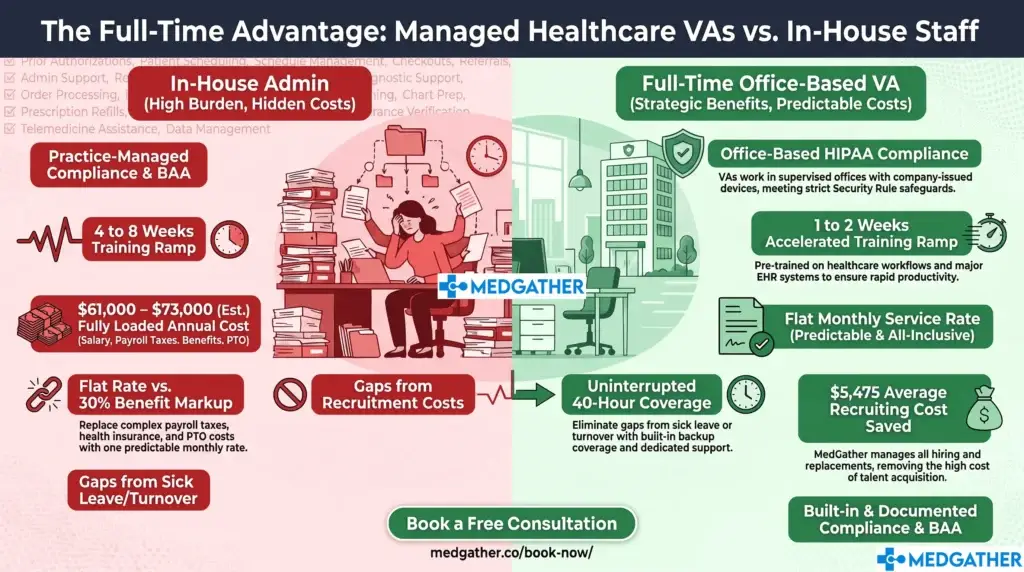
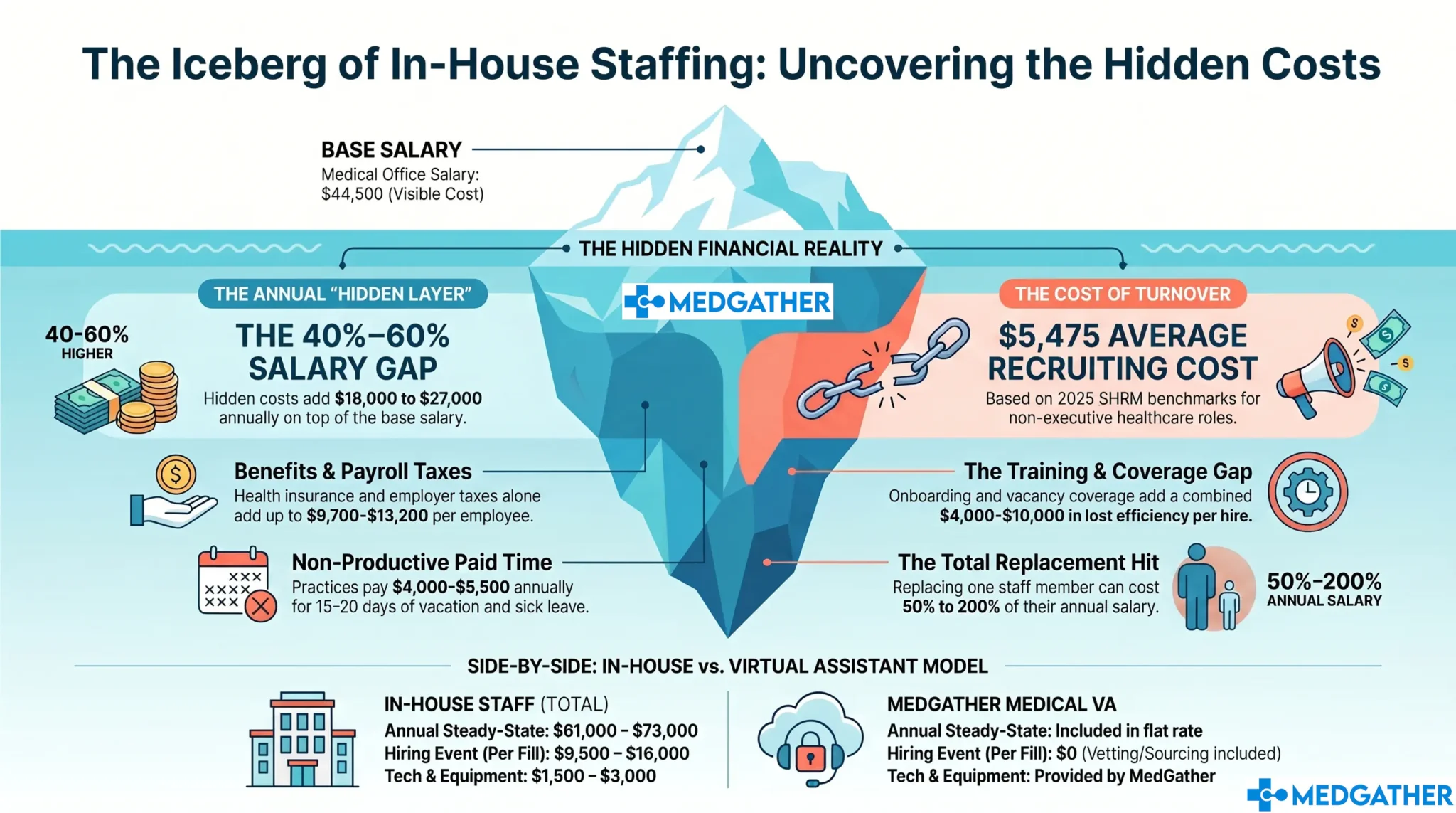
$61,000 to $73,000 a year is the typical fully loaded cost of a single in-house medical office position posted at $43,000 to $46,000 in base salary, once payroll taxes, benefits, paid time off, management time, and basic technology are added in. That is a hidden gap of $18,000 to $27,000 that never appears on the offer letter.
If the position turns over, recruiting, onboarding, and the coverage gap add another $9,500 to $16,000 for that hiring event alone, and broader industry turnover research puts the full replacement cost at $21,500 to $50,000 or more.
The number on the budget line is rarely the number the position actually costs.

Board-certified gastroenterologist and Founder of MedGather. Read full bio →
In This Guide
- What does the base salary for medical office staff actually look like?
- What hidden costs sit on top of that salary every year?
- What additional costs hit only when the position turns over?
- What does the full hidden cost breakdown look like side by side?
- How much does it really cost to replace a medical office staff member?
- Is the cost gap this large for a solo or small practice too?
- How does MedGather help practices avoid these hidden costs?
- Frequently asked questions
What Hidden Costs Sit on Top of That Salary Every Year?
Five cost categories apply to an in-house position every single year, regardless of whether that employee ever leaves. These are the always-on costs, and they do not depend on turnover.
- Employer payroll taxes. Social Security, Medicare, and federal and state unemployment insurance typically add $3,700 to $4,200 a year on a salary in this range, a fixed cost that applies the moment a position is on payroll.
- Health insurance and benefits. Even a modest employer contribution toward health coverage, plus any dental, vision, or retirement matching, runs $6,000 to $9,000 a year per employee in most markets.
- Paid time off, sick leave, and holiday pay. A practice paying for time the employee is not at work, typically 15 to 20 days a year between vacation, sick time, and holidays, adds $4,000 to $5,500 a year in salary paid against zero output at the desk.
- Management and supervision time. Someone, usually the practice owner or office manager, spends time scheduling, reviewing, and managing this position. Valued conservatively, that oversight time adds $2,500 to $5,000 a year.
- Technology, workspace, and equipment. A computer, software licenses, a phone line, office space, and the utilities and supplies that go with a physical workstation add $1,500 to $3,000 a year per position.
What Additional Costs Hit Only When the Position Turns Over?
The always-on costs above apply every year a position is filled. A second category of cost applies only at the moment a position needs to be filled or refilled, and it tends to be the cost practices forget to budget for entirely.
What Does the Base Salary for Medical Office Staff Actually Look Like?
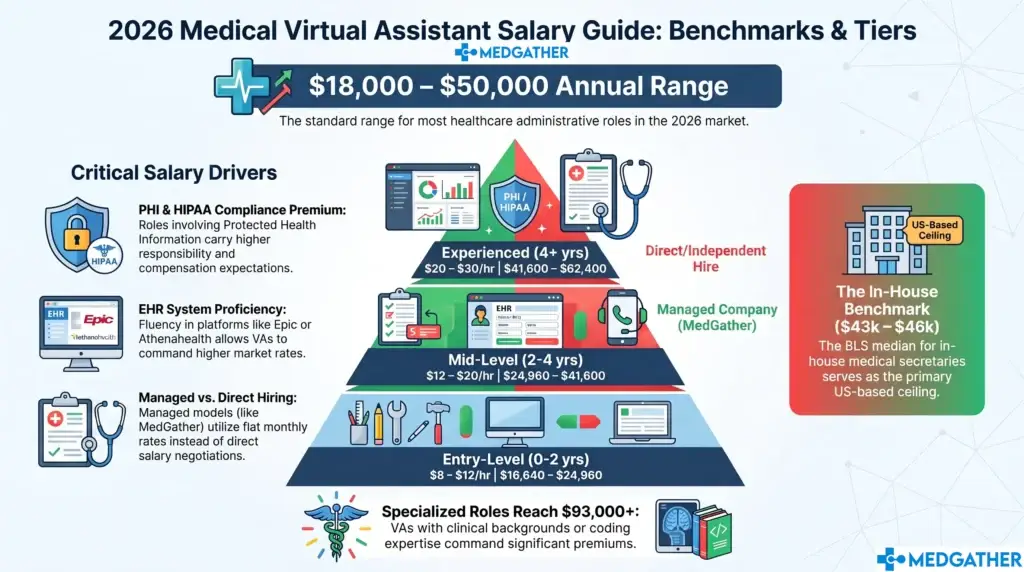
According to the Bureau of Labor Statistics, the median annual wage for medical secretaries and administrative assistants in the United States falls between $43,000 and $46,000 based on the most recently published wage data. That figure is the starting point most practices use when budgeting for a new hire, and it is also the number that creates the biggest gap between what gets budgeted and what the position actually costs.
The salary itself is not the problem. The problem is treating the salary as the total cost. Every in-house hire carries a second layer of cost that sits on top of the paycheck, and that layer typically adds 40 to 60 percent on top of base salary before a single hiring event ever happens.
Industry Benchmark: According to the Bureau of Labor Statistics , medical secretaries and administrative assistants earn a median annual wage in the mid-$40,000 range based on the most recently published Occupational Outlook Handbook data.
Does the Base Salary Figure Already Include Benefits or Taxes?
No. The BLS median wage figure reflects gross pay only. It does not include employer payroll taxes, health insurance contributions, paid time off, management overhead, or any of the other costs a practice carries simply by having an employee on payroll. A full breakdown of what a medical virtual assistant actually costs by comparison shows the other side of this same calculation, where most of these layers are already built into a single flat rate.
- Recruiting and hiring. According to the Society for Human Resource Management’s 2025 benchmarking research, the average cost-per-hire for a non-executive role is $5,475, covering job postings, screening time, interviews, and the administrative work of making an offer.
- Onboarding and training ramp. A new hire in a medical office setting typically needs four to eight weeks to reach full productivity. Paying full salary during a partial-productivity period adds $2,000 to $4,000 in effective cost before the position is contributing at full value.
- Coverage gap during the vacancy. Between a departure and a new hire’s start date, someone else, usually existing staff or the practice owner, absorbs that workload, often at the cost of overtime, delayed tasks, or a measurable dip in patient experience. That gap typically costs $2,000 to $6,000 depending on how long the position stays open.
Recruiting, onboarding, and the coverage gap add $9,500 to $16,000 for a single hiring event. That cost does not appear anywhere in the annual budget until the position actually turns over, and then it appears all at once.
Hiring Cost Benchmark: The Society for Human Resource Management (SHRM) reports that the average cost per hire for non-executive roles is approximately $5,475, highlighting how recruiting expenses can significantly increase the true cost of staffing.
How Often Does This Cost Actually Hit a Practice?
More often than most practice owners expect. Front-desk and administrative turnover in healthcare settings runs higher than in many other industries, driven by a combination of repetitive task load, patient-facing stress, and pay that often does not reflect the complexity of the role. Broader workforce research from SHRM puts the full cost of replacing an employee, including lost productivity and ramp time beyond the direct hiring-event costs above, at 50 to 200 percent of that employee’s annual salary, which works out to roughly $21,500 to $50,000 or more for a position in this salary band. The comparison between hiring an agency-placed VA and hiring independently covers a related decision many practices face once they have been through this cycle once.
What Does the Full Hidden Cost Breakdown Look Like Side by Side?
The table below combines both layers, the always-on annual costs and the hiring-event costs, into a single comparison against MedGather’s flat-rate medical virtual assistant model.
The table below combines both layers, the always-on annual costs and the hiring-event costs, into a single comparison against MedGather’s flat-rate medical virtual assistant model.
Hidden Cost Breakdown: In-House Medical Office Staff vs. MedGather Medical VA
| Column 1 | Column 2 | |
|---|---|---|
| Cost Category | In-House Staff Only | MedGather Medical VA |
| Always-On Annual Costs (Apply Every Year) | ||
| Base salary (BLS median) | $43,000 to $46,000 | Single predictable monthly rate, no separate wage negotiation |
| Employer payroll taxes | $3,700 to $4,200 | None, not billed separately |
| Health insurance and benefits | $6,000 to $9,000 | None |
| PTO, sick leave, and holiday pay | $4,000 to $5,500 | None, continuous coverage model |
| Management and supervision time | $2,500 to $5,000 | Dedicated client support included |
| Technology, workspace, and equipment | $1,500 to $3,000 | Provided by MedGather |
| Steady-State Annual Subtotal | $61,000 to $73,000 | Included in flat monthly rate |
| Hiring-Event Costs (Recruiting, Onboarding, Coverage) | ||
| Recruiting and hiring (per fill) | $5,475 average (SHRM) | Sourcing and screening handled before placement |
| Onboarding and training ramp | $2,000 to $4,000 | Pre-trained on healthcare workflows before day one |
| Coverage gap during vacancy | $2,000 to $6,000 | Backup support model, minimal vacancy gap |
| Hiring-Event Subtotal (Per Fill) | $9,500 to $16,000 | Included, no separate recruiting fee |
| Total Cost in a Year With One Hiring Event | $70,500 to $89,000+ | Predictable monthly rate (see current pricing at MedGather) |
Important Note: These figures are illustrative estimates based on published data from the Bureau of Labor Statistics (BLS) and the Society for Human Resource Management (SHRM). Actual staffing costs vary by location, benefits package, employee tenure, and practice size.
MedGather does not publish a single flat rate because staffing requirements vary by practice. Team size, hours, responsibilities, and workflow complexity all affect pricing. Contact MedGather for a quote tailored to your specific staffing needs.
Separate SHRM turnover research suggests the total cost of replacing an employee can range from $21,500 to $50,000 or more when lost productivity is included. That estimate is intentionally excluded from the table above to avoid double-counting costs already reflected in the hiring-event subtotal.
How Much Does It Really Cost to Replace a Medical Office Staff Member?
Here is what the numbers above look like applied to a single, real position.
A solo practice budgets $44,500 for one front-desk and administrative employee, a figure near the middle of the BLS wage range. Using the midpoint of each always-on cost category above, payroll taxes, benefits, PTO, management time, and technology add approximately $22,500 a year. The steady-state cost of that one position, every year it is filled, runs approximately $67,000, already 50 percent above the budgeted salary.
Two years in, the employee leaves. Recruiting a replacement costs $5,475 at the SHRM benchmark. Bringing the new hire to full productivity adds roughly $3,000 in ramp-time cost. Covering the workload during the search adds roughly $4,000 more. That hiring event alone adds approximately $12,500 on top of the steady-state cost, bringing the total cost of that position in the replacement year to approximately $79,500, against an original budget line of $44,500.
That gap, nearly $35,000 in the replacement year alone, is the gap most practices never see until they go looking for it.
Is the Cost Gap This Large for a Solo or Small Practice Too?
Yes, and in some respects the gap matters more for a smaller practice, not less. Larger groups can absorb one expensive hiring cycle across a bigger budget. A solo or two-provider practice often cannot.
Medical Group Management Association (MGMA) benchmarking data shows that most practices staff three to five support full-time-equivalent positions per physician. At three support positions and a hidden cost layer of $18,000 to $27,000 per position, the always-on hidden cost alone runs $54,000 to $81,000 a year across just the administrative side of a single-physician practice, before any position ever turns over. Practices with smaller teams and tighter margins tend to feel that gap first, because there is less budget cushion to absorb it.
Industry Benchmark: According to the Medical Group Management Association (MGMA), many medical practices operate with approximately three to five support staff full-time equivalents (FTEs) per physician. Administrative staffing remains one of the largest operating expenses for independent healthcare organizations.
Practices with smaller teams and tighter margins are often the most sensitive to staffing inefficiencies because every vacancy, overtime hour, or administrative bottleneck has a greater impact on overall operations and profitability.
How Does MedGather Help Practices Avoid These Hidden Costs?
MedGather places office-based virtual assistants with US medical practices through a single, predictable monthly rate that already accounts for the always-on layer this guide breaks down. Payroll, benefits administration, technology, and supervision are handled on MedGather’s side, not added on top of your invoice. How MedGather structures HIPAA compliance for every placement covers the compliance layer that comes with every assistant, and the hiring and vetting process behind every placement covers how candidates are screened before a practice ever meets them.
The hiring-event costs in this guide largely disappear too. Recruiting, screening, and onboarding ramp are absorbed by MedGather’s vetting pipeline before a candidate is placed, and a coverage plan is part of the model if a placement ever needs to change. The full return a practice sees once both layers of cost are removed walks through the calculation in more detail, and the day-to-day tasks a medical virtual assistant typically handles shows what that monthly rate actually covers. Practices that have made this switch also tend to report a measurable efficiency gain beyond the direct cost savings calculated in this guide.
See what a predictable, all-in monthly rate looks like for your practice.
MedGather's office-based medical virtual assistants remove both the always-on and hiring-event costs broken down in this guide, with a signed BAA, documented training, and a managed work environment already built in.
Frequently Asked Questions
What is the true cost of in-house medical office staff?
The true cost of an in-house medical office position is the base salary plus payroll taxes, benefits, paid time off, management time, and technology, which together typically run $61,000 to $73,000 a year on a base salary of $43,000 to $46,000. If the position turns over, recruiting, onboarding, and coverage costs add another $9,500 to $16,000 for that hiring event alone.
Does an in-house position really cost more than the salary line in the budget?
Yes. The always-on costs layered on top of base salary, payroll taxes, health insurance, PTO, management oversight, and technology, typically add 40 to 60 percent above the salary figure itself, even before a position ever needs to be replaced.
How much does it cost to replace a medical office staff member?
Replacing a medical office staff member typically costs $9,500 to $16,000 in direct recruiting, onboarding, and coverage-gap expenses for that single hiring event. Broader turnover research from SHRM puts the full replacement cost, including lost productivity, at 50 to 200 percent of the position’s annual salary, or roughly $21,500 to $50,000 or more for a position in this salary band.
Is a medical virtual assistant cheaper than in-house staff?
In most cases, yes, once the full hidden cost layer is accounted for rather than comparing salary alone. A direct cost comparison between in-house staff and a medical virtual assistant breaks down both models side by side, and the gap widens further once hiring-event costs and turnover risk are factored in.
The most direct way to reduce this hidden cost is to remove the layers that create it: payroll administration, benefits, recruiting, and onboarding. MedGather’s office-based virtual assistant model folds all of those layers into a single predictable monthly rate, which is why practices that switch typically see savings beyond the salary line alone.
Sources
- Bureau of Labor Statistics . Occupational Outlook Handbook: Medical Secretaries and Administrative Assistants.
- Society for Human Resource Management . 2025 Talent Acquisition Benchmarking Report: Cost Per Hire.
- Society for Human Resource Management . The Real Costs of Recruitment and Employee Turnover.
- Medical Group Management Association . MGMA DataDive: Cost and Revenue / Practice Operations Benchmarking Data.
Important Note: Illustrative estimates only. figures in this guide are general industry estimates, not a guarantee of savings for any specific practice. Actual costs vary by location, benefits package, staffing structure, and practice size.