The Role of a Medical Virtual Assistant in Modern Healthcare
U.S. medical practices are navigating near-impossible conditions. Patient volumes are climbing. Reimbursements are tightening. Administrative workloads—documentation, scheduling, insurance verification, prior authorizations—keep expanding without equivalent increases in staff capacity. And qualified in-office administrative staff are increasingly hard to find, expensive to retain, and prone to burnout.
The medical virtual assistant (MVA) has emerged as a direct operational response to these pressures. Not a gimmick, not a temporary fix—a structural shift in how practices staff their administrative layer. Thousands of U.S. practices are now relying on trained MVAs to keep workflows running, protect patient data, and free up clinical providers to focus on what they trained for.
This guide covers what the role of a medical virtual assistant actually involves, why it is becoming standard practice in U.S. healthcare, and what separates a well-implemented MVA arrangement from one that creates more problems than it solves.
TL;DR: What Is the Role of a Medical Virtual Assistant?
A medical virtual assistant (MVA) is a healthcare-trained administrative professional who helps medical practices manage scheduling, insurance verification, prior authorizations, patient communication, documentation support, and other non-clinical tasks. Unlike a general virtual assistant, an MVA understands medical terminology, electronic health records (EHRs), healthcare workflows, and HIPAA requirements.
By taking over time-consuming administrative work, medical virtual assistants help reduce physician burnout, improve operational efficiency, and allow providers to spend more time with patients. When working through a managed provider that operates from secure office facilities, MVAs also provide greater accountability, consistent support, and stronger protection for patient information.

Board-certified gastroenterologist and Founder of MedGather. Read full bio →
What Is a Medical Virtual Assistant?
A medical virtual assistant is a trained remote professional who handles the administrative, clerical, and operational tasks that keep a medical practice functioning. Unlike a general virtual assistant, an MVA is specifically trained for healthcare: EHR navigation, medical terminology, insurance processes, HIPAA compliance, and the communication standards appropriate for patient interaction.
The role covers a wide operational range. Some MVAs are generalists who manage the full administrative stack. Others specialize — in medical scribing, revenue cycle management, or prior authorization. The most reliable arrangements operate from structured, supervised settings where data security, access controls, and HIPAA compliance are enforced at the organizational level — not improvised by the individual.
Why Are U.S. Medical Practices Embracing the MVA Model?
The shift toward virtual medical administrative support is not driven by novelty. It is a structural response to overlapping pressures that are measurably worsening for U.S. practices.
Administrative burden is accelerating. According to the American Medical Association, physicians spend nearly two hours on administrative tasks for every hour of direct patient care. That ratio is a primary driver of the provider burnout now affecting practices across every U.S. specialty.
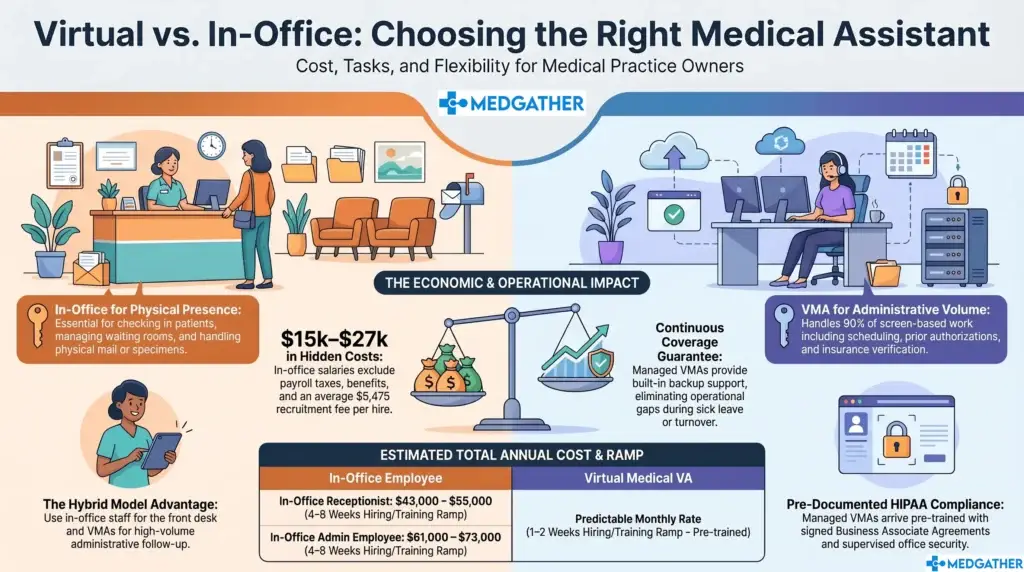
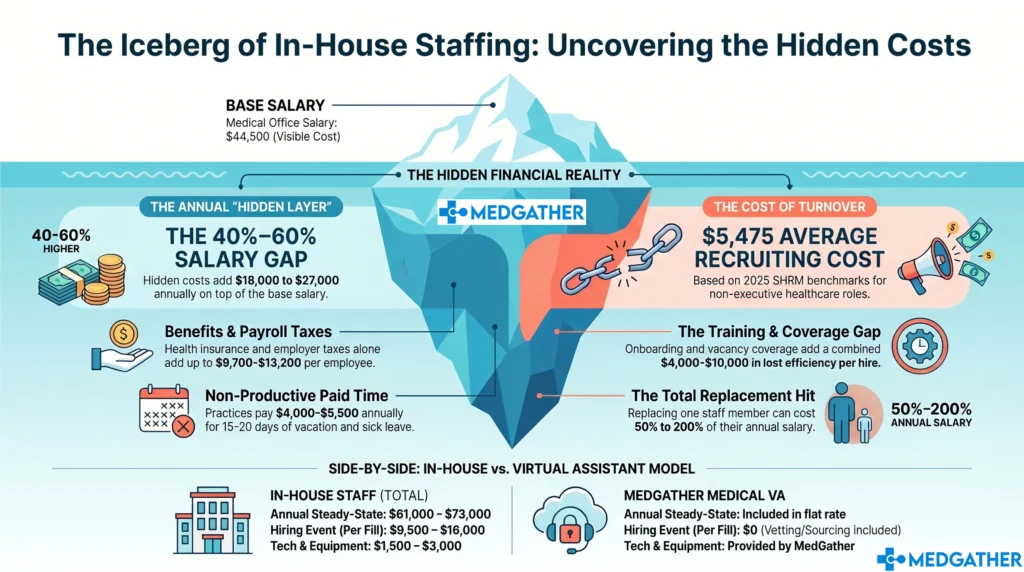
In-house hiring is becoming harder to sustain. Medical administrative roles in the U.S. see turnover rates that regularly exceed 30 percent annually. Every departure triggers recruitment, onboarding, and retraining costs that compound over time. Comparing the true cost of in-house staff versus a virtual assistant tells a very different story from the sticker salary alone.
Compliance requirements are intensifying. HIPAA expectations around remote work, data handling, and cybersecurity have grown more complex as home-based work expanded. Practices that onboard untrained or unvetted freelancers on personal devices create compliance exposure that may not surface until it is far too late. The financial consequences of a healthcare data breach now average $10.93 million per incident — the highest of any industry.
What Are the Core Responsibilities of a Medical Virtual Assistant?
The specific tasks an MVA handles depend on the practice type, specialty, and scope of the engagement. In most U.S. practices, the role spans the following functional areas.
The Core Responsibilities of a Medical Virtual Assistant
Appointment scheduling is high-volume, time-sensitive, and consequential when it goes wrong. New patient bookings, cancellations, rescheduling requests, waitlist management, and provider calendar coordination all require consistent attention. An MVA dedicated to scheduling keeps the calendar full and functional without pulling front-desk staff in multiple directions.
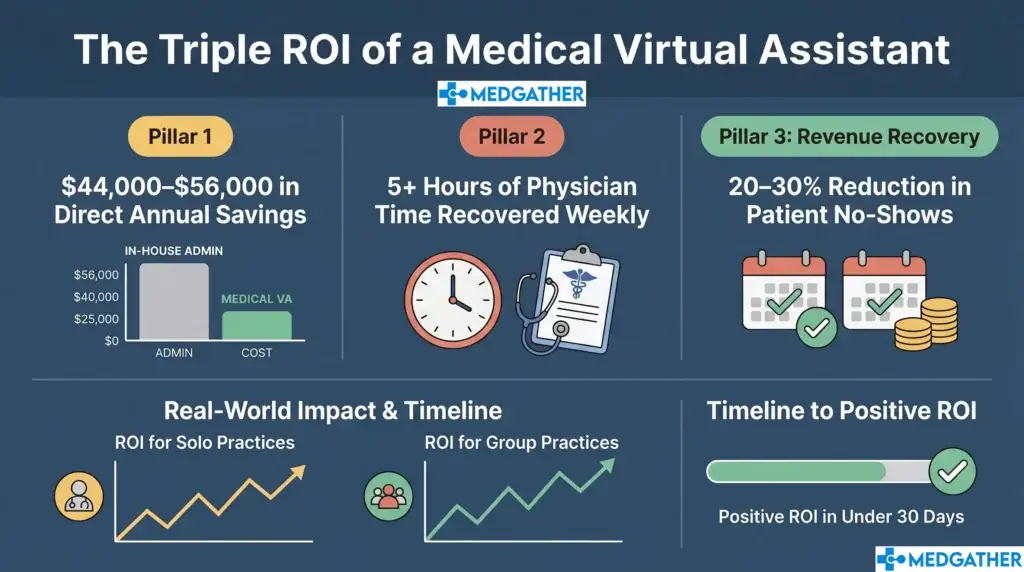
Beyond individual appointments, MVAs manage reminder outreach — one of the single most effective interventions for reducing no-show rates. Consistent, systematic reminders are the difference between a reliable schedule and one that loses revenue through empty slots.
Insurance Verification and Prior Authorization
Insurance eligibility verification before every visit prevents billing complications that only surface at the point of service. An MVA handles this as a pre-visit workflow so it happens reliably, every time.
Prior authorization management is the more demanding function. Submitting requests, tracking outstanding auths, following up when payers go quiet, and escalating when approvals stall — all of it requires dedicated attention. Specialty practices in orthopedics, cardiology, oncology, and similar fields lose significant clinical time when these processes are not owned by someone whose primary responsibility is to manage them.
Patient Communication and Follow-Up
Consistent patient communication — post-visit follow-up, prescription refill routing, general inquiry responses, portal message management — is one of the areas where practices most commonly fall behind when administrative capacity is stretched. An MVA handles this communication layer with the consistency that clinical staff rarely have time to maintain.
EHR Documentation Support
Physicians and advanced practice providers spend a disproportionate share of working hours on documentation. Virtual medical scribes — a specialized function within the broader MVA model — work alongside providers during or after patient encounters, entering clinical information into the EHR in real time. This is one of the highest-value applications of the medical virtual assistant role because it directly reduces the documentation burden that drives burnout in U.S. healthcare.
Medical Billing Coordination
MVAs in a billing support role help maintain a clean revenue cycle. They keep billing records organized, track claim status, identify unpaid claims before they age out, coordinate denial response documentation, and serve as the connective tissue between clinical documentation and billing team execution. The result is fewer missed claims and more predictable cash flow.
After-Hours Administrative Coverage
Patient inquiries, prescription requests, and appointment changes do not stop when the office closes. After-hours virtual assistant coverage extends administrative continuity beyond office hours — triaging urgent messages, capturing appointment requests, and ensuring nothing falls through the cracks overnight.
How the Role of a Medical Virtual Assistant Differs From a General VA
This distinction matters for any practice evaluating options. A general virtual assistant is trained for business operations — scheduling, email management, data entry, project coordination. Those skills transfer across industries. Medicine is not one of those industries.
A medical virtual assistant is trained specifically for healthcare. That training includes:
- HIPAA regulations and the obligations they create around protected health information (PHI)
- Medical terminology and how it appears in clinical documentation, orders, and patient communication
- EHR systems — navigation, accurate data entry, and documentation standards
- Insurance workflows — payer portals, prior authorization requirements, eligibility verification processes
- Patient communication standards appropriate for clinical environments and regulatory requirements
Placing a general VA in a medical administrative role without this training creates real operational and compliance risk. An error in scheduling or insurance verification has patient care consequences. An HIPAA misstep has regulatory ones. That is why choosing the right medical VA provider means looking beyond hourly rate.
What Security Requirement Must Every Practice Understand?
Any MVA who handles protected health information is a business associate under HIPAA. A Business Associate Agreement (BAA) must be in place — and the environment the assistant works in must meet HIPAA security standards. This is where the operating model matters as much as individual qualifications.
An MVA working from a personal laptop on a home Wi-Fi connection, without managed endpoints or secured access controls, is a data security liability — regardless of how capable they are individually. The practices with the strongest compliance posture work with MVAs who operate from managed, structured environments: company-issued devices, enterprise-secured networks, real-time supervision, and documented access controls.
The 2024 Change Healthcare breach — which exposed data for an estimated 190 million individuals — was traced in part to missing multi-factor authentication on a remote access point. Home-based, unsupervised remote access to PHI is one of the most common sources of healthcare data exposure. The arrangement you choose determines where that risk lands. |
How the Medical Virtual Assistant Role Is Evolving
Remote Patient Monitoring and Chronic Care Management. RPM and CCM programs create billable, reimbursable touchpoints between visits — but require consistent patient follow-up and data tracking. Virtual care coordinators within the MVA model are increasingly filling this function, enabling practices to capture CCM and RPM revenue without adding clinical headcount. This is one of the key ways MVAs help practices scale without proportionally increasing overhead.
Specialty-specific MVA teams. Rather than generalists, specialty practices in orthopedics, mental health, ophthalmology, and dermatology are building virtual assistant arrangements tailored to their specific workflows. Comparing MVA providers across different models shows how significantly the right fit varies by practice type and specialty.
AI-assisted documentation. AI scribing tools are evolving quickly, but introduce a judgment and accuracy requirement that trained human oversight still provides more reliably in complex clinical environments. The most effective arrangements pair AI tools with experienced MVAs — not as a replacement, but as a productivity layer on top of human expertise.
Is a Medical Virtual Assistant Right for Your Practice?
Most U.S. practices benefit from at least one of the core functions an MVA provides. The more useful question is which function creates the most immediate value. If physicians are losing clinical hours to documentation, a virtual scribe recovers that time directly. If scheduling inconsistency is driving no-shows, a dedicated MVA stabilizes it. If prior authorization delays are bottlenecking care, a specialist removes the bottleneck. How to hire a medical virtual assistant covers what to evaluate before making that decision.
The right MVA arrangement is not the cheapest option. It is the one that is properly trained for healthcare, operating in a secure and supervised environment, and structured to integrate with how your practice actually works.
Conclusion
The role of a medical virtual assistant in U.S. healthcare has shifted from an experiment into a mainstream operational model. Practices implementing it with properly trained staff, structured supervision, and HIPAA-compliant infrastructure see real, measurable improvements — in scheduling efficiency, clinical capacity, staff retention, and administrative cost.
The variation in outcomes comes almost entirely from implementation quality: the training level of the assistant, the security of the environment they work in, and whether the practice has built a clear management structure around remote support.
Ready to see how MedGather fits your practice?
Book a free strategy call — no obligation. A real conversation about what your practice needs.
Frequently Asked Questions
What is the role of a medical virtual assistant in a healthcare practice?
A medical virtual assistant handles the administrative and operational tasks that keep a medical practice running — scheduling, insurance verification, prior authorization, patient communication, EHR documentation support, and billing coordination. Unlike a general virtual assistant, an MVA is trained specifically for healthcare workflows, medical terminology, and HIPAA compliance requirements.
How is a medical virtual assistant different from a regular virtual assistant?
A general virtual assistant is trained for business administration tasks applicable across industries. A medical virtual assistant is specifically trained for healthcare: medical terminology, EHR navigation, insurance and payer processes, prior authorization workflows, and the HIPAA obligations that govern all handling of protected health information. Placing a general VA into a medical role without this training creates both operational and compliance risk.