Medical Virtual Assistant vs In-House Staff: Full Comparison
When comparing a medical virtual assistant vs in-house staff, many US practice owners are weighing the decision more carefully than before. Both options can work, but they differ in cost, flexibility, and how they support a practice’s growth.
Before getting into specifics, it is worth acknowledging that this is not really a competition. Some practices will always need in-house staff for certain roles, particularly those requiring physical presence in the clinic. But for the large portion of administrative work that does not require physical presence, the comparison is worth making honestly, because the assumptions most practice owners carry into it are often based on habit rather than current reality.
For a broader overview of how this model works, refer to this medical virtual assistant guide.
Hiring an in-house medical administrative employee comes with salary, benefits, payroll taxes, recruitment, and ongoing management costs that can push the true annual expense far beyond the base salary. A Medical Virtual Assistant offers a more scalable alternative, arriving trained in healthcare workflows and HIPAA compliance without the overhead of traditional hiring. While in-house staff are still essential for hands-on clinical and front desk responsibilities, office-based Medical Virtual Assistants like MedGather’s can securely manage most administrative work at a lower total cost and with greater operational flexibility.

Board-certified gastroenterologist and Founder of MedGather. Read full bio →
Cost Comparison: Medical Virtual Assistant vs In-House Staff
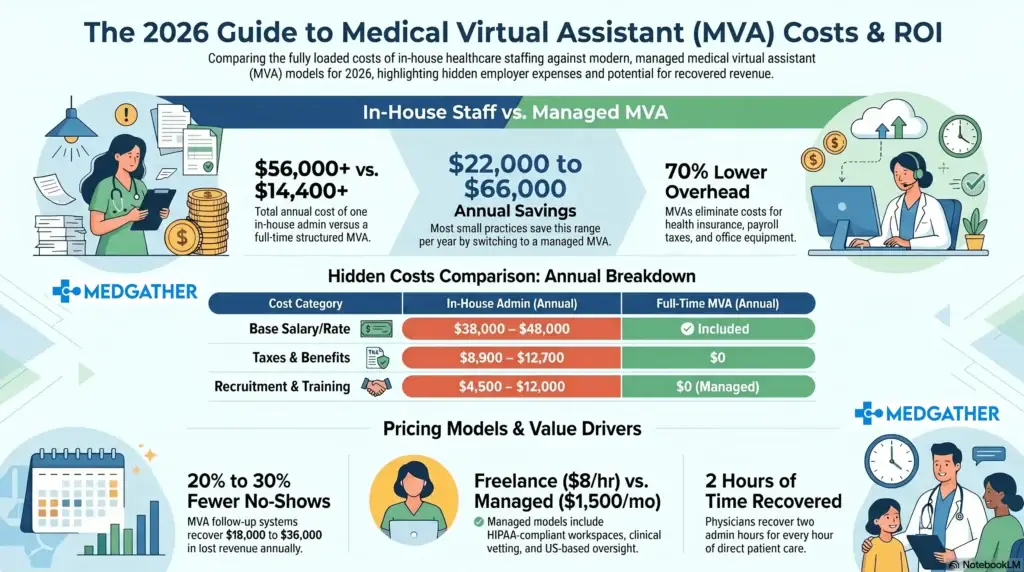
The most common starting point for this comparison is salary. A full-time in-house medical administrative assistant in the United States earns an average of around 38,000 to 45,000 dollars per year depending on location and experience, according to the Bureau of Labor Statistics. But salary is only part of the cost.
Source: US Bureau of Labor Statistics. “Occupational Outlook Handbook: Medical Secretaries and Administrative Assistants.” BLS, updated 2023.
When you add payroll taxes, health insurance contributions, paid time off, sick leave, and any retirement benefits, the real cost of an in-house hire typically runs 25 to 40 percent higher than the base salary. That puts the effective annual cost of a single full-time in-house administrative staff member at somewhere between 47,000 and 63,000 dollars before factoring in recruitment costs, onboarding time, or the productivity loss that comes with turnover.
The difference between a medical virtual assistant vs in-house staff becomes more apparent when you factor in long-term operational costs.
A medical virtual assistant arrangement through a service like MedGather operates at a significantly lower cost point, without the overhead of payroll taxes, benefits administration, or the recruitment cycle. For practices that are managing cash flow carefully, this difference is not marginal. It is often the difference between building administrative support now and waiting until the budget allows for it.
Availability and Coverage
An in-house staff member works set hours, takes sick days, goes on vacation, and has a finite capacity that does not flex easily when the practice gets busy. A medical virtual assistant arrangement can be structured to provide coverage that aligns with the practice’s specific operational needs, including extended hours that in-house staff cannot practically cover.
For practices that field patient communications or administrative requests outside of standard office hours, this flexibility has real value. The practice does not have to choose between paying overtime and leaving tasks unaddressed. The support structure is already in place.
Training and Ramp-Up Time
One of the most underestimated costs of in-house hiring is the time it takes for a new team member to reach full productivity. In a medical practice environment, that ramp-up period can stretch from six weeks to several months depending on the complexity of the role and the systems the practice uses.
A medical virtual assistant who comes through a service like MedGather arrives with healthcare-specific training already in place. Medical terminology, HIPAA compliance, clinical workflow familiarity, and administrative process knowledge are all part of the preparation before deployment. The practice still needs to communicate its specific preferences and systems, but the foundational knowledge is already there, which compresses the onboarding timeline significantly.
The real cost of a hire is never just the salary. It is the months of partial productivity, the management overhead, and the reset that happens every time the role turns over.
Oversight and Accountability
This is the area where in-house staff has a traditional advantage: physical presence means direct oversight. You can see who is at their desk, who is on a call, and who is handling what task in real time.
A well-structured medical VA service addresses this through systems rather than physical proximity. Task tracking, regular reporting, structured check-ins, and defined communication protocols give the practice visibility into what is being handled without requiring the VA to be physically present.
MedGather’s team also operates from supervised office facilities rather than home environments, which provides an additional layer of operational accountability that a standard remote work arrangement does not.
Data Security and HIPAA Compliance
For in-house staff, data security depends on the practice’s own systems and the training it provides. For a medical virtual assistant service, it depends on the infrastructure and protocols the service has built into its operation.
MedGather operates from secure office facilities with HIPAA-compliant systems, encrypted connections, a strict zero-device policy on the operations floor, and logged activity for every session. These controls are built into the environment rather than left to individual discretion, which makes compliance more consistent and auditable than it often is in a standard in-house setting.
Scalability
In-house staffing scales slowly. Adding administrative capacity means recruiting, hiring, onboarding, and managing additional team members, each one a months-long process with its own cost and risk. For a practice that is growing quickly or experiencing seasonal fluctuations in demand, that timeline does not match the pace of the need.
A medical VA service scales differently. Adjusting the scope of support, adding capacity, or modifying the tasks being handled can happen through the existing service relationship rather than through a new hiring cycle. For practices that are building toward growth rather than reacting to it, that flexibility is a meaningful operational advantage.
In the context of growth, the medical virtual assistant vs in-house staff decision often comes down to how quickly support can scale.
When In-House Still Makes Sense
To be fair and complete, in-house staff remains the right choice for roles that genuinely require physical presence. Front desk reception for walk-in patients, on-site task coordination, and roles that involve handling physical materials or operating in-clinic equipment are not candidates for virtual support. For those roles, in-house hiring is not just preferable but necessary.
The comparison becomes most relevant for the administrative tasks that do not require physical presence, and in most US medical practices, a substantial portion of the daily administrative workload falls into that category.
Conclusion
Neither option is universally better. The right answer depends on the specific tasks the practice needs covered, the stage of growth the practice is in, and the resources available to invest in administrative infrastructure. But for practices that are currently managing high administrative volume with limited staff, the economics and flexibility of a medical virtual assistant arrangement make it worth a serious look.
The comparison is not really between a person in the room and a person on a screen. It is between a support structure that costs more and scales slowly and one that costs less, ramps up faster, and grows with the practice.
For many practices, the medical virtual assistant vs in-house staff comparison highlights the tradeoff between flexibility and traditional structure.
If you are considering the next step, you can explore how to hire a medical virtual assistant in a structured and compliant way.
Frequently Asked Questions
How much does an in-house medical assistant really cost compared to a virtual assistant?
The average base salary for an in-house medical administrative assistant is $38,000 to $45,000, but adding taxes, sick leave, and benefits increases the true cost to between $47,000 and $63,000. MVAs offer a much lower overall cost point because they completely eliminate the overhead of benefits, payroll taxes, and recruitment expenses.
Do medical virtual assistants take longer to train than in-house staff?
No. In-house hires typically take anywhere from six weeks to several months to reach full productivity. MVAs from structured services like MedGather arrive already pre-trained in medical terminology, clinical workflows, and HIPAA compliance, which compresses the onboarding timeline significantly.
Are virtual medical assistants as secure as in-house staff?
Yes, when utilized through a professional service. While in-house staff rely on the clinic’s local training and systems, MedGather MVAs work from secure, supervised office facilities. These environments feature encrypted connections, logged session activity, and a strict zero-device policy on the operations floor, making HIPAA compliance consistent and auditable.
How does scalability differ between in-house staff and MVAs?
Expanding in-house staff is a slow, months-long process that involves recruiting, interviewing, and onboarding. Conversely, MVA capacity can be rapidly adjusted through the existing service relationship, making it much easier for a practice to scale up for growth or manage seasonal fluctuations in patient demand.
When must a practice choose in-house staff over a virtual assistant?
In-house staff is strictly necessary for any role that genuinely requires a physical presence. This includes front-desk reception for walk-in patients, handling physical materials or paperwork, and operating on-site clinical equipment.