Medical Virtual Assistant Small Practice: Why Independent Clinics Are Making the Switch
Running a small practice has always meant wearing more hats than you planned for. The physician is also the decision maker. The front desk handles everything from scheduling to insurance follow-up. And when someone calls in sick or puts in their notice, the whole operation feels it immediately.
Larger practices absorb that kind of disruption with backup staff and administrative teams. Small practices absorb it with overtime and goodwill, and both run out faster than anyone expects.
That is the gap a medical virtual assistant for small practices fills, and more independent clinics are figuring that out. Not because it is a trend, but because the numbers make a case that is hard to argue with once you actually run them.
TL;DR: Why Are Small Practices Switching to Medical Virtual Assistants?
Small medical practices are increasingly adopting medical virtual assistants (MVAs) to reduce administrative workload without the expense of hiring additional in-house staff. MVAs handle scheduling, insurance verification, prior authorizations, patient communication, documentation support, and other routine administrative tasks, allowing physicians and office staff to focus on patient care while improving day-to-day efficiency.
Compared with recruiting, training, and retaining in-house employees, a managed MVA provides predictable staffing, faster implementation, and continuous administrative support. This helps small practices reduce overtime, minimize workflow disruptions, and maintain consistent operations even during staffing changes.
Providers such as MedGather strengthen this model by supplying healthcare-trained, office-based medical virtual assistants who work from secure, managed facilities using company-issued devices and established HIPAA-compliant processes, giving practices greater accountability and data security.

Board-certified gastroenterologist and Founder of MedGather. Read full bio →
In This Guide
- The cost gap between practices that have support and those that do not
- Why small practices are more exposed than they realize
- What changes when a small practice gets the right support
- What a medical virtual assistant handles in a small practice
The Cost Gap Between Small Practices With Support and Those Without
According to the Medical Group Management Association’s 2023 Performance and Practices Report, practices with dedicated administrative support consistently reported lower overhead ratios and higher revenue per physician compared to practices where clinical staff were managing administrative tasks alongside patient care. That gap is not abstract. It shows up in the numbers every reporting cycle.
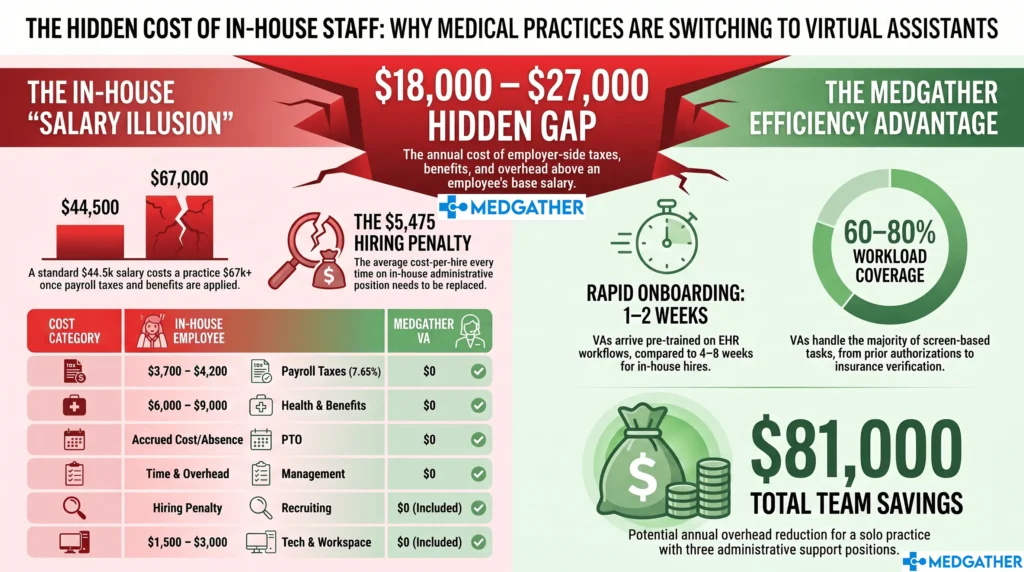
A full-time in-house administrative hire runs between $35,000 and $50,000 annually in salary alone, before benefits, payroll taxes, and the cost of the desk they sit at. A side-by-side breakdown of what that total actually looks like when you add it all up is the kind of calculation most small practices have never done because nobody has time to do it. When they do, the medical virtual assistant small practice model tends to look considerably more attractive than the sticker price suggests.
A trained medical virtual assistant through a structured service model costs a fraction of that, without the turnover risk, without the onboarding burden, and without the gap in coverage every time life gets in the way.
Small Practice: With vs. Without a Medical Virtual Assistant
Metric | Without a Medical VA | With a Medical VA |
Prior auth turnaround | 3 to 5 business days | 1 to 2 business days |
Front desk overtime (monthly) | 15 to 20 hours | 2 to 5 hours |
Missed patient calls (daily) | 8 to 12 calls | 1 to 3 calls |
Staff turnover rate (annual) | 20 to 30% | 10 to 15% |
Admin support cost (annual) | $35,000 to $50,000 per hire | Fraction of in-house cost |
After-hours patient coverage | None | Active coverage outside clinic hours |
HIPAA compliance oversight | Dependent on in-house training | Mandatory pre-assignment compliance training |
EHR documentation backlog | Frequent | Minimal |
For small practices, that difference compounds. Every dollar spent on unnecessary administrative overhead is a dollar not going toward equipment, staffing, or the patient experience that keeps people coming back.
Why Medical Virtual Assistant Small Practice Adoption Is Driven by Risk, Not Just Cost
Small practices are more exposed than most owners realize, and it goes beyond the staffing math.
The Department of Health and Human Services Office for Civil Rights reported in its 2023 annual breach report that smaller covered entities continue to account for a disproportionate share of HIPAA breach incidents. Unsecured access points and inadequate workforce training are among the leading causes.
Larger health systems have dedicated IT infrastructure and compliance teams. Small practices often do not, which makes them a more accessible target. The data breach risk is not theoretical. It shows up in the annual reports every year, and the practices bearing the most exposure are consistently the smaller ones.
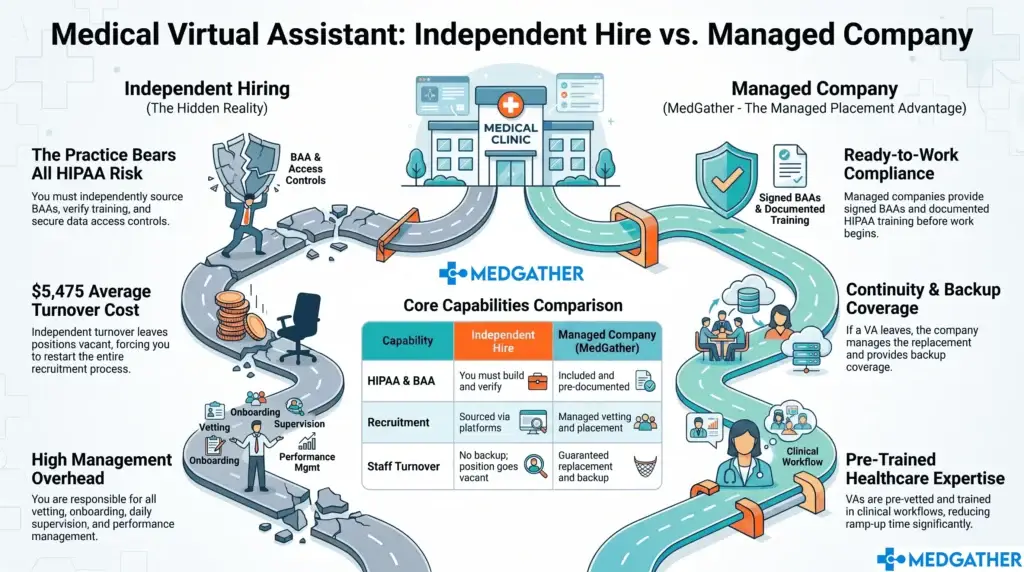
MedGather’s assistants operate from HIPAA-compliant, supervised workspaces with backup systems in place. Mandatory compliance training is completed before any assignment begins. A background check is required before any assistant is endorsed to a client. What that security structure means in practice versus what freelance or unmanaged arrangements typically leave open is worth understanding before assuming the current setup is sufficient.
What Changes When a Small Practice Gets the Right Support
Small practice owners and solo practitioners tend to be more hands-on than their counterparts at larger groups. They know their patients by name. They are involved in clinical decisions at every level. And they often have a direct personal relationship with their administrative staff, which makes every departure feel like a loss rather than just a vacancy.
That context is exactly why the quality of whoever is supporting the practice matters more in a small setting, not less. A generalist VA who does not understand the environment creates problems that land on whoever is already stretched. A properly trained MVA who comes from a clinical background and knows how to navigate an EHR is a different resource entirely.
MedGather’s assistants arrive proficient across Epic, Athenahealth, eClinicalWorks, and Modmed. The retraining cycle that quietly drains small practice resources and contributes to staff burnout is something most small practice owners know well from the inside. What that cycle actually costs when you map it honestly is a useful exercise before deciding the current setup is sustainable.
What a Medical Virtual Assistant Handles in a Small Practice
The administrative tasks that eat most of a small practice’s time are predictable. They are the same ones that show up across solo providers and small groups, and they are the ones that tend to fall through the cracks first when the team is already stretched.
Scheduling and Patient Communication
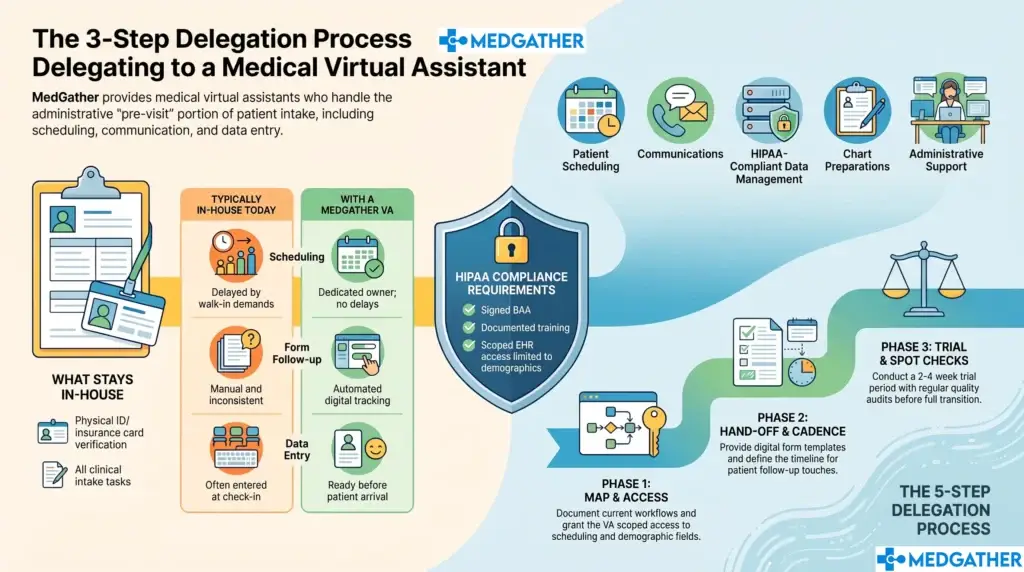
Calendar management, appointment reminders, and patient follow-up handled consistently, so the front desk is not bouncing between the phone and the waiting room at the same time. The full range of scheduling and communication tasks a properly scoped MVA can own goes deeper than most practices expect when they first start mapping it out.
Scheduling and Patient Communication
Calendar management, appointment reminders, and patient follow-up handled consistently, so the front desk is not bouncing between the phone and the waiting room at the same time. The full range of scheduling and communication tasks a properly scoped MVA can own goes deeper than most practices expect when they first start mapping it out.
Insurance Verification and Prior Authorization Follow-Up
Pre-visit insurance verification and prior authorization follow-up move forward without clinical staff having to chase them. The queue keeps moving even when the office is busy and the front desk is pulled in three directions at once.
After-Hours Coverage
Patient inquiries and scheduling requests do not stop when the practice closes. For a small practice with no backup staff, everything that comes in after hours stacks up and lands on whoever arrives first the next morning. MedGather’s after-hours support service keeps communication running overnight so the team starts each day with a cleared queue rather than a backlog that takes the first hour to dig through.
EHR Documentation Support
End-of-day documentation backlogs are one of the quietest time drains in a small practice. When the provider is also managing high patient volume with minimal support, notes get delayed, details get rushed, and someone ends the day two hours later than they planned. What a clinically trained MVA brings to documentation support starts with understanding what they are documenting, not just knowing which fields to fill in.
Your practice deserves the same support larger clinics have. MedGather gives small practices access to trained, supervised administrative support without the overhead of a full-time hire.
Is your clinic running on empty?
MedGather's medical virtual assistants come from nursing and clinical backgrounds, are trained before they arrive, and are ready to absorb the administrative layer without disrupting how your team operates.
Frequently Asked Questions
Is a virtual assistant service worth it for a practice with only one or two providers?
That is actually where structured support tends to have the most immediate impact. With a lean team, every administrative task that lands on the wrong person has a direct effect on patient care and clinic output. Removing that layer from a small practice produces measurable results faster than it does in a larger one, because there is less slack to absorb the workload before something visible breaks.
How quickly can a virtual assistant adapt to how our practice operates?
MedGather’s assistants complete onboarding and workflow training before being assigned to any clinic. Combined with their clinical background and EHR proficiency across Epic, Athenahealth, eClinicalWorks, and Modmed, the adjustment period is typically minimal. Most small practices report feeling the operational difference within the first two to three weeks.
What if we have had a bad experience with a freelance virtual assistant before?
Freelance arrangements and a supervised service model are structurally different in ways that matter in healthcare specifically. There is no oversight behind a freelancer. With MedGather, the assistant assigned to your practice is part of a supervised team with compliance protocols built into how they work every day. How the two models compare across the dimensions that matter most for healthcare practices is worth reviewing if a previous arrangement did not hold up.
Do we need to provide training or equipment?
No. MedGather’s assistants arrive already trained and operate from their own HIPAA-compliant workspaces. Your practice does not need to build a training program or provide hardware. Client-specific workflow briefing happens during onboarding, but the foundational training and equipment are already in place before that process begins.
Is patient data safe with a remote assistant?
Every MedGather assistant operates under mandatory HIPAA compliance training, from a verified workspace, with a background check on file before any client endorsement. The compliance structure is built into the model from the start. How MedGather’s office-based model maintains that security standard day to day covers the specifics for practices that want to understand it before committing.