Medical Virtual Assistant Skills: 8 Essential Qualities Every U.S. Practice Should Require
The medical virtual assistant skills that matter in a U.S. healthcare practice are not the same skills that make a generalist VA effective. That gap is the uncomfortable reality many practices discover only after they have already onboarded someone. A VA who handles general business admin with confidence can be completely out of their depth inside a healthcare workflow. The tasks look similar on the surface. The consequences of errors are not.
The role of a medical virtual assistant has grown in scope and complexity as more practices integrate remote support into their core operations. That growth has also widened the skill gap in the market. Some MVAs are genuinely trained for healthcare. Others are generalists who have added a few healthcare-adjacent terms to their resume and figured the rest would sort itself out on the job.
This post lays out the medical virtual assistant skills that actually matter: what to require, what to test, and why cutting corners on any of them creates more risk than it saves in cost.
TL;DR: What Skills Does a Medical Virtual Assistant Need?
A medical virtual assistant (MVA) needs more than general administrative experience. Because they support patient scheduling, insurance verification, documentation, electronic health records (EHRs), and other critical healthcare workflows, they must understand medical terminology, HIPAA requirements, and the day-to-day operations of a medical practice. Many high-performing MVAs have a clinical background, allowing them to communicate more effectively with providers, patients, and insurance companies.
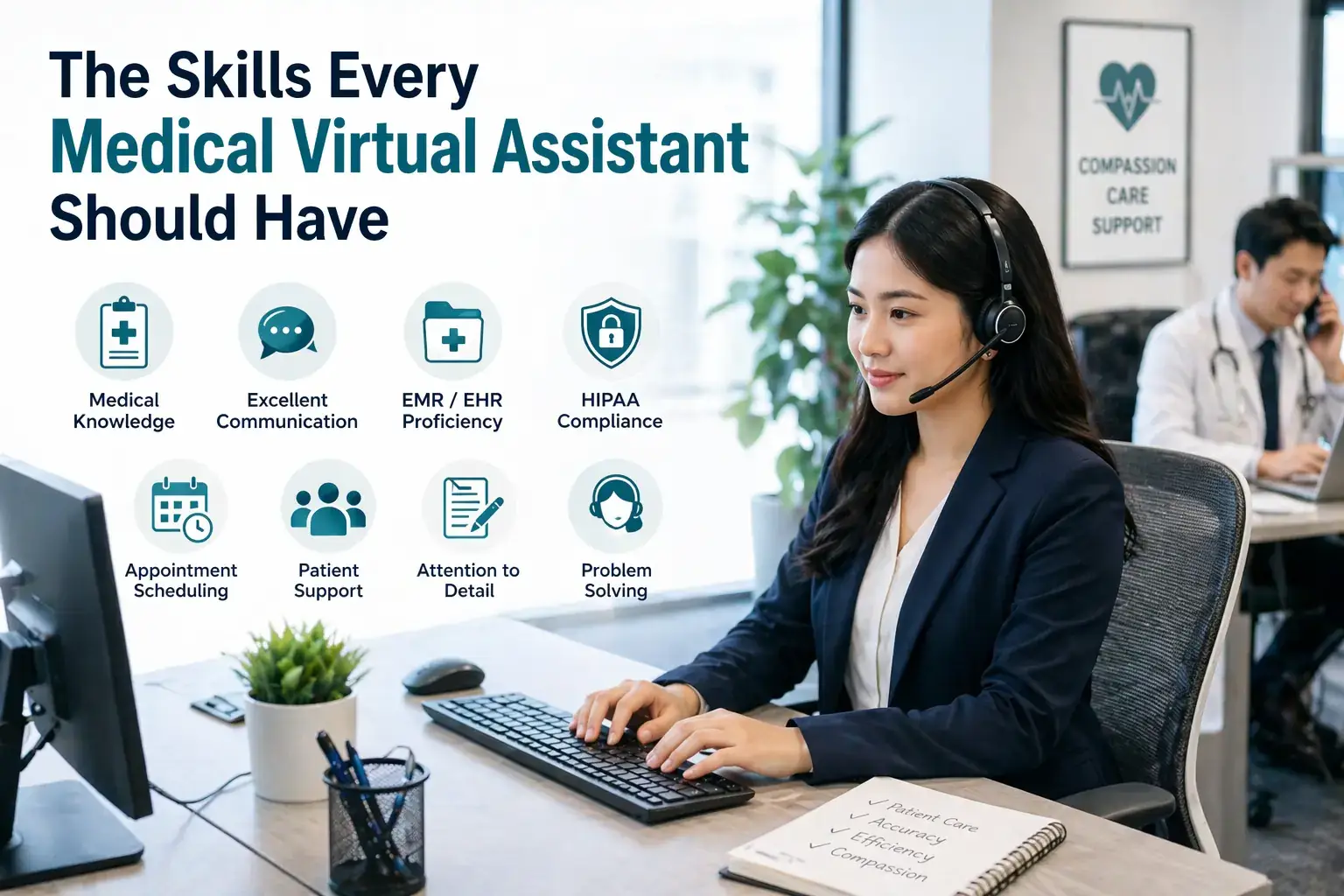
Essential skills include proficiency with EHR systems, medical documentation, insurance and revenue cycle processes, strong written and verbal communication, attention to detail, time management, and the ability to manage high volumes of administrative work accurately. These skills help reduce scheduling errors, billing delays, physician administrative burden, and patient wait times.
Practices benefit most when MVAs work through a managed provider that offers healthcare-specific training, secure office-based operations, company-issued devices, and ongoing supervision. This approach improves accountability, strengthens data security, and provides reliable administrative support that allows physicians and in-house staff to spend more time on patient care.

Board-certified gastroenterologist and Founder of MedGather. Read full bio →
In This Guide
- Why medical virtual assistant skill standards are not optional
- A clinical foundation: the starting point, not a nice-to-have
- Medical scribing and structured documentation
- EHR proficiency: familiar with the tools, tested on performance
- HIPAA compliance as a daily operating standard
- Communication skills built for U.S. healthcare
- Productivity, accuracy, and high-volume task handling
- The soft skills that determine day-to-day performance
Why Aren't Medical Virtual Assistant Skill Standards Optional?
Healthcare is not a forgiving industry for administrative errors. A missed prior authorization delays a patient’s procedure. An incorrectly entered medication creates a clinical risk. A HIPAA misstep triggers a federal investigation. The administrative layer that an MVA occupies sits directly adjacent to all of these outcomes.
This is what separates healthcare from most other industries where virtual assistants operate. In a marketing firm, a scheduling error is an inconvenience. In a medical practice, that same error affects patient access to care and practice revenue at the same time. The skill floor is simply higher here, and practices that treat it otherwise learn that lesson in the most expensive way possible.
The MGMA Staffing and Compensation Survey consistently shows that administrative errors in scheduling and authorization are among the top drivers of revenue cycle delays in U.S. practices. Search ‘MGMA administrative burden data’ and hyperlink to the current MGMA source when pasting into WordPress.
Why Is a Clinical Foundation the Starting Point, Not a Nice-to-Have?
The strongest medical virtual assistants come from clinical backgrounds. At MedGather, we actively recruit candidates who are nursing graduates or who have direct clinical exposure. This is not an arbitrary credential preference. It reflects what the work actually demands.
Medical terminology is not something that transfers from a general VA background. Words like “diaphoresis,” “erythematous,” or “bilateral lower extremity edema” appear in routine clinical documentation. An MVA who does not understand them cannot accurately support charting, triage patient messages by urgency, or organize records in a way that is genuinely useful to the treating provider.
Clinical exposure also gives MVAs a working understanding of how healthcare workflows are structured: the difference between an HPI and an assessment, why prior authorizations exist, how lab results connect to clinical decision-making. That understanding does not eliminate the need for healthcare-specific onboarding, but it cuts the ramp to competency significantly.
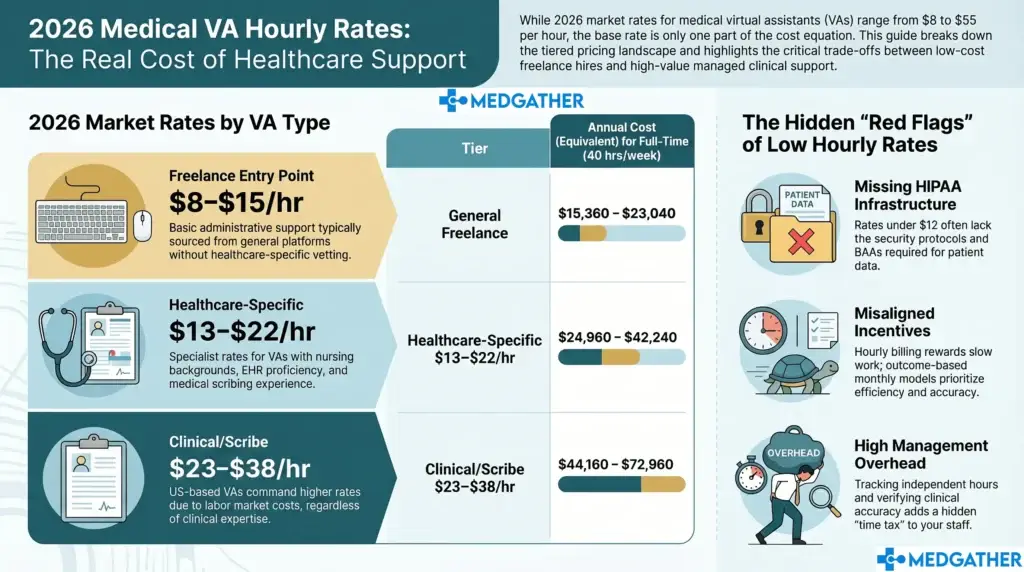
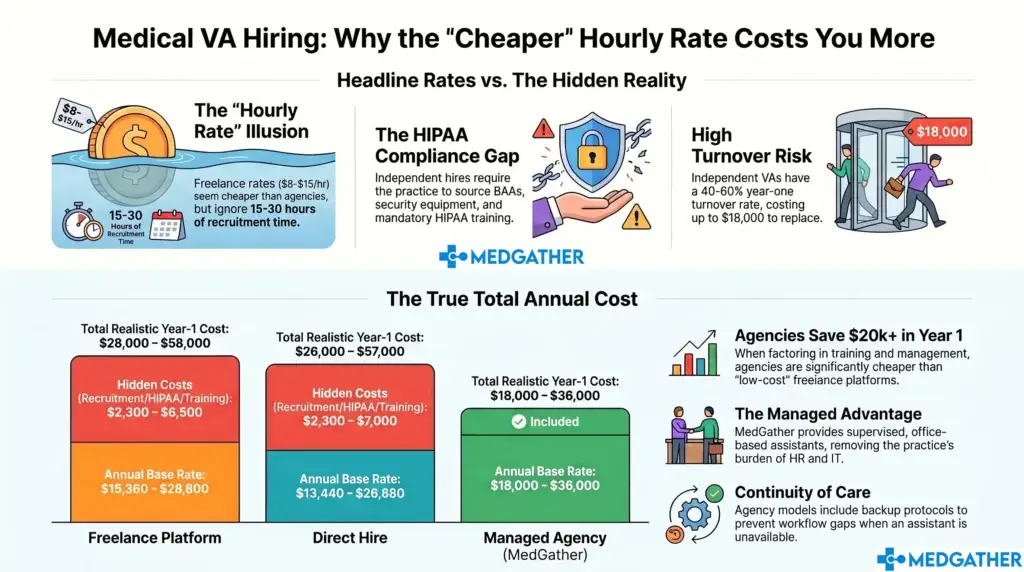
Practices that hire on administrative skill and hourly rate alone, without considering clinical background, tend to find themselves re-onboarding within months. The true cost of that cycle goes well beyond the replacement fee.
Medical Scribing and Structured Documentation
Documentation is one of the highest-value applications of the MVA model and one of the most skill-dependent. A virtual medical scribe who accurately captures an encounter in real time directly reduces the documentation burden that is driving provider burnout across U.S. healthcare.
The skill requirements here are specific. A qualified scribing MVA needs familiarity with SOAP note structure and the components of a clinical encounter: chief complaint, history of present illness, review of systems, physical examination findings, assessment, and plan. Practices with complex documentation patterns including neurology clinics, where charting is structured, detailed, and leaves little room for ambiguity, benefit most from MVAs who have worked with this kind of documentation before.
Accuracy in this function is non-negotiable. Errors in clinical documentation have direct implications for patient care, coding accuracy, and audit exposure. Summarizing when specifics are needed, omitting findings, or using imprecise language all create downstream problems that the provider has to fix at their own expense of time.
The full range of tasks a qualified MVA can handle in documentation and beyond goes considerably further than most practices initially realize. Scribing is one entry point, not the ceiling.
What Does EHR Proficiency Actually Require?
Electronic health record proficiency is a technical requirement that most job postings mention and very few actually verify. There is a meaningful difference between an MVA who has “used Epic” and one who can navigate it efficiently under production conditions: ordering workflows, documentation templates, message routing, chart organization, and real-time data entry without slowing the provider down.
The EHR systems most commonly used by U.S. practices include Epic, Athenahealth, eClinicalWorks, Modmed, Kareo, and a range of specialty-specific platforms. A qualified MVA will have working proficiency in at least two or three of these and be able to reach productive competency in an unfamiliar system within a structured onboarding window.
At MedGather, EHR proficiency is assessed through an internal check before any MVA is matched to a client. The structured environment MVAs operate in matters here: supervised, company-managed workspaces with proper system access produce better EHR performance than unsupervised home setups, regardless of an individual’s prior training.
HIMSS and ONC data consistently show EHR adoption across U.S. hospitals exceeding 96 percent. That near-universal adoption makes EHR proficiency a baseline expectation. The differentiator is how efficiently an MVA actually performs inside these systems under real working conditions.
Why Is HIPAA Compliance a Daily Operating Standard?
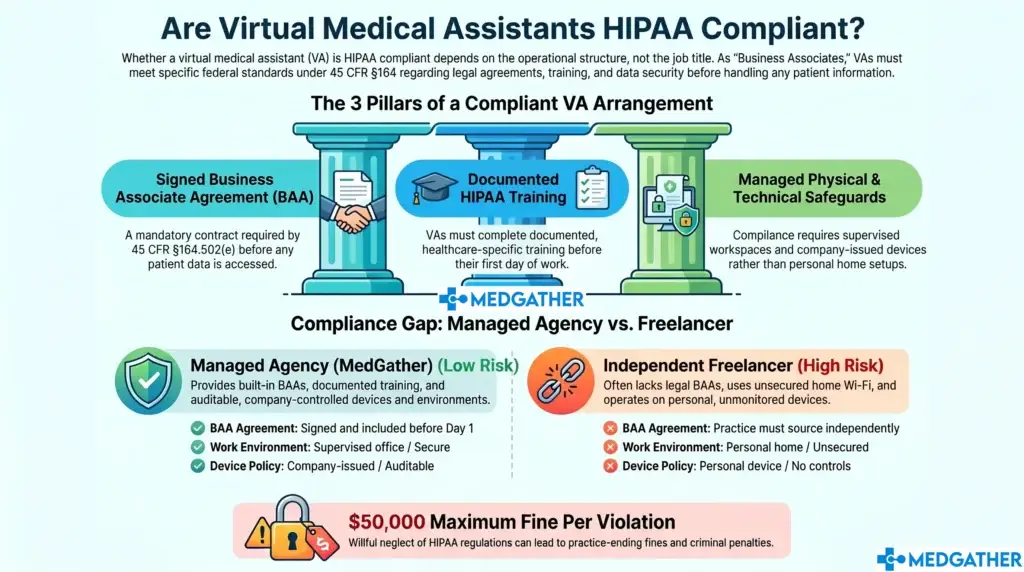
Every MVA who handles protected health information is a business associate under HIPAA. That creates specific legal obligations, starting with a signed Business Associate Agreement and extending to how the MVA handles, stores, transmits, and accesses PHI daily. The U.S. Department of Health and Human Services is explicit on this: it is the covered entity’s responsibility to ensure those obligations are met, not just assumed.
HIPAA compliance as a skill is not a checkbox that gets ticked at onboarding and forgotten. It is a working practice: knowing which patient information can be shared through which channels, understanding what constitutes a reportable breach, recognizing when a request for information falls outside permitted disclosure, and maintaining the workspace standards that protect PHI from unauthorized access.
MedGather requires all MVAs to complete formal HIPAA training before beginning any client engagement. That training is paired with a physical workspace standard: company-issued devices, secured network access, no personal equipment on client systems, and a supervised environment where access controls are enforced at the organizational level.
Practices that hire freelance MVAs working from personal laptops on home networks are carrying compliance exposure that most practices do not fully recognize until a breach has already occurred. At that point, the cost of the shortcut becomes very clear, very quickly.
What Communication Skills Does U.S. Healthcare Require?
An MVA communicates daily with U.S.-based physicians, clinical staff, patients, and insurance representatives. The standard required across all of these interactions is consistent: clear, professional, concise English with no ambiguity in written documentation and no friction in verbal exchange.
This goes beyond grammar and fluency. It is about understanding the communication culture of U.S. healthcare: the appropriate tone when supporting a physician mid-documentation, the patient-facing language that is reassuring without overstepping clinical scope, the professional directness that payer interactions require. An MVA who communicates well in general business contexts may still need significant adjustment to meet what a medical environment expects.
Communication also extends beyond regular office hours. Practices that rely on MVAs for after-hours administrative coverage need consistent, professional handling of patient messages and urgent routing outside of business hours. That consistency requires both the communication skill and the clinical judgment to apply it appropriately.
How Much Productivity, Accuracy, and Task Volume Should You Expect?
A medical practice generates significant administrative volume every day: appointment requests, prior authorization submissions, fax reviews, chart updates, lab result routing, referral coordination, and a steady stream of incoming patient messages. A qualified MVA needs to handle this volume without the error rate that creates downstream problems for the clinical and billing teams.
The productivity standard for a full-time MVA is materially different from what a part-time or shared resource can realistically sustain. Practices that underestimate the actual volume of work they are delegating often find that a single MVA becomes bottlenecked within weeks, either slowing down workflows or rushing through tasks at the expense of accuracy.
Attention to detail in clinical documentation is where many MVAs who look capable on paper reveal their actual performance level. A correctly structured SOAP note, an accurately transcribed medication list, a prior authorization submitted with the right diagnosis codes: these tasks require sustained accuracy across many repetitions per day. An MVA who cannot maintain that standard under volume is not suited for a clinical environment, regardless of their other capabilities.
The operational difference between a properly trained MVA and in-house administrative staff becomes measurable quickly when the right baseline is in place from day one.
What Soft Skills Actually Determine Day-to-Day Performance?
Technical skills get an MVA through the interview. Soft skills determine whether they are still performing well at the six-month mark. The difference matters more in healthcare than in most fields because the work is high-stakes, the pace is often fast, and the MVA is frequently operating with limited direct supervision.
The soft skills that separate a reliable MVA from one who requires constant management are relatively consistent across practice types:
- Proactive communication. Raising issues before they become problems. Flagging when a prior auth is stalling. Noting when a chart entry looks inconsistent. Not waiting to be asked.
- Organization across multiple providers or workflows. Many MVAs support more than one physician or manage several task categories simultaneously. The ability to prioritize without dropping items is what keeps complex practices running smoothly.
- Independent operation within clear parameters. A good MVA does not require micromanagement. They understand the scope of their role, execute within it reliably, and escalate when something falls outside that scope.
- Responsiveness during shift. Availability is a basic expectation. An MVA who is unreachable during working hours or slow to respond to urgent routing is creating workflow gaps that affect clinical operations directly.
- A stable, HIPAA-compliant tech setup. This means a reliable internet connection with a documented backup plan, a workspace that meets HIPAA physical safeguard requirements, and the technical literacy to troubleshoot basic connectivity issues without downtime.
Background checks are required before any MedGather MVA is endorsed to a client. Practices that skip this step when hiring independently take on risk that a structured vetting process is specifically built to screen out.
How to Actually Evaluate These Skills Before You Commit
Knowing what skills to require is only useful if you have a way to assess them before the onboarding begins. Most practices that end up with underperforming MVAs made the same mistake: they hired on credentials and references without testing real performance on healthcare-specific tasks.
A practical skills evaluation for an MVA candidate should include a documentation exercise using a sample clinical note, an EHR navigation test in the system your practice uses, a scenario-based HIPAA question to assess practical understanding rather than just awareness, and a writing sample that reflects the communication standard you need for patient-facing or provider-facing work.
A full framework for what to test, what questions to ask, and how to structure a trial period before full commitment is covered in the how to hire a medical virtual assistant guide. The straightforward version: if you would not trust the candidate with a live patient record after a 30-minute skills review, that is worth paying attention to.
The Skill Standard Is the Standard of Care
The medical virtual assistant market has expanded quickly enough that the quality range is now significant. At one end are properly trained, clinically grounded, HIPAA-compliant professionals who add real operational capacity to a practice. At the other are generalists with limited healthcare exposure who handle straightforward tasks acceptably but create friction, risk, or outright errors in anything more complex.
The difference comes down to the standards applied at hiring, the training provided before engagement begins, and the environment the MVA operates in. Practices that get all three right see consistent, measurable improvements in workflow capacity and administrative accuracy. Practices that compromise on any of the three tend to spend the following months troubleshooting the gap.
For a complete picture of how the MVA model works and what to look for when evaluating providers, the Ultimate Guide to Medical Virtual Assistants is the right place to start. If you already know what you need and want to see whether MedGather fits, the next step is a straightforward conversation.
Ready to see how MedGather fits your practice?
Book a free strategy call — no obligation. A real conversation about what your practice needs.
Frequently Asked Questions
What skills should a medical virtual assistant have?
A qualified medical virtual assistant should have a clinical background or solid medical knowledge, proficiency in at least one major EHR system, formal HIPAA training, structured documentation skills, and clear professional English communication. Soft skills including reliability, high-volume accuracy, and independent operation are equally important for day-to-day performance in a clinical environment. The full requirement goes well beyond what most general VA platforms screen for, which is why healthcare-specific vetting matters.
Does a medical virtual assistant need a clinical background?
A clinical background is not a universal requirement for every MVA role, but it significantly shortens the learning curve and reduces error risk in documentation and clinical workflow support. MVAs with nursing backgrounds or direct clinical exposure understand medical terminology, recognize the context of clinical information, and integrate into healthcare workflows faster than those coming from general administrative roles. For documentation-heavy functions like medical scribing, clinical background is effectively a prerequisite rather than a preference.