Hire VA Independently vs VA Company: Which Is Right for Your Practice?
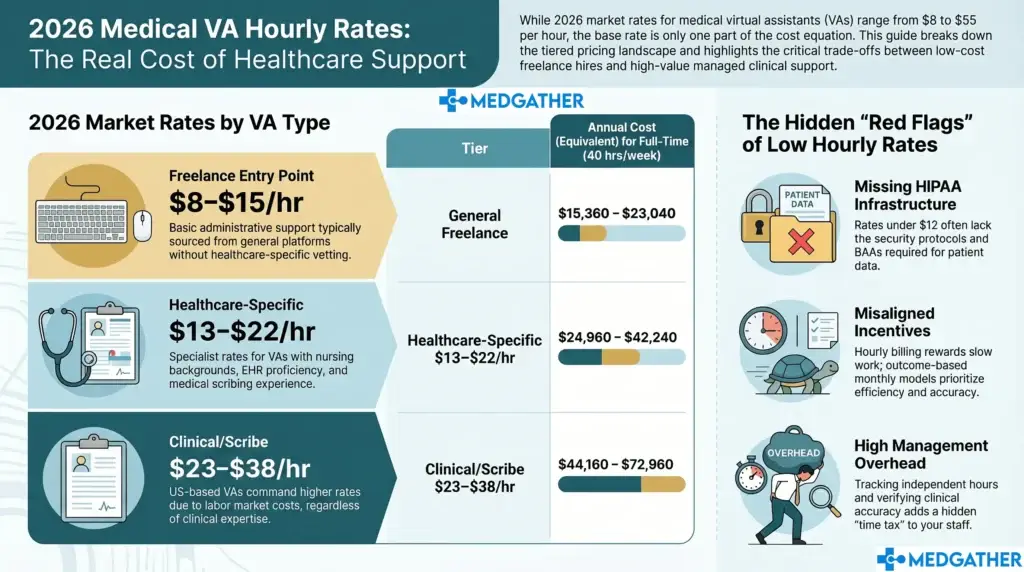
When practices ask whether to hire VA independently vs VA company, they usually frame it as a cost question. That framing misses the point. The cost difference between an independent hire and a managed company is real, and if you want those numbers, the full rate and annual cost comparison between all three hiring models has them. But the more important question is not which model costs less per hour. It is which model you can actually manage without creating new problems for your practice.
This guide gives a direct recommendation, explains the two narrow situations where independent genuinely makes sense, and provides a scenario-by-scenario decision table that makes the choice plain. No cost tables here; those belong in the cost guide. This post is about decision logic.
MedGather is a managed VA company that places office-based virtual medical assistants with US clinical practices. The decision framework in this guide naturally reflects that context, and MedGather is named directly throughout.
TL;DR, Hire VA Independently vs VA Company: Which Is Right for Your Practice?
For most US medical practices handling patient data: use a managed VA company. The compliance infrastructure, vetting, and backup coverage that come with a managed placement are not things most practices want to build themselves. The independent route saves the headline rate and adds cost, risk, and management overhead everywhere else.
The two situations where independent makes sense: (1) you need light general admin support with no PHI involved, (2) your practice already has a dedicated HR and compliance function that can absorb the vetting, training, and management load.
If neither of those describes you, the independent route is not saving you money. It is deferring costs to a less convenient time.

Board-certified gastroenterologist and Founder of MedGather. Read full bio →
In This Guide
- Hiring an Independent VA vs. a VA Company: What’s the Difference?
- Which model should most medical practices use?
- What three factors should drive the decision?
- When does hiring a VA independently actually make sense?
- What does each model provide side by side?
- What is the risk of getting this decision wrong?
- How does MedGather fit into this decision?
Hiring an Independent VA vs. a VA Company: What's the Difference?
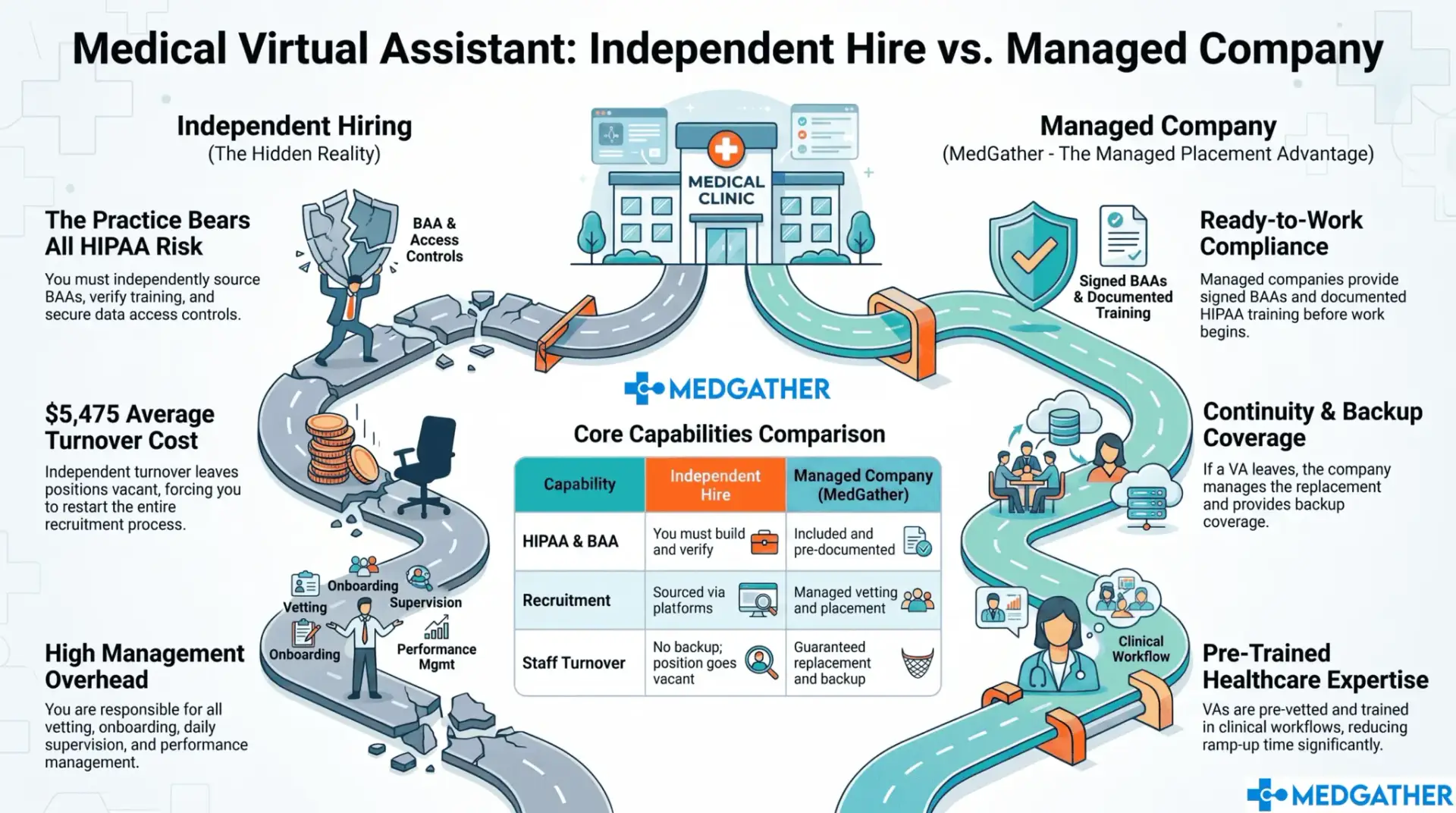
Independent hire means you source, screen, onboard, and manage the VA directly. Under the independent model, HIPAA compliance setup, the Business Associate Agreement, training documentation, background checks, and day-to-day supervision all fall on your practice. There is no intermediary between you and the VA.
A VA company is a managed placement model. The company vets candidates before presenting them, handles HIPAA compliance infrastructure, manages day-to-day supervision, and provides backup coverage if the VA leaves or is unavailable. You work with the VA on your tasks. The company handles everything around the VA.
Within the independent model, there are two subtypes: the freelance platform hire (e.g., Upwork, Fiverr, and Freelance.com) and the direct independent hire, each with different rate structures and risk profiles. How those two subtypes compare in detail on annual cost is covered in the cost-focused guide. The distinction matters less for the decision of question here than the core split between managed and unmanaged.
Which Model Should Most Medical Practices Use?
For a US medical practice that handles patient data, which is almost every practice, use a managed VA company. The reason doesn’t involve independent VAs being less capable. The reason is that the infrastructure you need to run an independent VA arrangement safely (a properly executed BAA, documented HIPAA training, secure access controls, a coverage plan for turnover) requires active management that most practices are not set up to absorb on top of everything else.
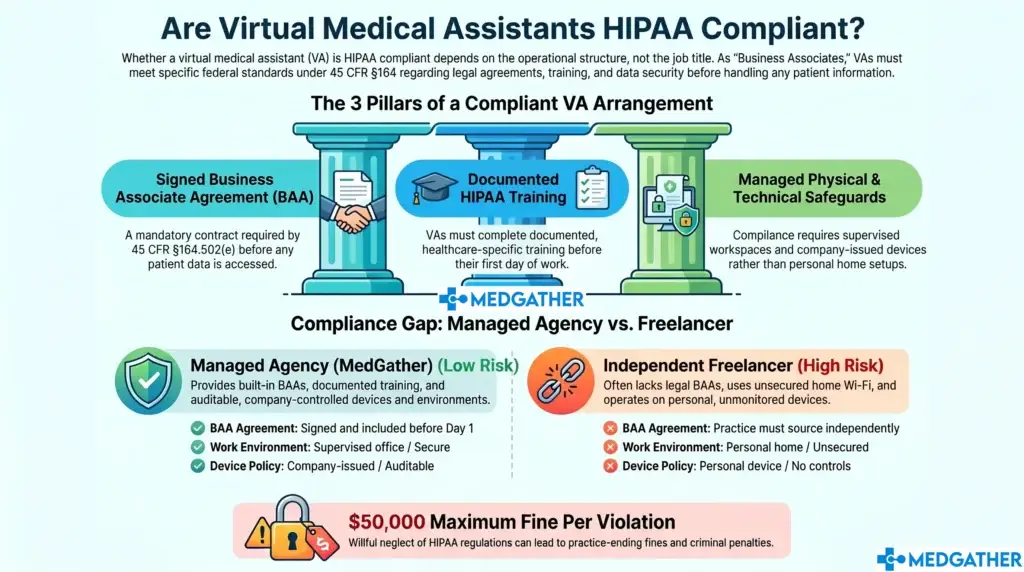
Every VA arrangement that involves protected health information needs three things in place before the VA touches any patient data: a signed Business Associate Agreement, documented HIPAA training, and a working environment that meets the Security Rule’s physical and technical safeguard requirements. Why these requirements apply to VAs exactly as they apply to in-house staff covers the regulatory detail. The practical point is this: in an independent arrangement, confirming all three are in place before work starts is your problem to solve, not the VA’s.
A managed company handles this as part of the placement. That structural difference is worth more than the hourly rate of savings on the independent side for most practices.
What Three Factors Should Drive the Decision?
Three factors determine whether the independent model is viable for your practice.
- Whether the work involves PHI. If the VA is handling scheduling, patient communications, prior authorizations, insurance verification, or any task that touches patient records, HIPAA applies. The compliance overhead of an independent arrangement in this context is significant. If the work involves no patient data at all, the compliance factor largely disappears.
- Your management capacity. An independent VA requires active management from your team: task assignment, performance oversight, compliance documentation, and handling issues if they arise. A managed company absorbs most of that overhead. If your practice is already running lean on administrative capacity, adding a management layer for the VA works against the reason you hired one.
- Your risk of tolerance for turnover. When an independent VA leaves, your practice is responsible for recruiting, onboarding, and training the replacement. With a managed provider, those responsibilities shift to the VA company, which coordinates the transition and replacement process. For practices where administrative continuity is critical, operational support may justify the additional cost.
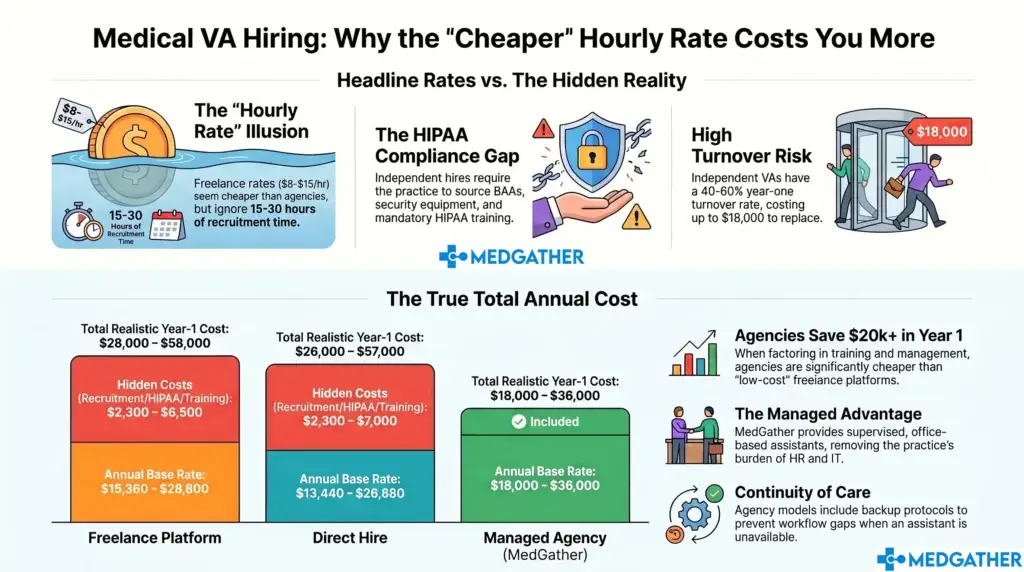
If all three factors point toward a managed model and you are weighing the cost, the full cost breakdown of what each model actually costs over a full year including turnover events puts real numbers on the comparison.
When Does Hiring a VA Independently Actually Make Sense?
Two situations, and they are narrower than most practices expect.
- Light general admin with no PHI involved. If you need 5 to 15 hours per week of help with tasks that sit entirely outside the clinical and patient-data workflow, such as calendar management, inbox organization, general correspondence, or document organization, the compliance overhead of a managed medical VA arrangement is built for a heavier use case than yours. A freelance platform hire for general admin tasks is a reasonable option here. These tasks map to MedGather’s general VA service offering, not the medical VA placement model, and the compliance requirements are different.
- You have an existing HR and compliance function. A larger practice or hospital system that already has its own HR team, documented compliance workflows, and internal infrastructure for onboarding and training remote staff can absorb the management overhead of an independent hire. For a solo or small clinical practice without that infrastructure, building it from scratch for one VA does not make financial sense.
Outside these two scenarios, the independent route is not saving you money in any meaningful sense. It is moving cost from a predictable line item to an unpredictable one.
What Does Each Model Provide Side by Side?
The table below maps both the situations you might be in and the capabilities each model provides. It does not include cost figures; those are in the cost comparison guide linked above, because the decision is not primarily a cost calculation.
Hire VA Independently vs VA Company: Decision and Capability Matrix
| Decision Factor | Independent Hire | VA Company (MedGather) |
| Is This Your Situation? | ||
| Your practice handles PHI (scheduling, patient comms, prior auth, records) | Independent VA carries HIPAA exposure until you set up BAA and verify compliance independently | BAA executed and HIPAA training documented before VA touches any patient data |
| You need 20+ hours per week of dedicated administrative coverage | Possible, but vetting, onboarding, and performance management all fall on your team | Full coverage with day-to-day supervision handled by MedGather |
| You have had turnover issues with admin staff before | The position goes vacant until you restart recruiting; no backup | Backup coverage included, replacement managed within the placement model |
| You want compliance infrastructure in place before day one | You build it, document it, and verify it independently before work starts | Included as standard before the VA starts |
| You need light general admin with no PHI (calendar, inbox, documents) | Freelance platform or direct hire is a reasonable and cost-effective option | General VA services available, but managed medical VA model may exceed what is needed |
| What Does Each Model Provide? | ||
| HIPAA training and Business Associate Agreement | You source and arrange independently before any patient data is accessed | Included: pre-assignment and documented |
| Candidate vetting and background check | Platform listings or your own screening process | Conducted by MedGather before presenting a candidate |
| Healthcare workflow training before day one | Your team trains from scratch; a 4- to 8-week ramp is typical | Pre-trained on healthcare workflows, 1-to-2-week ramp |
| Coverage if the VA is unavailable or leaves | No backup, vacancy until you recruit again | Backup model included, replacement managed within the company |
| Day-to-day management and supervision | Falls on your practice entirely | Handled by MedGather |
| Predictable monthly cost with no employer-side burden | Hourly rate applies, employer compliance costs are your responsibility | Single flat monthly rate, no payroll taxes, benefits, or recruiting costs |
What Is the Risk of Getting This Decision Wrong?
The risks are asymmetric, which is the main reason the decision matters.
If you use a managed company for work that does not require that level of infrastructure, the downside is that you pay slightly more per hour than a freelance rate for a lighter use case. That is cost inefficiency, not liability.
If you use an independent VA for PHI-heavy work without a properly executed BAA, documented training, and verified compliance controls, the downside is a potential HIPAA violation. HHS enforcement can result in civil monetary penalties, and practices are not shielded by the fact that a third party was handling the data. The compliance responsibility stays with the covered entity, which is your practice. What a HIPAA violation exposure looks like for a practice using a non-compliant VA arrangement covers that specific risk.
The second risk is continuity. An independent VA who leaves your practice takes their institutional knowledge with them on their own timeline. There is no managed transition, no backup while you recruit, and no pre-trained replacement ready to step in. For a practice where administrative coverage is operationally critical, that gap hits at the worst possible time.
What that continuity gap costs a practice in real terms, across both the direct recruiting cost and the coverage gap period, places the numbers on the risk that the independent model tends to obscure.
How Does MedGather Fit Into This Decision?
MedGather is a managed medical virtual assistant company that provides office-based staffing for healthcare practices. Every placement operates within a structured, HIPAA-compliant environment before patient information is accessed. Practices can delegate any combination of MedGather’s 15 medical virtual assistant services, including Prior Authorizations, Patient Scheduling, Doctor Schedule Management, Patient Checkouts, Referral Management, Administrative Support, Order Processing, Diagnostic Support, Patient Communications, Chart Preparation, Medical Coding, Prescription Refills, Insurance Verification, Telemedicine Assistance, and HIPAA-Compliant Data Management.
The placement model is built specifically for practices that want the administrative capacity of a full-time VA without the employer-side cost structure, compliance overhead, or turnover risk of an independent hire. What MedGather’s vetting and placement process looks like before a VA starts covers how a placement works in practice. What the efficiency gain looks like once a VA is handling the administrative workload, shows the operational impact beyond the direct cost comparison.
For smaller practices weighing this decision against tighter margins, why the cost and risk trade-off of the managed model typically favors independent practices more than larger groups covers that calculation specifically.
Key Takeaways, Hire VA Independently vs VA Company
- For most US medical practices handling patient data, use a managed VA company. The HIPAA compliance infrastructure, candidate vetting, and continuity coverage are not things most practices want to build themselves.
- The independent route works in two narrow situations: very light general admin with no PHI involved, or a practice with an existing HR and compliance function that can absorb the management overhead.
- The decision turns on three factors: whether the work involves PHI, your management capacity, and your risk tolerance for turnover gaps.
- The risks are asymmetric. Using a managed company for a light use case costs slightly more per hour. Using an independent VA for PHI-heavy work without a compliant structure creates HIPAA exposure.
- MedGather's placement model includes all 15 medical VA services, a BAA before day one, pre-assignment HIPAA training, and managed supervision, in a single flat monthly rate with no employer-side cost burden.
Frequently Asked Questions
Should I hire a VA independently or use a VA company for my medical practice?
For practice handling patient data, use a managed VA company. The compliance infrastructure, vetting, and backup coverage that come with a managed placement are not easy to replicate independently. Hiring independently makes sense for light general admin tasks with no PHI involvement, or for a larger practice with existing HR and compliance infrastructure that can absorb the management load.
Is hiring a VA independently cheaper than using a VA company?
Per hour, yes. Per year, usually no, once the cost of vetting, HIPAA compliance setup, onboarding, and any turnover events are included. The full annual cost comparison between freelance, direct independent, and managed agency models has specific figures. This post focuses on which model works best for your medical practice, not which costs less on paper.
What is the risk of hiring a medical VA independently?
Two main risks. First, if the work involves PHI and the HIPAA compliance structure is not properly in place before work starts, your practice carries the regulatory exposure. The BAA, training documentation, and access controls are your responsibility to establish and verify. Second, when an independent VA leaves, you absorb the full recruiting, coverage gap, and ramp-up cost yourself. A managed company handles both through the placement structure.
Does a VA company handle HIPAA compliance for me?
Yes, in a properly structured managed placement. MedGather executes a Business Associate Agreement before the VA accesses any patient data, completes and documents HIPAA training pre-assignment, and places VAs in a supervised office environment with company-issued devices. In an independent arrangement, you source, arrange, and verify all of this yourself.
Can I switch from an independent VA to a managed VA company later?
Yes, and many practices do after their first independent turnover event makes the actual costs visible. The transition is straightforward: you end the independent arrangement and begin a managed placement, with the new VA pre-trained and HIPAA-compliant from day one. What that onboarding process looks like with MedGather covers the practical steps.
Board-certified gastroenterologist and Founder of MedGather. Read full bio →
- Society for Human Resource Management. 2025 Talent Acquisition Benchmarking Report – average cost-per-hire for non-executive roles.
- U.S. Department of Health and Human Services. HIPAA Security Rule – Business Associate Agreement requirements and covered entity obligations.
- Medical Group Management Association. MGMA DataDive – Practice Operations benchmarking on administrative staffing and turnover.