Medical Practice Management Alternatives: Reduce Overhead Without Sacrificing Coverage
If you are evaluating medical virtual assistant options for your practice, you have probably noticed that the market is crowded. Every provider claims HIPAA compliance. Every service lists the same tasks. Every website looks professional.
The difference is not in what they say. It is in how they actually operate.
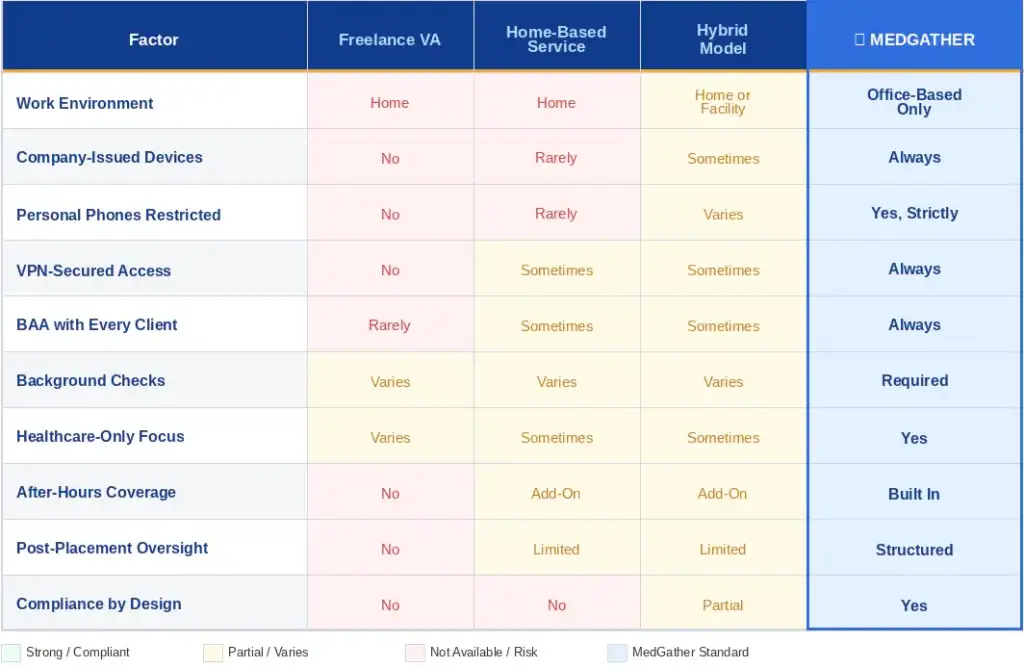
This page breaks down the four models available to US healthcare practices today, what each one delivers, where each one falls short, and where MedGather fits into that picture.
Medical Practice Management Alternatives: The 4 Virtual Assistant Models
Model 1: Individual Freelance VA
This is the most accessible and lowest-cost entry point. Individual freelancers are hired directly through platforms or referrals and work independently, handling tasks similar to a medical administrative assistant in a clinic setting.
What it offers: Low hourly cost, flexible arrangements, quick onboarding.
What it lacks: No built-in compliance infrastructure, no backup support, and no formal oversight. The practice assumes full responsibility for HIPAA compliance, data handling, and performance management. If the arrangement does not work out, the process often starts over from scratch.
Model 2: Home-Based VA Service
This is the most common model in the market. A company recruits, vets, and assigns virtual assistants who work remotely from home environments. Some providers offer HIPAA training and use software tools to enhance security.
What it offers: More structure than freelancers, access to trained staff, and support with onboarding and matching.
What it lacks: Work is still performed on personal networks and devices. Oversight depends heavily on individual discipline and monitoring tools rather than a controlled environment. While many providers claim HIPAA compliance, the level of protection can vary significantly.
Model 3: Hybrid Model
Some services offer both home-based and facility-based options, often with secure environments available as an upgrade.
What it offers: Flexibility and the option to increase security when needed.
What it lacks: The secure setup is not always the default. Unless specifically requested, services may still operate under home-based conditions. This can lead to inconsistencies in how teams operate.
This is where MedGather operates. Every virtual assistant works from a supervised, access-controlled office environment. No home-based setups, no personal devices, and all systems are secured and monitored.
Unlike freelance or home-based arrangements, MedGather’s model means the compliance infrastructure is built into the physical environment itself, not dependent on individual behavior or software patches. Oversight is structural, not optional.
What it offers: A structured support model where data protection and accountability are built into daily operations. Oversight is consistent, and compliance measures are part of the environment, not left to individual setup.
Best for: Healthcare practices where patient data protection, operational continuity, and compliance integrity are non-negotiable.
The model you choose is not just an operational decision. It is also a compliance decision with financial and legal implications.
Medical virtual assistants handle sensitive patient data daily. It is important to look beyond general claims and understand how each provider actually maintains security and compliance.
Lower-cost options may seem appealing upfront. However, gaps in oversight or data protection can introduce risks that outweigh those savings. Not all virtual assistant services are built the same, and the differences are not always visible at first glance.
The key question is not simply which model is cheapest, but which one your practice can confidently operate within from both a risk and reliability standpoint.
Medical practice management alternatives include freelance virtual assistants, home-based VA services, hybrid models, and structured office-based solutions like MedGather.
Not all virtual assistants are inherently HIPAA compliant. Compliance depends on the provider’s infrastructure, policies, and data handling environment.
Office-based structured models like MedGather provide the highest level of control and security because they operate in monitored, access-controlled environments.
Where MedGather Fits
MedGather is designed for healthcare practices that need reliable administrative support without compromising on structure or security.
For clinics managing higher patient volumes, multiple providers, or complex workflows, consistency and oversight become critical.
MedGather provides a dedicated support system operating within a controlled environment, helping ensure tasks are handled accurately and securely.
Support can include scheduling, insurance verification, prior authorizations, EMR documentation assistance, billing coordination, patient communication, and after-hours coverage.
Rather than just adding another remote worker, this approach provides a structured extension of your team, built to support long-term operations.
To provide the best experiences, we use technologies like cookies to store and/or access device information. Consenting to these technologies will allow us to process data such as browsing behavior or unique IDs on this site. Not consenting or withdrawing consent, may adversely affect certain features and functions.
Functional
Always active
The technical storage or access is strictly necessary for the legitimate purpose of enabling the use of a specific service explicitly requested by the subscriber or user, or for the sole purpose of carrying out the transmission of a communication over an electronic communications network.
Preferences
The technical storage or access is necessary for the legitimate purpose of storing preferences that are not requested by the subscriber or user.
Statistics
The technical storage or access that is used exclusively for statistical purposes.The technical storage or access that is used exclusively for anonymous statistical purposes. Without a subpoena, voluntary compliance on the part of your Internet Service Provider, or additional records from a third party, information stored or retrieved for this purpose alone cannot usually be used to identify you.
Marketing
The technical storage or access is required to create user profiles to send advertising, or to track the user on a website or across several websites for similar marketing purposes.