Why Top Practices Switch to Virtual Medical Assistants
Medical billing is growing fast. Outsourcing in this sector is projected to expand by 11.9% annually through 2032, yet the shift to remote billing teams has quietly eroded the IT perimeter that once safeguarded Protected Health Information (PHI). As staff work from home, many rely on personal devices, consumer-grade applications, and unapproved cloud tools, creating exposure points administrators cannot see, manage, or fully secure.
Shadow IT is not a theoretical risk. It appears in everyday workflows such as PHI stored in personal Dropbox or Google Drive accounts, care coordination handled through consumer messaging apps, and system access over public Wi-Fi connections without proper encryption. Each shortcut widens the gap between what is convenient and what is compliant.
That gap is where data breaches, regulatory fines, and long-term reputational damage begin to surface. For healthcare practices, remote billing is no longer just an operational decision. It is a security decision with financial and legal consequences that can extend far beyond the billing department.
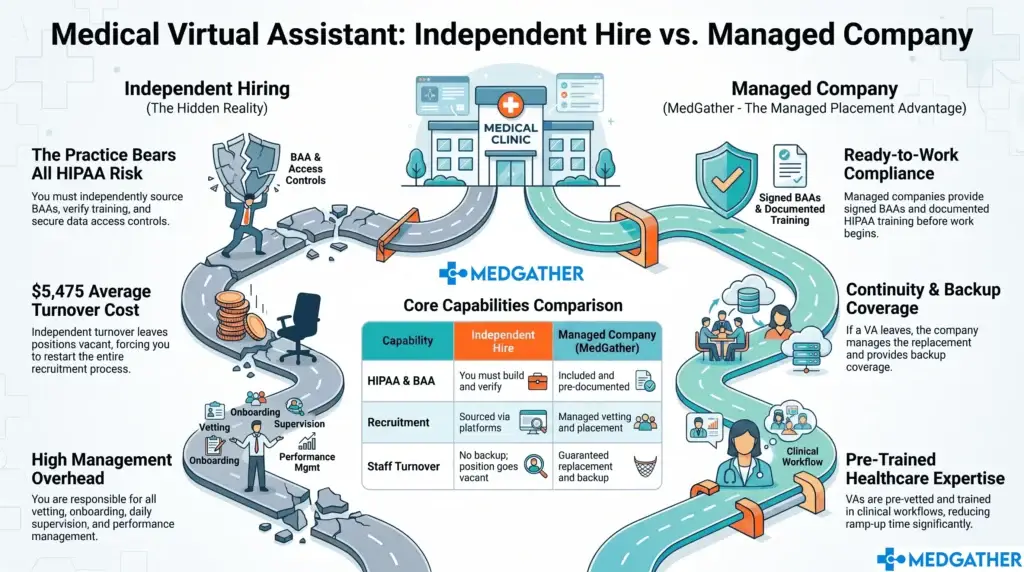
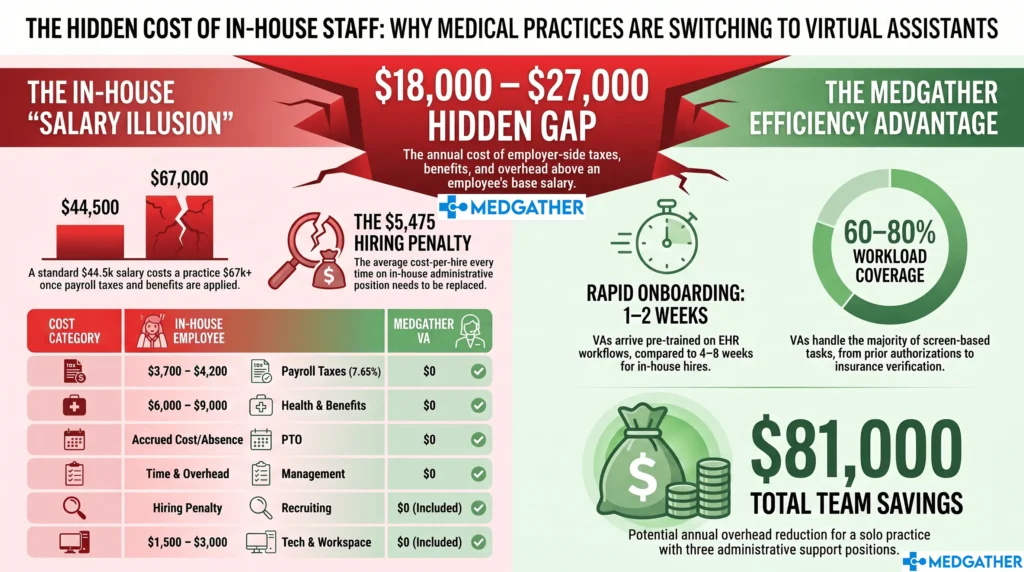
Leading healthcare practices are replacing home-based virtual assistants with secure, office-based Medical Virtual Assistants because unmanaged devices, personal networks, and Shadow IT create unnecessary HIPAA and cybersecurity risks. MedGather’s office-based model provides supervised teams, company-managed technology, and secure workflows that help protect patient data while allowing practices to scale efficiently.

Board-certified gastroenterologist and Founder of MedGather. Read full bio →
What Is a Virtual Medical Assistant? (And Why “Where” They Work Matters)
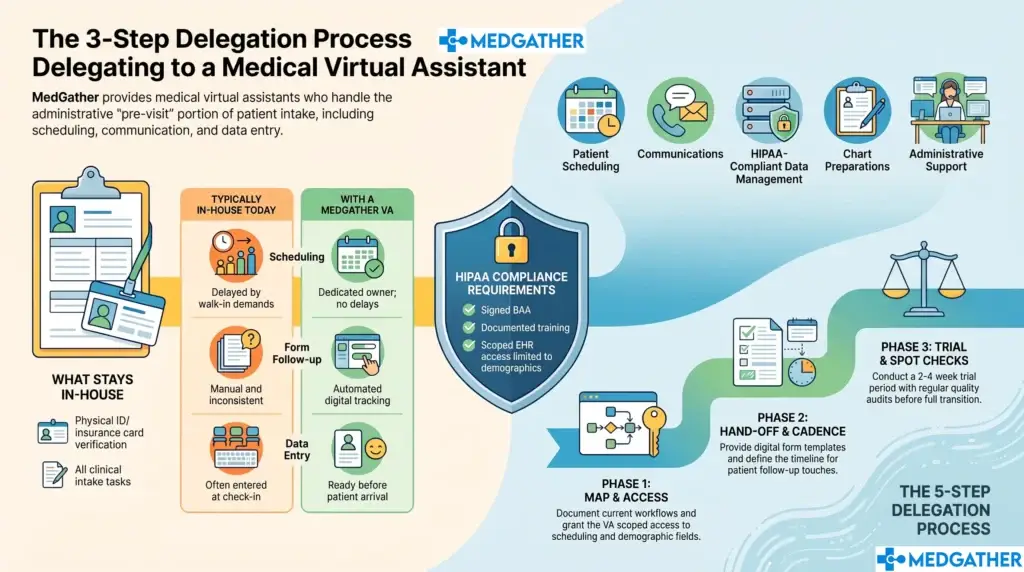
A Virtual Medical Assistant or Medical Scribe supports revenue cycle management, scheduling, patient intake, clinical documentation, and encounter note preparation from a remote location. The critical variable is not the task itself, but the environment where the work is performed. Home-based freelancers often operate on unmanaged devices and networks, while office-based teams like MedGather work from secured facilities with professional IT oversight and encrypted infrastructure. That physical and administrative control significantly reduces exposure to Shadow IT.
When assistants work in centralized, monitored environments, healthcare practices gain greater visibility and control through real-time supervision, strict access management, and auditable workflows. This structured approach helps organizations maintain HIPAA-compliant operations while protecting sensitive patient information.
The “Shadow IT” Problem in Standard Medical Billing Services
In decentralized billing workflows, staff often circumvent slow or unclear processes with quick fixes, personal cloud storage, text threads, or unsecured connections. These choices undermine HIPAA requirements for access control, auditability, and transmission security. Medical Scribe tasks such as note drafting and encounter summaries are especially vulnerable to copy-and-paste shortcuts across unapproved applications when standardized tools and workflows are not in place.
Remote work also intersects with Remote Patient Monitoring (RPM). Billing teams may handle data from glucometers, pulse oximeters, and wearable devices as part of reimbursement and documentation workflows. When those interactions occur on personal laptops, mobile devices, or unsecured home Wi-Fi networks without encryption or monitoring, the risk of exposing Protected Health Information (PHI) increases significantly.
How a Premium Virtual Medical Assistant Eliminates Data Breaches
A Premium Virtual Medical Assistant model replaces ad hoc tools with standardized security controls, including full-disk encryption, multi-factor authentication (MFA), enterprise VPN/TLS, device monitoring with audit logs, and instant account deprovisioning. These safeguards align operationally with established federal guidance, including HHS Cybersecurity Performance Goals and NIST best practices for asset inventory, network segmentation, and endpoint monitoring. The result is a security program that turns compliance from a written policy into a consistent daily practice.
Policy is just as important as technology. Bring Your Own Device (BYOD) standards and remote work policies, including device registration, restrictions on unapproved applications, home network security requirements, and mobile device management with remote wipe capabilities, close many of the gaps that Shadow IT exploits.
A premium, office-based model also standardizes Medical Scribe workflows within approved systems protected by encryption, MFA, and continuous supervision. This creates a more secure and consistent environment for handling Protected Health Information (PHI) while reducing operational risk for healthcare practices.
Case Studies: The Price of Cutting Corners
Regulatory enforcement actions regularly cite preventable failures such as missing risk analyses, unencrypted devices, uncontrolled remote access, and weak offboarding processes. Incidents involving lost laptops, insider misuse, and phishing-related data theft continue to appear in enforcement actions by the Office for Civil Rights (OCR) and state regulators.
The lesson is consistent: what seems convenient in the short term can become extremely costly when Protected Health Information (PHI) is exposed.
Governance and BAAs: Closing Vendor Risk
Shadow IT often enters through well-intentioned third-party tools that never go through a formal security review. A defensible governance program should include:
- Business Associate Agreements (BAAs) that define security safeguards, data handling responsibilities, and breach notification requirements.
- A sanctioned applications list with formal intake, security review, approval, and periodic revalidation.
- Change management and role-based access controls that ensure permissions follow the HIPAA “minimum necessary” standard.
Include Medical Scribe applications in your approved software inventory and Business Associate Agreements, with documented audit trails for every interaction involving Protected Health Information (PHI).
Identity and Device Management: Practical Controls That Work
Healthcare practices can significantly reduce security risk by centrally managing user identities, devices, and system access. Effective controls include:
- Single sign-on (SSO) with multi-factor authentication (MFA) for all billing, EHR, and clinical documentation systems.
- Device inventory and mobile device management (MDM), including full-disk encryption, automatic screen locking, privacy filters, and regular security patching.
- Secure network standards, such as WPA3 on approved routers and always-on VPN connections for remote access.
- Rapid offboarding procedures that immediately revoke access across EHR platforms, clearinghouses, email accounts, cloud storage, and other business systems.
Together, these controls help healthcare organizations reduce unauthorized access, strengthen HIPAA compliance, and protect Protected Health Information (PHI) throughout the medical billing workflow.
Training and Culture: Closing the Human Gap
Technology alone cannot prevent data breaches. Healthcare organizations also need employees who understand how to handle sensitive information safely. Establish a quarterly training program that includes:
- Phishing simulations and short security lessons tailored to medical billing and documentation workflows.
- Clear “what to use” playbooks that replace consumer applications with approved, secure alternatives.
- Incident reporting procedures that encourage employees to report issues immediately instead of attempting quiet fixes.
Training should reflect real-world Medical Scribe workflows, including drafting notes, transferring information between approved systems, and responding to urgent provider requests involving Protected Health Information (PHI). Practical, role-specific scenarios help employees build secure habits before small mistakes become costly incidents.
RPM and the New Data Surface
As healthcare practices expand their Remote Patient Monitoring (RPM) programs, more patient data flows into the revenue cycle. A secure operating model should clearly define:
- Who can access RPM data, on which devices, and under which roles, including billing staff, Medical Scribes, and care coordinators.
- How RPM data is transmitted, stored, and billed using approved, HIPAA-compliant systems.
- What audit trails are maintained to demonstrate HIPAA-compliant handling from data collection through reimbursement.
Treat RPM as part of your revenue cycle’s core system of record, not as a separate data source. Integrating RPM into standardized workflows improves security, strengthens compliance, and provides complete visibility into how Protected Health Information (PHI) is accessed and managed.
Measuring Security ROI in Medical Billing Services
Security should be treated as a measurable business investment, not simply a compliance expense. Healthcare organizations can track its value using key performance indicators such as:
- Mean time to deprovision, measuring how quickly user access is revoked after an employee leaves or changes roles.
- MDM enrollment and encryption coverage across all laptops, mobile devices, and other endpoints.
- Exception rate, tracking how many unauthorized applications or tools are detected and remediated.
- Audit log completeness across billing platforms, Electronic Health Record (EHR) systems, and claims management software.
Organizations that improve these metrics reduce the likelihood of data breaches, lower incident response costs, strengthen HIPAA compliance, and maintain uninterrupted revenue cycle operations. Those outcomes represent measurable returns on security investments.
Implementation Checklist: From Policy to Proof
Building a secure remote medical billing operation requires more than written policies. Use this checklist to strengthen security, improve compliance, and reduce operational risk:
- Approve a remote work and Bring Your Own Device (BYOD) policy, and require employees to acknowledge it.
- Publish an approved software list and block high-risk consumer applications.
- Enroll every device in Mobile Device Management (MDM), with encryption and automatic security updates enabled.
- Require single sign-on (SSO), multi-factor authentication (MFA), and always-on VPN access for all billing systems.
- Conduct quarterly phishing awareness training and regular user access reviews.
- Review Business Associate Agreements (BAAs) and verify that vendor security controls remain current.
- Maintain a documented breach response plan that clearly defines roles, timelines, communication procedures, and recovery steps.
Organizations that consistently follow these practices are better positioned to protect Protected Health Information (PHI), demonstrate HIPAA compliance, and reduce the financial impact of security incidents.
Secure Your Revenue Cycle with MedGather
If your practice is expanding its billing operations with a Virtual Assistant team, security should be part of your hiring decision. MedGather’s Virtual Medical Assistants work exclusively from secure, office-based facilities with centralized oversight, enterprise-grade security controls, and continuous IT monitoring. This managed environment helps keep Protected Health Information (PHI) within HIPAA-compliant safeguards while supporting efficient revenue cycle operations.
Ready to hire a Virtual Medical Assistant who protects both your patients and your practice? Book a free consultation to see how MedGather’s secure, office-based model can help you replace Shadow IT risks with professionally managed healthcare support.
Protect Your Revenue Cycle with MedGather
Your medical billing team handles some of your practice's most sensitive information every day. The right support model should improve efficiency without increasing security risk.
Frequently Asked Questions
What is "Shadow IT" and why is it dangerous for medical practices?
Shadow IT refers to the use of unapproved, consumer-grade tools for work purposes, such as storing PHI in personal Google Drive or Dropbox accounts, or accessing systems over public Wi-Fi. In decentralized billing workflows, staff often use these workarounds for convenience, which severely undermines HIPAA requirements for access control and transmission security, leading to data breaches.
Why does the physical working environment of a Virtual Medical Assistant matter?
The environment is a critical variable for data security. Home-based freelancers frequently operate on unmanaged devices and home networks, increasing the risk of exposure. In contrast, office-based teams like MedGather work inside secured facilities with professional IT oversight, which dramatically reduces the risks of Shadow IT and keeps data flows compliant by design.
What specific security controls does a premium virtual assistant model use?
A premium model standardizes security by implementing full-disk encryption, Single Sign-On (SSO) with MFA, enterprise VPNs, and Mobile Device Management (MDM). It also allows for continuous device monitoring, audit logs, and an instant “kill-switch” for rapid account deprovisioning to immediately revoke system access when necessary.
How do Remote Patient Monitoring (RPM) devices affect remote billing security?
As practices adopt RPM, billing teams must interact with new data streams from devices like glucometers and wearables. If remote workers handle this data on unencrypted personal laptops or phones, the risk of PHI exposure spikes. RPM data must be treated as part of the secured revenue-cycle system, with strict rules on who touches the data, approved transmission methods, and complete audit trails.
What role do Business Associate Agreements (BAAs) play in securing remote billing?
BAAs are essential for closing vendor risks associated with third-party tools. They legally codify safeguards, data handling expectations, and breach notification protocols. Practices must include all sanctioned apps and Medical Scribe applications in their BAAs to ensure there are documented audit trails for every time patient data is touched.