25 Tasks a Medical Virtual Assistant Can Handle for Your Practice
A medical virtual assistant (MVA) is a trained, remote healthcare administrative professional who manages the operational and administrative workflows of a US medical practice from an off-site location. Unlike a general virtual assistant, an MVA brings clinical background knowledge, EHR platform familiarity, and direct experience with healthcare-specific processes including prior authorization, insurance eligibility verification, and patient communication protocols. When placed through a managed provider like MedGather, they work from a supervised, HIPAA-compliant office environment with company-issued devices and documented compliance training.
In most US practices, administrative work is not a background function. It is a constant demand that runs in parallel with clinical care, interrupting staff, delaying revenue, and creating gaps in the patient experience when it is not handled consistently. The 25 tasks below represent the operational backbone of most US healthcare practices, grouped by function with delegation guidance at the end.
This is where a medical virtual assistant becomes valuable. Instead of reacting to tasks throughout the day, practices can rely on a structured support layer that keeps operations moving in the background.
TL;DR: What Tasks Can a Medical Virtual Assistant Handle?
A medical virtual assistant can handle 25 core administrative tasks across five functional areas: scheduling and patient access, insurance and revenue cycle, patient communication, EMR and documentation support, and front desk operations.
According to American Medical Association (AMA) research, physicians spend an average of two hours on administrative tasks for every hour of direct patient care. Practices that delegate these responsibilities to a trained, managed medical virtual assistant (MVA) often reduce no-show rates by 20% to 30% and cut staff overtime by 25% to 40% within the first 60 days.

Board-certified gastroenterologist and Founder of MedGather. Read full bio →
In This Guide
- Scheduling and patient access tasks (5 tasks)
- Insurance and revenue cycle tasks (6 tasks)
- Patient communication tasks (5 tasks)
- EMR and documentation support tasks (4 tasks)
- Front desk and administrative operations tasks (5 tasks)
- What tasks should you delegate first?
- Why these 25 tasks matter more than they seem
- Frequently asked questions
Below are 25 tasks a medical VA can handle, grouped by function, along with why each one matters in real practice operations.
If you are new to this model, you can start with this medical virtual assistant guide to understand how these roles fit into a practice.
What Scheduling and Patient Access Tasks Can a Medical VA Handle?
Scheduling is the operational front door of a medical practice. When it breaks down, everything downstream is affected: revenue, patient satisfaction, and clinical efficiency. A well-trained medical VA takes full ownership of the scheduling layer, handling all five of these tasks without interrupting clinical staff.
1. New Patient Scheduling
First impressions start at booking. A VA who handles new patient intake properly sets the tone for the entire patient relationship, collects the right information upfront, and ensures the right appointment type is booked without clinical staff involvement.
2. Appointment Rescheduling and Cancellations
Rescheduling handled promptly keeps the calendar full and reduces revenue loss from empty appointment slots. A dedicated VA works the schedule actively rather than waiting for last-minute calls to accumulate.
3. Waitlist Management
A well-managed waitlist fills cancellation gaps quickly. Without someone actively working it, last-minute cancellations translate directly to lost revenue. A VA monitors the waitlist daily and moves patients into open slots.
4. Appointment Reminder Outreach
Consistent reminders are the single most direct intervention for reducing no-show rates. A VA handles reminder calls, texts, and emails systematically rather than fitting them in when bandwidth allows. Most practices see a 20 to 30 percent reduction in no-shows within the first month of structured reminder outreach.
5. Provider Calendar Coordination
Managing provider availability, blocking administrative time, coordinating across multiple providers, and preventing double-booking without creating conflicts. For multi-provider practices, this is a full-time task in itself.
Which Insurance and Revenue Cycle Tasks Can a Medical VA Take Over?
Insurance-related work is among the highest-value administrative tasks in a medical practice. Errors, delays, and missed follow-ups in this category translate directly into revenue loss. An MVA with clinical background and payer portal experience handles all six of these tasks accurately and proactively.
6. Insurance Eligibility Verification
Eligibility is checked before every visit, not at the point of service. Issues caught before the appointment do not become billing complications afterward. A VA runs verification checks as part of the pre-visit workflow rather than discovering problems on the day of service.
7. Prior Authorization Submissions
Submitting authorization requests through payer-specific portals within the required timelines and with the correct supporting documentation. Prior auth submissions done incorrectly the first time add days to turnaround and can result in denials that are difficult to appeal.
8. Prior Authorization Follow-Up
Tracking outstanding authorizations, following up when payers go quiet, and escalating when approvals are stalling before they affect scheduled appointments. This is one of the most time-intensive revenue cycle tasks in a busy practice, and one of the clearest use cases for a dedicated VA. See how prior auth coordination fits into a full medical VA task scope for more context.
9. Claims Tracking and Follow-Up
Monitoring claim status across payers, identifying claims that have aged without payment or response, and initiating follow-up before unpaid claims move past the timely filing window.
10. Denial Management Support
Organizing the documentation and clinical information needed for denied claim appeals, coordinating between clinical and billing staff, and tracking the status of appeals through the payer system.
11. Medical Billing Coordination
Keeping billing records organized, coordinating between clinical documentation and your billing team or external billing vendor, and ensuring nothing falls through the cracks between documentation completion and claim submission. Important: This task covers administrative coordination only. MedGather does not provide billing services. All claim submission and billing execution remains with your designated billing staff or external billing partner.

What Patient Communication Tasks Can a Medical VA Handle?
Patient communication is the connective tissue between clinical visits. When it is handled inconsistently, patients fall through the gaps. When it is handled well, it drives retention, reduces complaints, and keeps the practice front of mind between appointments. The communication responsibilities an MVA can own from day one are well within the scope of a trained, clinically experienced assistant.
12. Routine Patient Inquiry Responses
Answering questions about appointments, office location and hours, required documentation, and general practice information. Patients who reach a live, knowledgeable person instead of a voicemail have a measurably better first impression.
13. Post-Visit Follow-Up Communication
Follow-up messages after clinical visits keep patients informed, reinforce care instructions, and create a touchpoint between appointments that most practices miss entirely due to bandwidth.
14. Prescription Refill Inquiry Handling
Routing refill requests to the appropriate clinical staff, communicating status and timelines back to patients, and preventing refill inquiries from clogging the provider’s inbox.
15. Patient Satisfaction Outreach
Following up with patients after visits to check in and address concerns before they become negative reviews. Proactive outreach is far more effective than reactive damage control after a complaint has already been posted.
16. Appointment Confirmation Calls
Following up with patients by phone to confirm upcoming appointments, verify any pre-visit requirements, and address questions that might lead to last-minute cancellations. Combined with reminder outreach (Task 4), this is the two-step protocol that consistently delivers the largest reduction in no-show rates.
How Can a Medical VA Support EMR and Documentation?
EMR and documentation support is where clinical background matters most. These tasks require accuracy, familiarity with platform-specific workflows, and an understanding of what correct documentation looks like. MedGather’s assistants complete EHR proficiency checks specific to the platform your practice uses before assignment. What that vetting process looks like in practice covers the clinical and technical requirements in detail.
17. EMR Documentation Support
Administrative documentation entry, chart organization, and EMR updates that do not require clinical judgment but require accuracy and platform familiarity. This includes encounter preparation, note templating, and post-visit chart cleanup.
18. Patient Record Organization
Keeping records current, organized, and accessible so clinical staff are not hunting for information during patient interactions. In EHR systems where records are split across visits or providers, this maintenance work prevents errors and saves time during the encounter.
19. Referral Documentation
Preparing and sending referral packets with the relevant clinical and insurance information the receiving provider needs. Incomplete referral packets delay care and create callbacks that consume staff time.
20. Lab and Imaging Result Tracking
Following up on outstanding results, routing completed results to the appropriate clinical staff for review, and communicating result availability to patients per the practice’s protocol. Untracked results that sit unreviewed are both a clinical and a compliance risk.
What Front Desk and Administrative Tasks Does a Medical VA Handle?
The front desk functions of a medical practice create the most consistent pressure points for staff. Phones, inboxes, faxes, and after-hours coverage are not optional , they have to be handled every day. How practices integrate these functions into a structured VA workflow covers the implementation sequence in practical terms.
21. Incoming Call Handling and Overflow
Answering calls during high-volume hours so patients reach a live person instead of voicemail during the times they are most likely to call. For practices without adequate front desk coverage, call overflow is the most visible sign of a staffing problem.
22. Inbox Management
Organizing the practice inbox, routing what requires clinical attention to the right staff, responding to routine correspondence, and preventing the inbox backlog that accumulates in most practices by mid-week.
23. Referral Coordination and Follow-Up
Tracking whether referred patients have connected with the receiving provider, and following up when they have not. Referral leakage costs practices revenue and creates gaps in patient care that are difficult to document.
24. Fax and Document Management
Processing incoming faxes, routing documents to the appropriate staff, and preventing documents from sitting unattended in the fax queue. In practices that still receive a significant volume of clinical faxes, unmanaged queues are a consistent source of compliance and operational risk.
25. After-Hours Administrative Support:
Handling patient inquiries, new appointment requests, and administrative tasks outside regular clinic hours so nothing waits until the following morning. After-hours coverage is one of the clearest differentiators between a VA model and in-house staffing. How after-hours support works as a structured service explains the coverage model in detail.
What Does Practice Operations Look Like Without a VA vs. With One?
The 25 tasks above are handled in some form in every medical practice. The question is whether they are handled consistently. Here is what the difference looks like across the key operational metrics.
Practice Operations: Without VA vs. With a Managed Medical VA
Metric | Without VA | With Managed Medical VA |
No-show rate | 15 to 20% average | 8 to 12% with systematic reminders |
Prior auth turnaround | 3 to 7 days (reactive) | 1 to 2 days (proactive tracking) |
Staff overtime | 8 to 15 hrs/week | 2 to 5 hrs/week |
Inbox management | Reactive , same-day backlog | Structured , organized daily |
After-hours coverage | None , patients wait until next day | Covered , inquiries handled same evening |
Call handling | Voicemail during peak hours | Live answer throughout operating hours |
Documentation backlog | Grows throughout the week | Cleared daily by dedicated VA |
Data above reflects typical patterns in small to mid-sized US primary care practices. Individual results vary by practice size, specialty, and prior administrative structure.
Taken together, these 25 tasks represent the operational backbone of most US medical practices. When they are handled consistently by trained professionals working within a compliant, supervised environment, the difference in how a practice runs is measurable.
What Tasks Should You Delegate to a Medical VA First?
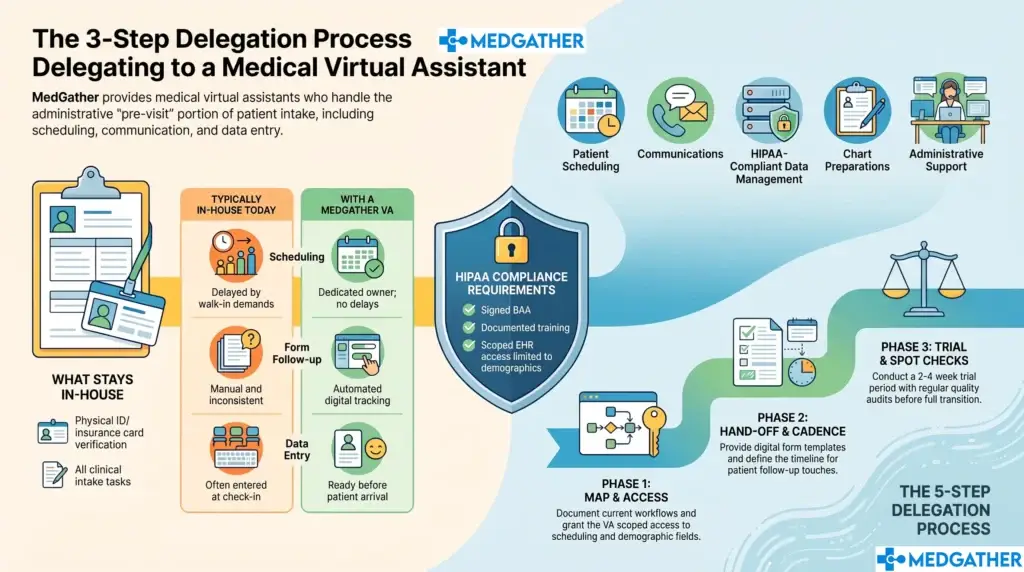
Not every practice needs to delegate all 25 tasks immediately. The most effective approach is to start where operational pressure is highest and build from there. The sequence below follows the order that produces the fastest measurable results in most practice types.
In most US practices, the first areas to offload are:
Step 1: Scheduling and appointment reminders. These tasks directly affect daily revenue and patient access. Most practices see the fastest measurable ROI from delegating scheduling, reminder outreach, and waitlist management first. The no-show reduction alone typically recovers more than the cost of the VA within the first 30 days.
Step 2: Insurance verification and prior authorization follow-up. Once scheduling is stabilized, prior auth and eligibility verification are the next highest-value tasks. Both have a direct impact on revenue cycle timing and denial rates. Delegating these removes the single most time-intensive administrative responsibility from clinical staff.
Step 3: Inbox management and call overflow. By the time scheduling and revenue cycle tasks are running consistently, inbox and call volume can be safely handed off. These tasks are often the most visible source of daily stress for practice staff and the most appreciated when removed.
Step 3: EMR documentation support and referral coordination. Documentation support requires the most clinical familiarity and typically takes the longest to fully hand off. Add this layer after the VA is familiar with your workflows and EHR system. Referral coordination can begin earlier if there is a high referral volume creating backlog.
The full scope of what a trained MVA can manage from day one is covered in the role of a medical virtual assistant in modern healthcare, which includes the function breakdown across practice types.
Once these are stabilized, additional responsibilities can be layered in without disrupting clinical operations.


Why Do These 25 Tasks Matter More Than They Seem?
Each of these tasks may look routine in isolation. Together, they form the operational backbone of a practice. When they are delayed, inconsistently handled, or assigned to clinical staff who are already at capacity, the result is predictable.
- Slower patient throughput. When scheduling, reminders, and prior auth are not managed proactively, the downstream effect shows up in the appointment calendar within weeks.
- Revenue leakage. Claims that are not tracked, prior auths that stall, and denials that go unappealed represent money that is earned but never collected. The MGMA estimates that practices lose between 5 and 10 percent of collectible revenue to preventable administrative errors.
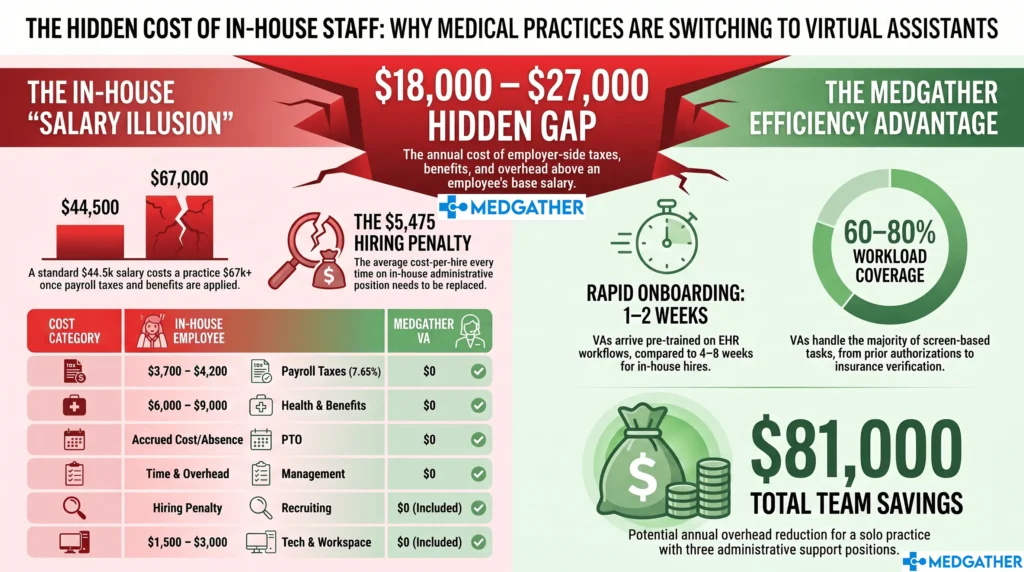
- Staff burnout. When clinical staff absorb administrative tasks as overflow, the work environment deteriorates faster than most practices recognize. According to BLS data, medical administrative assistant roles have among the highest turnover rates in the healthcare support sector, in part because the workload is poorly scoped and poorly structured.
This is where the structured, supervised VA model produces a measurable difference. How MedGather’s office-based model handles these tasks in a compliant environment covers the operational detail for practices evaluating the model before making a decision.
If you are evaluating how this could work in your setup, explore our medical virtual assistant services
to see how these tasks are handled in a secure, office-based environment.
How Does MedGather Handle These 25 Tasks?
MedGather places pre-vetted, clinically trained medical virtual assistants with US healthcare practices through an office-based model. Every assistant works from a supervised, HIPAA-compliant workspace with company-issued devices and documented compliance training completed before their first day with your practice.
Before assignment, each assistant completes an EHR proficiency check specific to the platform your practice uses, a clinical background review, and a HIPAA compliance certification. What the full vetting and hiring process looks like explains what is verified before a name is ever presented to a client.
The 25 tasks above represent the standard scope of what a MedGather MVA manages for the practices we work with. The specific task mix is defined by your practice’s needs, not a one-size approach. To get a real picture of what delegation would look like for your specific workflows, a free strategy consultation is the right starting point.
See which of these 25 tasks your practice needs most.
MedGather matches your workflows to a pre-trained, clinically experienced VA. Book a free strategy call and get a clear picture of what a structured VA arrangement would look like for your specific practice.
Frequently Asked Questions
What tasks can a medical virtual assistant handle?
A medical virtual assistant can handle 25 core administrative tasks across five functional areas: scheduling and patient access (new patient scheduling, rescheduling, waitlist management, appointment reminders, calendar coordination), insurance and revenue cycle (eligibility verification, prior authorization submission and follow-up, claims tracking, denial management support, billing coordination), patient communication (routine inquiries, post-visit follow-up, prescription refill routing, patient satisfaction outreach, confirmation calls), EMR and documentation support (documentation entry, record organization, referral documentation, lab and imaging result tracking), and front desk operations (call handling, inbox management, referral coordination, fax management, after-hours coverage).
What administrative tasks should a medical practice delegate to a VA first?
The most effective first-delegation sequence for most US practices is: (1) appointment scheduling and reminder outreach, which typically produces a 20 to 30 percent reduction in no-show rates within 30 days; (2) insurance eligibility verification and prior authorization follow-up, which directly reduces revenue cycle delays; (3) inbox and call overflow management, which reduces staff interruption during patient hours; and (4) EMR documentation support, which requires more ramp-up but produces significant time savings once established. Starting with all four at once is possible when using a managed provider that pre-trains VAs before assignment.
Can a medical virtual assistant handle tasks that involve patient health information?
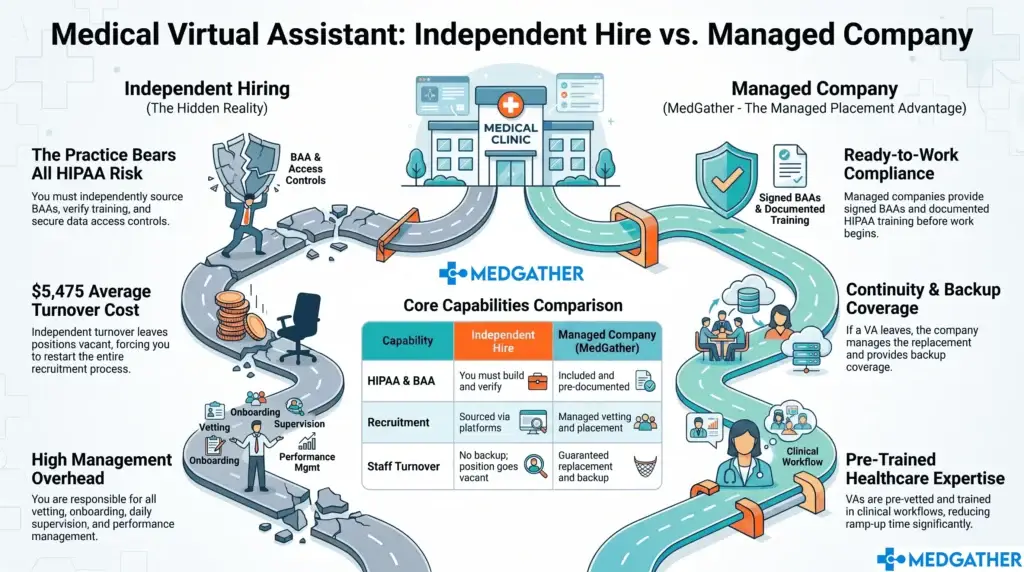
Yes, when the VA is placed through a managed provider that operates a HIPAA-compliant model. This includes a signed Business Associate Agreement before any patient data is accessed, HIPAA compliance training completed before the first day, work from a company-issued device in a supervised environment (not a personal device on a home network), and documented physical safeguard protocols. MedGather’s office-based model includes all of these. Freelance or independently hired VAs working from home on personal devices do not carry these protections by default.
How many of these 25 tasks can one medical virtual assistant cover in a day?
A full-time MVA working 40 hours per week can realistically cover all 25 task types, with the volume of each depending on the size and specialty of the practice. In a typical small to mid-sized primary care practice, a full-time MVA handles 15 to 40 appointment-related actions per day, manages prior authorization for 5 to 15 active cases, processes incoming faxes and inbox items, and handles patient inquiry volume that would otherwise require at least one additional front desk staff member. The specific capacity depends on the practice’s patient volume and the depth of each task category.
What makes a medically trained VA different from a general virtual assistant for these tasks?
A general virtual assistant can handle scheduling, inbox management, and basic correspondence, but will struggle with tasks that require clinical context: prior authorization submissions that require clinical documentation review, EMR documentation entry that must match platform-specific templates, insurance eligibility verification that requires understanding of plan types and coverage categories, and referral documentation that requires knowing what the receiving provider needs to see. A medical VA with a nursing or clinical background handles these tasks accurately without requiring clinical staff to explain the context every time. The combination of clinical background, EHR proficiency, and HIPAA training is what makes a medical VA appropriate for healthcare-specific administrative work.
Sources:
Physician burnout statistics 2024: The latest changes and trends in physician burnout by specialty
Occupational Employment and Wage Statistics
Medical Group Management Association. MGMA DataDive: Cost and Revenue Report. 2023.
Society for Human Resource Management. The Real Cost of Employee Turnover