Are Virtual Medical Assistants HIPAA Compliant?
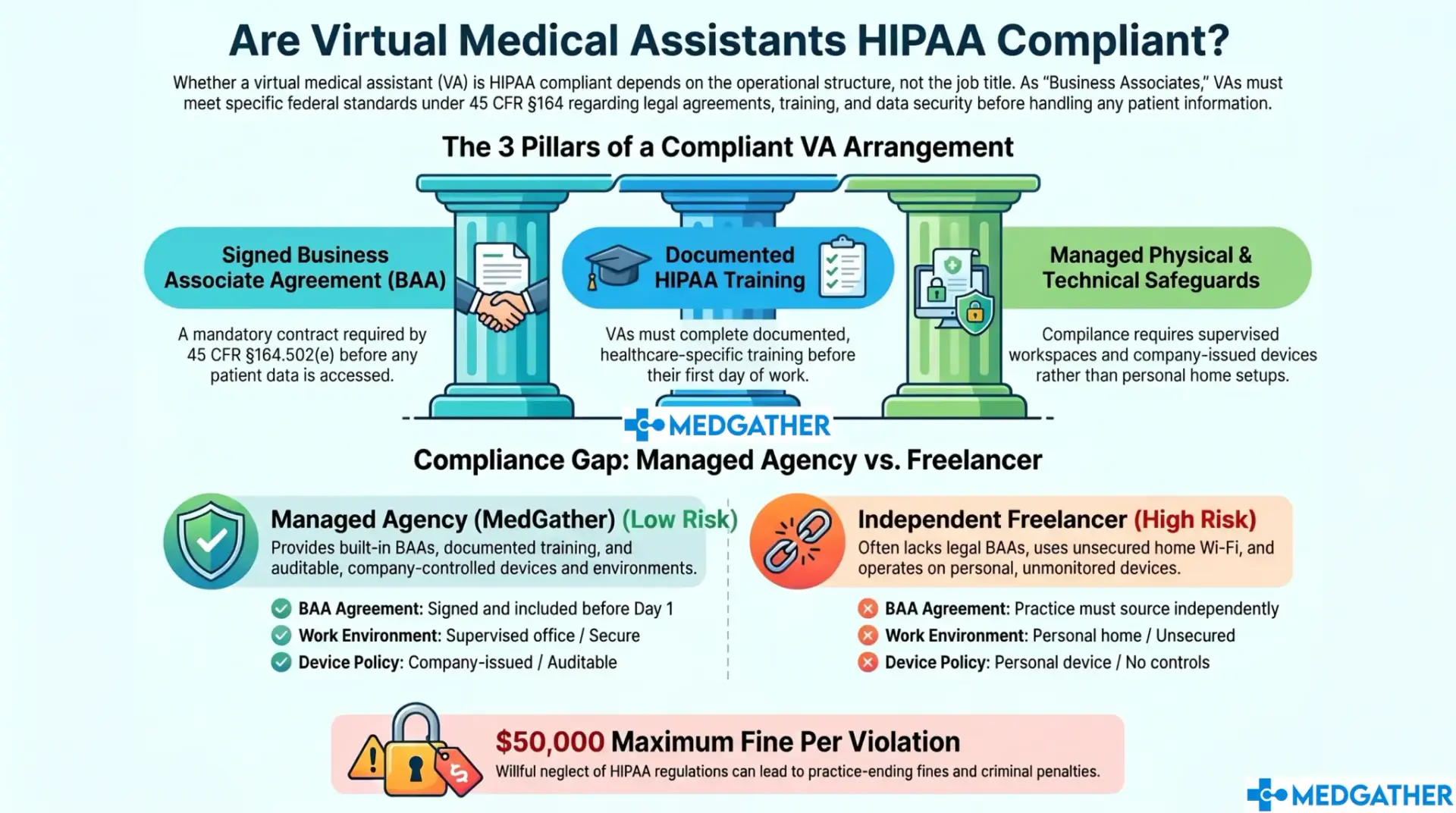
Whether a virtual medical assistant can support HIPAA-compliant operations depends largely on how the arrangement is structured. The question extends beyond the VA as an individual. the VA as an individual. It is about the provider they work through, the agreements in place before they touch patient data, and the environment they work from. Get those three things right, and the answer is yes. Leave any one of them unaddressed, and your practice may face increased compliance and data security risks.
A medical virtual assistant who handles protected health information (PHI) is classified as a business associate under HIPAA. Under 45 CFR §160.103, PHI includes any individually identifiable health information held or transmitted in any form. That covers appointment details, insurance records, clinical notes, lab results, and any communication that links a patient’s identity to their health status. If your VA touches any of that information, they are a business associate under federal law, and specific requirements apply before day one.
This post covers the key requirements for HIPAA-related arrangements, what a compliant medical virtual assistant structure looks like compared to one that does not meet those standards, and how to evaluate an arrangement you currently have or are considering. The content is intended for educational purposes only and should not be interpreted as legal advice. For guidance specific to your practice, consult your healthcare compliance officer or legal counsel.
| TL;DR , Are Virtual Medical Assistants HIPAA Compliant?Yes , when placed through a managed, office-based provider that has a signed Business Associate Agreement (BAA) in place, documented HIPAA training completed before the first day, and a supervised, compliant workspace with company-issued devices.No , a freelance or independently hired VA working from a personal device on an unsecured home network is not automatically HIPAA compliant. Neither is any arrangement where a BAA is absent, training is undocumented, or the workspace has not been evaluated against HIPAA physical safeguard requirements.The compliance status is determined by the structure, not the job title. |
In This Guide
- What does HIPAA compliance actually mean for a virtual medical assistant?
- When is a virtual medical assistant HIPAA compliant?
- When is a virtual medical assistant not HIPAA compliant?
- What are the specific HIPAA requirements for a VA arrangement?
- How do you verify and set up a HIPAA-compliant VA arrangement?
- What does a HIPAA compliance failure actually cost?
- How does MedGather handle HIPAA compliance?
- Frequently asked questions
What Does HIPAA Compliance Actually Mean for a Virtual Medical Assistant?
HIPAA (the Health Insurance Portability and Accountability Act) establishes the rules governing how patient health information can be used, stored, and shared. When a virtual assistant handles patient data on behalf of your practice, they fall under the definition of a business associate as defined in 45 CFR §160.103 , a person or entity that performs functions or activities involving the use or disclosure of protected health information on behalf of a covered entity.
That classification triggers a specific set of legal requirements that apply regardless of whether the VA works remotely or on-site, full-time or part-time, or through a platform or directly.
What Is Protected Health Information (PHI)?
Under 45 CFR §160.103, PHI is any individually identifiable health information that relates to a person’s past, present, or future health condition, the provision of healthcare to that person, or payment for healthcare. This includes names, dates, contact information, medical record numbers, health plan beneficiary numbers, account numbers, and any other identifier that could be used to identify an individual in combination with health data.
In practical terms, a VA who books appointments, verifies insurance, manages the inbox, coordinates referrals, or handles any documentation connected to a patient is handling PHI in some form. The full scope of tasks a medical VA handles day to day makes clear how much of that work involves patient data.
What Is a Business Associate Agreement (BAA)?
A BAA is a written contract required by 45 CFR §164.502(e) between a covered entity (your practice) and a business associate (your VA or their provider). It specifies how PHI may be used and disclosed, requires the business associate to implement appropriate safeguards, and sets out what happens in the event of a breach. Without a signed BAA in place, your practice is operating out of compliance with HIPAA before the VA has processed a single patient record.
Outbound stat: HHS Office for Civil Rights (OCR) , HIPAA enforcement actions and penalties. OCR has resolved over 140 investigations with corrective action since 2003, with settlements ranging from $1,000 to $16 million. A missing or deficient BAA is one of the most commonly cited compliance failures in OCR investigations. |
When Is a Virtual Medical Assistant HIPAA Compliant?
A virtual medical assistant arrangement meets HIPAA requirements when four specific conditions are all present. Missing any one of them creates a compliance gap even if the others are in order.
HIPAA Compliance Comparison: Managed Agency VA vs. Freelance Independent VA
| Compliance Element | Freelance or Independent VA | Managed Agency VA (e.g. MedGather) |
| Business Associate Agreement | Not provided , practice must source and execute independently | Included , signed before day one |
| HIPAA training documentation | Not standard , practice must verify and retain | Mandatory pre-assignment, documented |
| Work environment | Personal home , physical safeguards not auditable | Supervised office , HIPAA-compliant workspace |
| Device policy | Personal device , no access controls at device level | Company-issued device , controlled and auditable |
| Technical safeguards (45 CFR §164.312) | Not verifiable without practice-side setup | Built into the managed model |
| Breach notification protocol | Ad hoc , no documented escalation path | Organizational process , defined protocol |
| Practice compliance exposure | HIGH , gaps require practice-side remediation | Significantly reduced by provider’s structure |
Red = freelance or independently hired VA without a managed compliance structure. Green = managed agency model with compliance built in before day one. This comparison is not legal advice.
When Is a Virtual Medical Assistant Not HIPAA Compliant?
The most common compliance gaps in virtual assistant arrangements are not the result of bad intent. They are the result of practices and providers not understanding what HIPAA requires before a VA handles patient data. Here are the four situations that create exposure most consistently.
No BAA Has Been Signed
This is the most frequent and most serious gap. Without a signed BAA, the practice has no documented agreement covering how PHI will be handled, what happens in a breach, or what safeguards the VA is required to maintain. Under HIPAA, the absence of a BAA is itself a violation, independent of whether a breach ever occurs. What the financial exposure from a HIPAA compliance failure actually looks like puts the risk in concrete terms.
The VA Is Working From a Personal Device on an Unsecured Network
A freelance VA working from a personal laptop at home on a residential Wi-Fi network does not meet the physical and technical safeguard requirements of the HIPAA Security Rule. The device is not access-controlled at the enterprise level, the network is not monitored, and transmission security cannot be verified. These are not edge cases. They describe the standard working environment of most freelance VAs hired through platforms like Upwork or OnlineJobs.ph without additional compliance infrastructure.
HIPAA Training Was Not Completed or Not Documented
A VA who handles PHI must have completed HIPAA training before their first day of work with the practice. The training must be documented. A VA who states they are familiar with HIPAA requirements without a training certificate, and a dated completion record does not satisfy this requirement. The burden of verification sits with the practice unless the provider has documented this on the practice’s behalf
The Arrangement Is a Staffing Platform Without a Compliance Structure
Some staffing platforms position themselves as healthcare-friendly without maintaining an actual HIPAA compliance program. The presence of healthcare clients on the platform is not evidence of compliance. What matters is whether the platform has a BAA with your practice, whether it has documented HIPAA training for the VAs on its roster, and whether it has physical and technical safeguards in place. How to evaluate whether a VA provider has the compliance structure your practice actually needs covers the specific questions to ask.
What Are the Specific HIPAA Requirements for a Virtual Assistant Arrangement?
The HIPAA requirements that apply to a virtual medical assistant arrangement come from three primary rules. Here is what each requires in plain language.
The Privacy Rule (45 CFR Part 164, Subpart E)
The Privacy Rule governs how PHI can be used and disclosed. It requires that PHI only be used or shared for treatment, payment, or healthcare operations, or with patient authorization for other purposes. A VA must understand and follow the minimum necessary standard: only accessing the patient information required to complete the task at hand, nothing more.
The Security Rule (45 CFR §164.308 to §164.312)
The Security Rule governs electronic PHI (ePHI) and requires administrative, physical, and technical safeguards. For a virtual assistant arrangement, the relevant requirements are: a documented risk analysis (§164.308(a)(1)), workforce training (§164.308(a)(5)), workstation use and security policies (§164.310(b) and §164.310(c)), access controls (§164.312(a)), audit controls (§164.312(b)), and transmission security (§164.312(e)).
HIPAA Training Was Not Completed or Not Documented
A VA who handles PHI must have completed HIPAA training before their first day of work with the practice. The training must be documented. A VA who states they are familiar with HIPAA requirements without a training certificate, and a dated completion record does not satisfy this requirement. The burden of verification sits with the practice unless the provider has documented this on the practice’s behalf
The Arrangement Is a Staffing Platform Without a Compliance Structure
Some staffing platforms position themselves as healthcare-friendly without maintaining an actual HIPAA compliance program. The presence of healthcare clients on the platform is not evidence of compliance. What matters is whether the platform has a BAA with your practice, whether it has documented HIPAA training for the VAs on its roster, and whether it has physical and technical safeguards in place. How to evaluate whether a VA provider has the compliance structure your practice actually needs covers the specific questions to ask.
The Business Associate Rule (45 CFR §164.502(e) and §164.504(e))
The Business Associate Rule requires a signed BAA before a business associate handles PHI. The BAA must specify the permitted uses and disclosures of PHI, require the business associate to implement appropriate safeguards, require reporting of breaches, and specify the consequences of non-compliance. A BAA that was drafted for a different vendor relationship and repurposed without modification may not satisfy these requirements.
| Outbound stat: HHS.gov , HIPAA for Professionals. The HHS published guidance on Business Associate Agreements specifies that covered entities must have a BAA in place with all business associates before PHI is disclosed. |
How Do You Verify a HIPAA-Compliant VA and Set Up the Arrangement Correctly?
This section covers both phases: what to verify before you hire, and what to put in place before the VA handles any patient data. Both are required.
Phase 1: Verify Before You Hire (Steps 1–5)
Ask Whether a BAA Will Be in Place Before PHI Is Accessed
Do not assume. Ask explicitly: “Will you provide a signed Business Associate Agreement before the VA handles any patient records?” A provider that cannot answer clearly or plans to handle it later is not ready to function as a HIPAA business associate.
Request Documentation of HIPAA Training Completion
Ask for the training program used, completion date, and supporting documentation. Training should specifically address healthcare data handling and should be completed before assignment to healthcare clients.
Verify the VA's Work Environment
Determine whether the VA works from a supervised office or a personal home setup. Ask whether company-issued devices are used and whether physical security controls are enforced.
Ask About Technical Safeguards
Review how ePHI is protected in transit and at rest, whether enterprise access controls are implemented, and whether audit logs are maintained for PHI access activities.
Ask for the Breach Notification Protocol
Understand the provider's breach reporting process and escalation timeline. The absence of a clear answer is itself a red flag.
Phase 2: Set Up Correctly Before Day One (Steps 6–10)
Execute the BAA Before Any Access Begins
Ensure the agreement is fully signed and retained before the VA gains access to patient information.
Conduct a PHI Workflow Walkthrough
Review systems, patient information exposure points, and minimum necessary access requirements before work begins.
Document System Access Permissions
Create a written inventory of approved systems, communication tools, and permission levels granted to the VA.
Establish a PHI Incident Reporting Process
Provide a designated contact person and escalation path for suspected breaches or suspicious activity.
Review the Arrangement with Compliance or Legal Counsel
Have the BAA and access permissions reviewed by a compliance officer or healthcare attorney before launch.
What Does a HIPAA Compliance Failure With a Virtual Assistant Actually Cost?
HIPAA penalties under the HITECH Act are tiered based on culpability. The minimum penalty for violations discovered through willful neglect is $10,000 per violation, with an annual cap of $250,000 per violation category. Civil penalties can reach $1.9 million per violation category per year. Criminal penalties under 42 U.S.C. §1320d-6 can include fines up to $250,000 and imprisonment.
For a small or solo practice, even a minimum-level HIPAA penalty can be practice-ending. Beyond the financial penalty, breach notification obligations, reputation damage, and patient trust erosion create costs that extend well past the settlement amount. What a breach actually costs a small medical practice across all categories puts the exposure in concrete terms using real breach cost research.
| Outbound stat: HHS OCR HIPAA penalty tiers , published at hhs.gov. Civil penalty tiers range from $100 per violation (unknowing) to $50,000 per violation (willful neglect, not corrected), with annual caps per violation category. Criminal penalties under 42 U.S.C. §1320d-6 include imprisonment of 1 to 10 years depending on intent. |
How Does MedGather Handle HIPAA Compliance for Virtual Medical Assistants?
MedGather’s compliance model is built around the specific requirements of the HIPAA Business Associate framework. Every assistant placed through MedGather operates from a supervised, office-based environment with company-issued devices, a documented HIPAA training certificate completed before their first client engagement, and a signed Business Associate Agreement executed before the VA handles any patient data. How the office-based supervision model works day to day covers the physical and technical safeguards built into the working environment.
The compliance layer is not optional or add-on. It is the baseline for every MedGather placement. When you work with MedGather, the BAA, training documentation, and workspace safeguards are handled on the provider side, not delegated to your practice to verify and set up independently. Why practices that have tried the unmanaged model make the switch is a consistent pattern tied specifically to the compliance exposure that comes with freelance and unmanaged arrangements.
If you are at the point of evaluating whether a managed, HIPAA-compliant VA arrangement is right for your practice, a free consultation is the right next step. There is no obligation, and it is the fastest way to understand what a compliant arrangement would actually look like for your specific workflows and patient volume.
Get a compliant VA arrangement for your practice
Every MedGather placement includes a signed BAA, pre-assignment HIPAA training, office-based workspace, and company-issued devices. No setup required on your side
Frequently Asked Questions
Are virtual medical assistants HIPAA compliant?
Virtual medical assistants are HIPAA compliant when the arrangement includes four elements: a signed Business Associate Agreement (required under 45 CFR §164.502(e)) before any patient data is accessed, documented HIPAA training completed before the first day, a physically and technically compliant workspace with company-issued devices, and an organizational breach notification protocol. A freelance VA working from a personal device at home without a BAA is not HIPAA compliant, regardless of their stated familiarity with the regulation. Compliance is determined by structure, not by job title.
Does a virtual medical assistant need to sign a Business Associate Agreement?
Yes. Under 45 CFR §164.502(e), a covered entity must obtain a satisfactory assurance from any business associate who creates, receives, maintains, or transmits PHI on its behalf. That assurance takes the form of a written Business Associate Agreement. A VA who handles appointment records, insurance information, patient communications, or any other information linking a patient’s identity to their health status is a business associate under this definition. Operating without a signed BAA is a HIPAA violation independent of whether a breach ever occurs.
Can a virtual assistant work from home and still be HIPAA compliant?
Technically yes, but practically it requires the same safeguards as an office-based environment: a dedicated workstation not shared with family members, enterprise-level access controls on the device, a secured and monitored network connection, documented physical security for the workspace, and a company-verified audit capability for PHI access. These requirements are difficult to verify and maintain for independently hired home-based VAs. A managed office-based model, where the provider maintains the physical environment and technical infrastructure, is a more reliable path to meeting the HIPAA Security Rule requirements for remote PHI handling.
What HIPAA training does a virtual medical assistant need?
A virtual medical assistant handling PHI must complete HIPAA training before accessing any patient data. The training should cover the Privacy Rule requirements (permitted uses and disclosures of PHI, the minimum necessary standard), the Security Rule requirements (administrative, physical, and technical safeguards), the Breach Notification Rule (what constitutes a breach and how to report it), and the practice’s own policies and procedures. Training must be documented with a dated completion record. A general awareness of data privacy is not a substitute for HIPAA-specific healthcare training.
What happens if a virtual medical assistant causes a HIPAA breach?
If a virtual medical assistant causes a breach involving PHI, the covered entity (your practice) bears the primary legal obligation for breach notification under 45 CFR §164.400 to §164.414. This includes notifying affected individuals within 60 days of discovery, notifying HHS, and notifying local media if the breach affects more than 500 residents of a state. Civil penalties range from $100 to $50,000 per violation depending on culpability, with annual caps per violation category. A Business Associate Agreement that was in place before the breach can define shared responsibility and indemnification, which is one of the key reasons it is required before, not after, a compliance event.
Sources:
US Department of Health and Human Services. HIPAA for Professionals, Business Associates. hhs.gov. Find at hhs.gov/hipaa/for-professionals/privacy/guidance/business-associates.
US Department of Health and Human Services. Summary of the HIPAA Privacy Rule. hhs.gov. Find at hhs.gov/hipaa/for-professionals/privacy/laws-regulations.
HHS Office for Civil Rights. HIPAA Enforcement Highlights and Civil Monetary Penalties. Find at https://www.hhs.gov/hipaa/for-professionals/compliance-enforcement/data/enforcement-highlights/index.html
| Legal disclaimerThis article is for educational purposes only and does not constitute legal advice. HIPAA compliance requirements vary by practice type, patient population, and state law. Consult a qualified healthcare attorney or compliance officer for guidance specific to your practice. |