The Hidden Cost of Remote Billing: Is Your Practice Protected?
Medical billing is growing fast. Outsourcing in this sector is projected to expand by
11.9% annually through 2032
, yet the shift to remote billing teams has quietly eroded the IT perimeter that once safeguarded
Protected Health Information (PHI)
. As staff work from home, many rely on personal devices, consumer-grade applications, and unapproved cloud tools, creating exposure points administrators cannot see, manage, or fully secure.
Shadow IT is not a theoretical risk. It shows up in everyday workflows such as PHI stored in personal
Dropbox
or
Google Drive
accounts, care coordination handled through consumer messaging apps, and system access over public Wi-Fi connections without proper encryption. Each shortcut widens the gap between what is convenient and what is compliant.
That gap is where data breaches, regulatory fines, and long-term reputational damage begin to surface. For healthcare practices, remote billing is no longer just an operational decision. It is a security decision with financial and legal consequences that can extend far beyond the billing department.
What Is a Virtual Medical Assistant? (And Why “Where” They Work Matters)
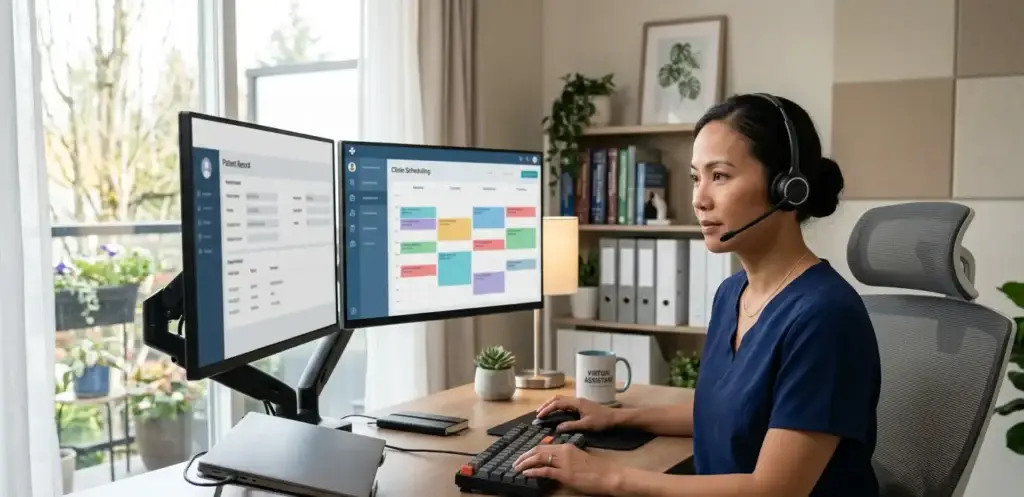
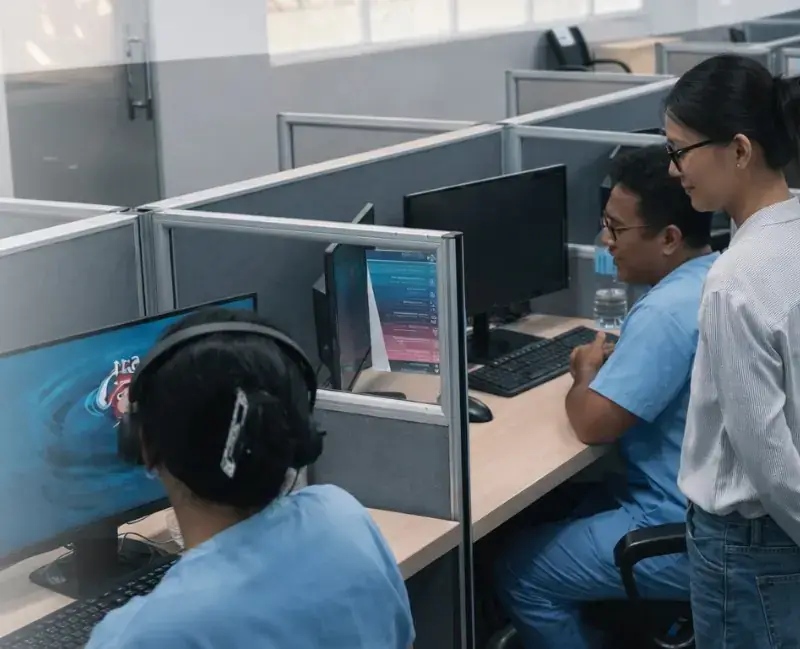
A Virtual Medical Assistant or Medical Scribe supports revenue cycle, scheduling, intake, clinical documentation, and encounter note preparation from a remote location. The critical variable is not the task, it is the environment. Home-based freelancers often operate on unmanaged devices and networks; office-based teams like MedGather work inside secured facilities with professional IT oversight and fully encrypted infrastructure. That physical and administrative control dramatically reduces exposure to Shadow IT.
When assistants work in centralized, monitored spaces, practices gain visibility: real-time oversight, tight access controls, and auditable boundaries that keep data flows HIPAA compliant by design.
The “Shadow IT” Problem in Standard Medical Billing Services
In decentralized billing workflows, staff often circumvent slow or unclear processes with quick fixes, personal clouds, text threads, or unsecured connections. These choices undermine HIPAA requirements for access control, auditability, and transmission security. Medical Scribe tasks like note drafting and encounter summaries are especially vulnerable to “copy-paste” shortcuts across unapproved apps when tools are not standardized.
Remote work also intersects with Remote Patient Monitoring (RPM): billing teams may touch data streams from glucometers, pulse oximeters, and wearables. If those interactions occur on personal laptops or phones without encryption or monitoring, and over home Wi-Fi, PHI exposure risk spikes.
How a Premium Virtual Medical Assistant Eliminates Data Breaches
A Premium Virtual Medical Assistant model replaces ad-hoc tools with standardized security controls: full-disk encryption, MFA, enterprise VPN/TLS, device monitoring with audit logs, and instant account deprovisioning. These safeguards align operationally with established federal guidance (e.g., HHS cybersecurity performance goals and NIST practices) for inventory, segmentation, and endpoint monitoring, converting compliance from a policy document into daily operating reality.
Policy matters as much as tooling. BYOD and remote-work standards such as device registration, prohibitions on unapproved apps, home-network hardening, and consent for mobile-device management with remote wipe close the loopholes Shadow IT exploits. A premium, office-based model also standardizes Medical Scribe workflows inside approved systems protected by encryption, MFA, and continuous oversight.
Case Studies: The Price of Cutting Corners
Regulatory enforcement regularly cites preventable failures such as missing risk analyses, unencrypted devices, uncontrolled remote access, and weak offboarding. Incidents like lost laptops, insider misuse, and phishing-triggered data theft recur across actions from OCR and state authorities. The lesson is consistent: what looks “convenient” in the moment becomes costly when PHI is exposed.
Governance and BAAs: Closing Vendor Risk
Shadow IT often enters through “helpful” third-party tools that never went through review. A defensible program requires:
- Business Associate Agreements (BAAs) that codify safeguards, data handling, and breach notification.
- A sanctioned-apps list, with intake, review, and periodic re-validation.
- Change control and role-based access that align permissions to the “minimum necessary.”
Include Medical Scribe applications in your sanctioned-apps list and BAAs, with documented audit trails for every data touch.
Identity and Device Management: Practical Controls That Work
Security improves dramatically when identity and devices are managed centrally:
- Single sign-on with MFA for all billing and documentation systems.
- Device inventory and MDM: full-disk encryption, auto-lock, screen-privacy, and patch compliance.
- Network standards (e.g., WPA3 on approved routers) and always-on VPN.
- Rapid offboarding: kill-switch deprovisioning that immediately revokes access across EHR, clearinghouse, email, and storage.
Training and Culture: Closing the Human Gap
Technology fails when people do not know how to use it safely. Establish a quarterly cadence for:
- Phishing simulations and micro-lessons focused on billing workflows.
- Clear “what to use” playbooks that replace consumer tools with approved equivalents.
- Incident reporting norms that reward fast escalation over quiet fixes.
Use scenarios that mirror real Medical Scribe tasks: draft notes, copying text between systems, and urgent provider requests involving PHI.
RPM and the New Data Surface
As practices adopt Remote Patient Monitoring (RPM), additional data flows enter the revenue cycle. A secure operating model defines:
- Who touches RPM data, on what devices, and under which roles (billing, Medical Scribe, care coordination).
- How that data is transmitted, stored, and billed inside approved systems.
- What audit trails exist to demonstrate HIPAA-compliant handling end-to-end.
Treat RPM as part of the revenue-cycle “system of record,” not an off-to-the-side feed.
Measuring Security ROI in Medical Billing Services
Security is an investment; measure it like one:
- Mean time to deprovision (from HR ticket to revoked access).
- MDM enrollment and encryption coverage across all endpoints.
- Exceptions rate: unsanctioned tools detected and resolved.
- Audit-log completeness across billing, EHR, and claims systems.
Reduced breach likelihood, lower incident response costs, and uninterrupted cash flow are tangible returns.
Implementation Checklist: From Policy to Proof
- Approve a remote-work and BYOD policy; require signatures.
- Publish a sanctioned toolset; block high-risk consumer apps.
- Enroll every device in MDM; enforce encryption and auto-updates.
- Mandate SSO + MFA and always-on VPN for all billing access.
- Run quarterly phishing training and access-review attestations.
- Validate your BAAs and vendor controls.
- Document a breach-response plan with roles, timelines, and scripts.
Secure Your Revenue Cycle with MedGather
If you are scaling billing with a Virtual Assistant team, the safest path is the office-based model. MedGather’s Virtual Medical Assistants work exclusively in secured facilities, delivering centralized visibility, end-to-end encryption, and continuous IT monitoring that keeps PHI inside HIPAA-compliant guardrails.
Ready to hire a Virtual Medical Assistant that protects your patients and your revenue cycle? Shift from Shadow IT to managed security without sacrificing speed.