Prevent Breaches with a HIPAA Compliant Virtual Assistant for Healthcare
Healthcare is now the most expensive industry in the world to suffer a data breach. Recent analysis of healthcare incidents shows that the average cost of a breach has climbed to about $10.93 million per incident, the highest of any sector. These figures, reported in leading data breach and HIPAA-focused publications, capture not just technical recovery costs, but also legal fees, penalties, and the long-term erosion of patient trust.
At the same time, healthcare organizations are expanding their use of Virtual Assistant Services to keep up with demand, reduce burnout, and control staffing costs. Roles like Virtual Medical Assistant, Remote Medical Scribe, and Remote Admin Support have become essential to daily operations. But when those positions are filled through home-based, decentralized work arrangements, every Virtual Assistant Vacancy becomes a potential security liability.
This article reframes virtual staffing as a security architecture decision and explains why MedGather’s secure, office-based model for Healthcare Assistants is designed to prevent the kind of $10M mistake that can derail an entire organization.
TL;DR: Why Should Healthcare Practices Choose Secure, Centralized Virtual Assistants?
As healthcare practices increasingly rely on medical virtual assistants (MVAs) to reduce administrative workload, data security becomes just as important as productivity. Healthcare data breaches are the most expensive across any industry, averaging $10.93 million per incident, and more than 60% of data loss incidents involve human error or failure to follow security policies.
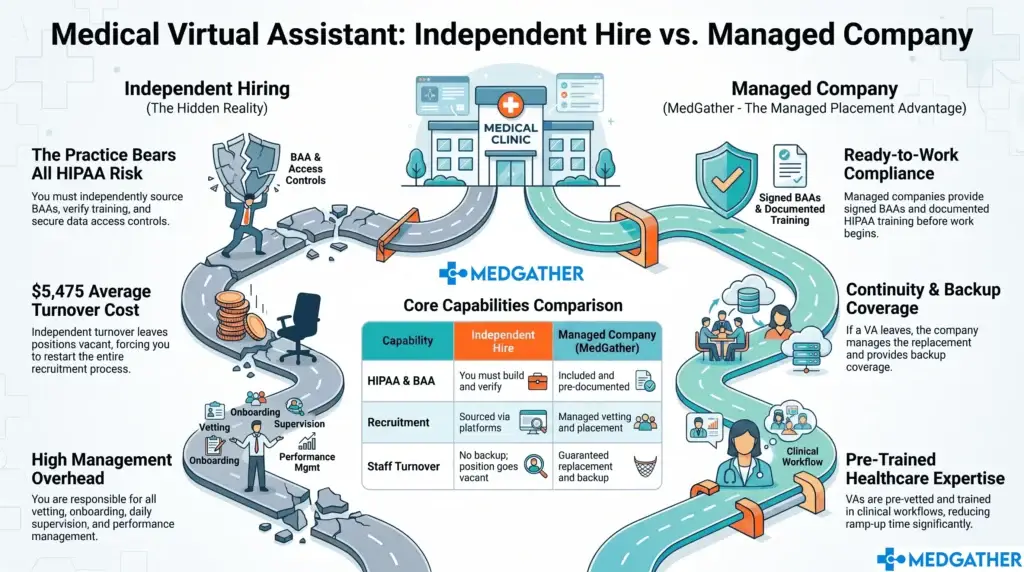
Choosing a HIPAA-compliant virtual assistant provider that operates from a secure, controlled environment helps reduce these risks. Home-based workers may rely on personal devices, unapproved communication tools, or unsecured home networks that are more difficult for healthcare organizations to monitor and manage. Office-based Medical Virtual Assistants provide a more structured approach to security and compliance. Learn more about HIPAA-compliant medical virtual assistants.
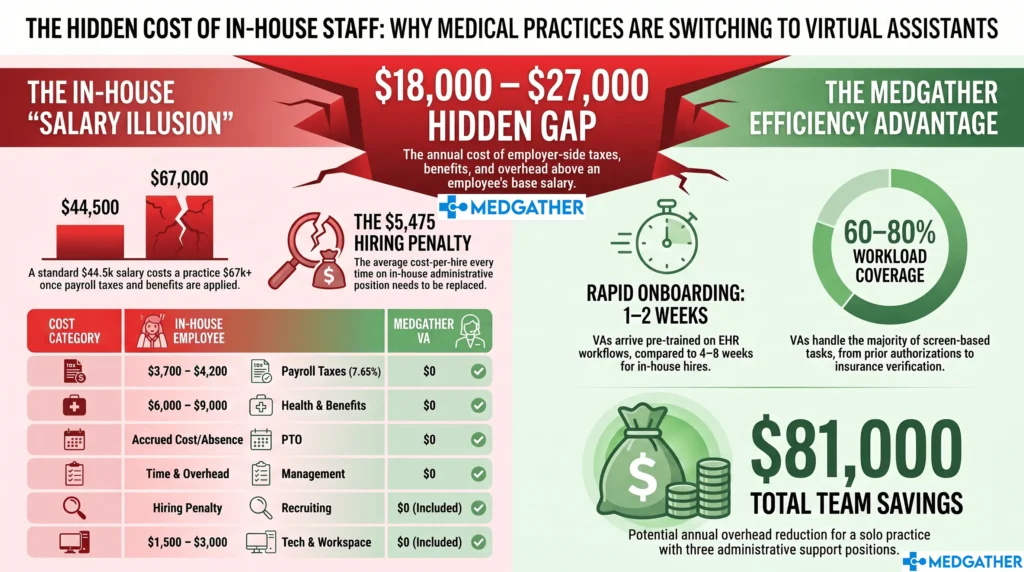
MedGather’s medical virtual assistants work from professionally managed, HIPAA-compliant office facilities using company-issued devices, enterprise-grade security, and ongoing supervision. This allows healthcare practices to delegate high-access administrative tasks with greater confidence while reducing operational risk. When evaluating the ROI of hiring a medical virtual assistant, stronger security and compliance can be just as valuable as direct cost savings.

Board-certified gastroenterologist and Founder of MedGather. Read full bio →
The Financial Reality: Why You Can’t Afford a “Cheap” Hire

Recent healthcare breach studies make two critical points very clear:
- The average cost of a healthcare data breach is around $10.93 million per incident.
- Healthcare breaches have the longest lifecycle of any industry, taking roughly 279 days on average to identify and contain.
That long lifecycle is not a minor detail. The longer a breach remains undetected, the more systems it touches, the more records are exposed, and the more expensive the response becomes. By the time the breach is discovered, organizations are often facing multiple categories of cost:
- Regulatory penalties and corrective action plans
- Class action settlements and legal representation
- Forensic investigations and system remediation
- Business disruption and reputational damage
One Incident, Many Bills: The Premera Case
The Premera Blue Cross breach illustrates how a single incident can cascade into a multi-layered financial event. After attackers accessed systems containing protected health information for millions of individuals over many months, investigations identified significant gaps in risk analysis and security controls.
The outcome:
- A 6.85 million dollar resolution with the federal Office for Civil Rights for HIPAA non-compliance
- An additional 10 million dollar multistate settlement with a coalition of state attorneys general
These regulatory payments alone exceeded 16 million dollars, before accounting for class actions, remediation projects, and internal costs. The case highlights an uncomfortable truth: what looked like manageable operational risk before the breach became an extremely expensive problem afterward.
When set against that backdrop, the idea of choosing a “cheap” remote assistant on a personal device, simply because the hourly rate is lower, starts to look like a dangerous financial gamble.
The Remote Risk: How Decentralization Multiplies Danger
Why Home-Based Virtual Work Creates Breach Vulnerabilities
Modern research into healthcare data loss makes one pattern stand out: human behavior is a primary driver of incidents. Recent analysis of healthcare data loss and exfiltration shows that:
- About 31 percent of incidents are caused by employee negligence
- Another 31 percent occur when employees fail to follow existing policies
Together, that means more than half of data loss events stem from everyday behavior, not sophisticated attackers. In a decentralized model, where assistants work from home with minimal oversight, the risk intensifies. It becomes much easier for a Healthcare Assistant or Virtual Medical Assistant to:
- Store downloads containing patient information on personal devices
- Use unapproved messaging apps or personal email accounts for quick communication
- Bypass security guidance in the name of convenience or speed
Because these behaviors happen on networks and devices outside the organization’s direct control, they are harder to monitor and detect. Combined with the long average time to identify a breach, small mistakes can silently escalate into large-scale regulatory and financial events.
The SEO Trap: High-Volume Keywords, High-Stakes Decisions
Search trends help explain why this risk is growing. Keyword research shows strong and rising search volume for:
- Virtual assistant services
- Virtual medical assistant
- Remote admin support
- Related terms such as virtual receptionist services
These are high-intent phrases, which means buyers are actively looking for remote help. Yet much of the market positions itself purely on price and flexibility. Agencies and freelancers highlight home-based freedom, low hourly rates, and “work from anywhere” convenience, but rarely detail where data will live, how access will be supervised, or which security controls are in place.
For a healthcare leader, that mismatch is precisely where the 10 million dollar mistake begins: treating a high-risk, high-access role like a commodity service.
MedGather vs Competitors: The Centralized Advantage
Most virtual assistant providers still follow a distributed, home-based model. Their value proposition centers on low cost, flexible hours, and the promise that someone, somewhere, can plug into your workflows remotely. That may be acceptable for non-regulated industries, but healthcare needs a different standard.
MedGather’s model is designed specifically to address the vulnerabilities highlighted in breach and data loss research. Rather than relying on home offices and personal devices, MedGather:
- Employs office-based Healthcare Assistants who work from a secure facility
- Provides and manages the hardware and network environment they operate in
- Hires, trains, and supervises assistants directly, enforcing consistent processes and standards
This centralization brings three major advantages:
Controlled environment
Assistants access systems using organization-owned devices inside a professionally managed office. This makes it far easier to enforce encryption, endpoint protection, and network security than in a patchwork of home environments.
Real-time oversight
Supervisors are physically present and able to observe how work is being done. This supports rapid coaching, correction, and reinforcement of policy, especially around handling protected health information.
Alignment with security best practices
Because MedGather controls the environment, it can implement least-privilege access, strong authentication, and strict separation between PHI and personal data. Virtual assistants are not left to improvise security on their own.
For healthcare practices, the result is a significant reduction in the operational risk associated with virtual staffing, without sacrificing the efficiency gains that Virtual Assistant Services are meant to deliver.
Defining the Modern Healthcare Assistant
The role of a Healthcare Assistant has expanded well beyond basic administrative support. In many practices, assistants now function as:
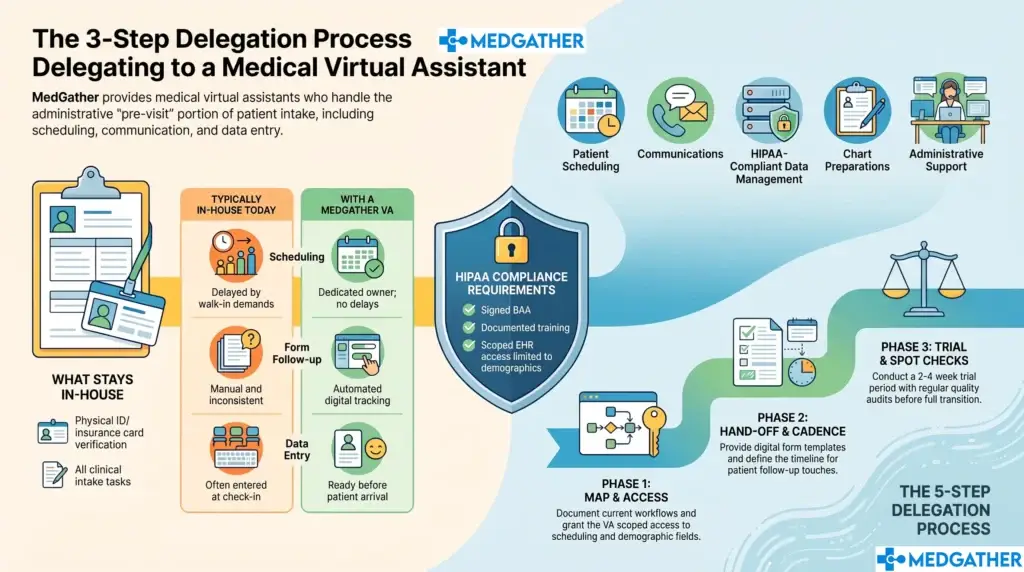
- A Virtual Medical Assistant, supporting both front-office and clinical workflows
- A virtual receptionist, handling inbound calls, scheduling, and patient communication
- A Remote Medical Scribe, documenting encounters, updating the record, and preparing follow-up tasks
- A remote member of the medical office team, helping with referrals, prior authorizations, and billing support
Why These Roles Matter
Industry commentary on virtual medical scribes underscores why these roles matter so much. When implemented well, Remote Medical Scribe services:
- Reduce documentation burden on physicians
- Help combat burnout by taking work off clinicians’ plates
- Improve visit efficiency and documentation accuracy
- Enhance patient experience by allowing clinicians to focus on the encounter rather than the keyboard
Why Security Must Keep Pace
But those same benefits come with heightened risk. Scribes and assistants often have deep access to electronic health records, scheduling systems, and internal communication tools. That makes them powerful allies in patient care and, if poorly managed, potential points of failure for privacy and security.
How MedGather Reduces That Risk
MedGather’s secure, office-based model acknowledges this reality. Healthcare Assistants are recruited and trained specifically for regulated environments, with clear expectations around secure workflows, proper use of systems, and the handling of sensitive information. This design turns the assistant from a potential weak link into a controlled, monitored part of the practice’s security posture.
Ready to Hire? How to Fill Your Virtual Assistant Vacancy Safely
The role of a Healthcare Assistant has expanded well beyond basic administrative support. In many practices, assistants now function as:
- A Virtual Medical Assistant, supporting both front-office and clinical workflows
- A virtual receptionist, handling inbound calls, scheduling, and patient communication
- A Remote Medical Scribe, documenting encounters, updating the record, and preparing follow-up tasks
- A remote member of the medical office team, helping with referrals, prior authorizations, and billing support
What Does a Healthcare Assistant Do?
Industry commentary on virtual medical scribes underscores why these roles matter so much. When implemented well, Remote Medical Scribe services:
- Reduce documentation burden on physicians
- Help combat burnout by taking work off clinicians’ plates
- Improve visit efficiency and documentation accuracy
- Enhance patient experience by allowing clinicians to focus on the encounter rather than the keyboard
Why Is Security Important for Healthcare Assistants?
But those same benefits come with heightened risk. Scribes and assistants often have deep access to electronic health records, scheduling systems, and internal communication tools. That makes them powerful allies in patient care and, if poorly managed, potential points of failure for privacy and security.
How Does MedGather Protect Patient Data?
MedGather’s secure, office-based model acknowledges this reality. Healthcare Assistants are recruited and trained specifically for regulated environments, with clear expectations around secure workflows, proper use of systems, and the handling of sensitive information. This design turns the assistant from a potential weak link into a controlled, monitored part of the practice’s security posture.
Frequently Asked Questions
Why are home-based virtual assistants considered a major security risk for healthcare practices?
Home-based virtual assistants often work in decentralized environments where they rely on consumer Wi-Fi, personal devices, and sometimes unapproved messaging apps. Because these behaviors happen outside a controlled corporate network, it is incredibly difficult for practices to monitor workflows or enforce security policies, significantly multiplying the risk of a breach.
How much does a typical healthcare data breach cost?
Healthcare data breaches are currently the most expensive across any industry, costing an average of $10.93 million per incident. Additionally, these breaches have the longest lifecycle of any sector, taking an average of 279 days to identify and contain, which compounds the costs of regulatory penalties, legal fees, and reputational damage.
How does MedGather’s centralized model protect patient data compared to standard freelancers?
Unlike standard remote workers who operate from home, MedGather utilizes a centralized model where Healthcare Assistants work from a secure, professionally managed office facility. MedGather provides organization-owned and managed hardware, enforces strict encryption and endpoint protection, and implements real-time, on-site supervision to ensure HIPAA policies are consistently followed.
What is the primary cause of data loss and breaches in healthcare?
Research indicates that human behavior is the primary driver of healthcare data loss. More than half of data loss events stem from everyday behaviors rather than sophisticated cyberattacks: approximately 31% of incidents are caused by employee negligence, and another 31% occur when employees bypass or fail to follow existing security policies.