For years, freelance virtual assistants were the go-to solution for busy executives seeking help with calendar management, inbox triage, and task delegation. But as operations grow more complex and digital risks increase, executives are recognizing that the low-cost freelance VA model often comes with hidden costs, inconsistent quality, and serious security concerns.
That’s why a growing number of CEOs, CFOs, and COOs are pivoting to a more reliable, professional model: in-office virtual assistant teams.
The Shift in Executive Support: From Solo Freelancers to Structured Teams

The appeal of freelance VAs is easy to understand: on-demand help, global availability, and lower rates. But these benefits often come with trade-offs: unmanaged workflows, scattered communication, missed deadlines, and inconsistent professionalism.
Executives today require more than task completion. They need operational continuity, data protection, and predictable performance, and that requires infrastructure, not improvisation.
“We tried hiring freelance VAs to help the C-suite,” says a COO at a mid-sized tech company. “But it turned into more work managing them than doing the tasks ourselves. We needed structure, oversight, and security. Things only an in-office VA provider could deliver.”
The Hidden Risks of Freelance Virtual Assistants
Freelancers often work from home, in isolation, without any IT oversight or data protocols in place. This introduces a number of risks that many leaders don’t see until it’s too late:
- Security vulnerabilities from unsecured home Wi-Fi and personal devices
- No supervision, which means missed deadlines or ignored protocols
- Frequent turnover, leaving executives constantly retraining new people
- No accountability if sensitive data is mishandled
- Lack of scalability: you’re hiring individuals, not a system
For decision-makers responsible for compliance, reputation, and continuity, these are not small concerns.
The In-Office VA Advantage: Security, Structure, and Scale
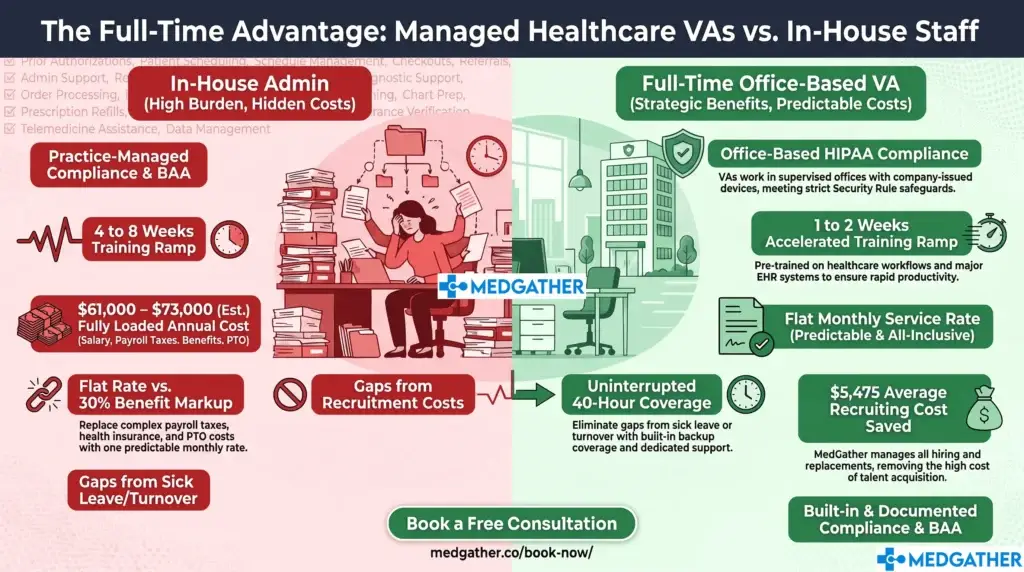
In contrast, in-office virtual assistant companies offer a level of professionalism and security that freelancers simply cannot match:
- Secure physical environments with monitored workstations
- Supervised workflows led by experienced team leads
- Dedicated client support managers to ensure performance
- Contractual compliance with data protection standards (e.g., HIPAA, GDPR, etc.)
- Team-based redundancy so support never stops if someone’s sick or unavailable
These aren’t gig workers. They’re full-time professionals working within a managed, high-performance environment designed for executive-level support.
What C-Level Executives Really Want in a VA Partner
Most executive teams aren’t looking for someone who just “does tasks.” They want someone who understands how to operate with discretion, speed, and structure. They want someone who can be trusted with sensitive internal communications, client data, financial workflows, or compliance documentation.
If you’re managing multiple departments or scaling operations, a team-based, in-office VA model lets you delegate high-leverage tasks with confidence, knowing there are policies, performance oversight, and contingency plans in place.
Case Example: How One CFO Eliminated $90K in Annual Overhead by Switching to a Structured VA Team
A healthcare CFO overseeing three clinics was frustrated by the inefficiencies of juggling part-time freelancers. Communication delays, HIPAA compliance concerns, and lack of reliability were creating operational bottlenecks.
After switching to an in-office VA team, the CFO saw:
- 24% increase in administrative task completion speed
- 100% HIPAA-compliant workflows
- Annual savings of $90,000 compared to in-house hires
- Zero turnover in 18 months due to structured team support
The change gave the executive team peace of mind and bandwidth to focus on growth.
Freelancers Are for Tasks. In-Office VA Teams Are for Strategy.
When you’re a CEO or COO, you’re not just outsourcing tasks. You’re delegating responsibility. That requires a partner who understands structure, security, and scalability.
In-office VA teams deliver a system, not a freelancer. They allow you to run lean operations without sacrificing professionalism, control, or oversight.
Final Thoughts: It’s Time to Rethink the Virtual Assistant Model
If you’re a business leader who’s outgrown the gig economy model, or you’re tired of managing your own assistants, it may be time to upgrade.
A secure, in-office virtual assistant team can:
- Protect your data
- Improve efficiency
- Remove administrative friction
- Grow alongside your business
And if you operate beyond the 9-to-5, consider our After-Hours Support for executive-level delegation done right.
For non-clinical teams needing secure and scalable admin help, explore our Remote Office Support for executive-level delegation done right.
If you’re in healthcare or managing clinical workflows, our Remote Medical Office Support for executive-level delegation done right.
Ready to explore how this model can work for your company? Book a discovery call with our team and see what executive-level support really feels like.